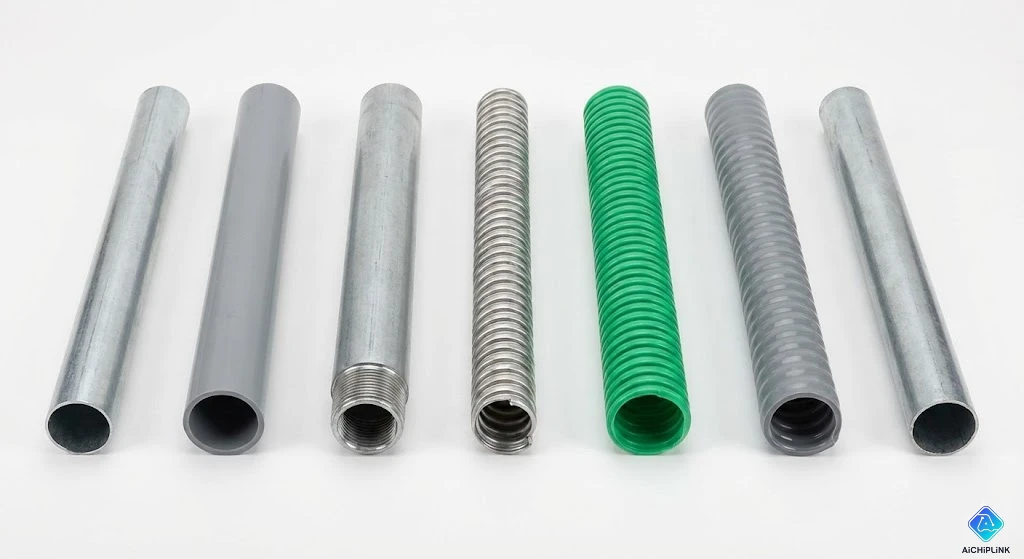
Wiring is the nervous system of your building, and Electrical Conduit is the armor that protects it.
Whether you are running wire to a new garage outlet, burying a line to a garden shed, or wiring an industrial motor, you cannot just leave cables exposed. You need a tube to route and protect them. But walk into the electrical aisle of any hardware store, and you will see a confusing array of metal pipes, plastic tubes, and flexible hoses.
Which one do you need? Is plastic better than metal? What is "Smurf Tube"?
This guide breaks down the 7 main types of electrical conduits and helps you decide which one is right for your job.
1. EMT (Electrical Metallic Tubing)
"The Standard Thin-Wall"
EMT is the most common conduit found in commercial buildings and garages. It is made of galvanized steel or aluminum.
- Pros: Lightweight, easy to bend, rust-resistant, and relatively cheap. It acts as a valid ground path.
- Cons: Not threaded (uses set-screw or compression fittings). Thin walls offer only moderate physical protection.
- Best For: Indoor wiring in dry areas (garages, basements, workshops).
2. RMC (Rigid Metal Conduit)
"The Heavy-Duty Tank" RMC is the toughest conduit available. It has thick walls (similar to a water pipe) and threaded ends.
- Pros: Extreme protection against impact. Can be used outdoors and in hazardous areas.
- Cons: Very heavy, expensive, and hard to bend. Requires threading tools.
- Best For: Outdoor service masts (where power enters the house), industrial zones, or anywhere the pipe might get hit by a car or forklift.
3. IMC (Intermediate Metal Conduit)
"The Middle Ground" IMC was designed to replace RMC. It has thinner walls than RMC (making it lighter and cheaper) but is thicker and stronger than EMT.
- Best For: A valid substitute for RMC in many outdoor applications where you want strength without the back-breaking weight.
4. FMC (Flexible Metal Conduit)
"Greenfield" FMC is a spiral-wound metal strip that looks like armored cable armor. It is hollow, allowing you to pull wires through it.
- Pros: Flexible. Vibration resistant.
- Cons: Not waterproof. Cannot be used outdoors.
- Best For: Connecting motors, transformers, or lights where there is vibration or where bending a rigid pipe is impossible.
5. LFMC (Liquid-Tight Flexible Metal Conduit)
"Sealtite"
Take FMC and coat it in a waterproof plastic jacket, and you get LFMC.
- Pros: Waterproof and flexible.
- Best For: Outdoor AC units, water pumps, and damp industrial environments.
6. PVC (Rigid Polyvinyl Chloride)
"The Plastic Pipe" PVC is the go-to for underground work. It comes in two grades:
- Schedule 40: Standard thickness. Used for underground and some above-ground work.
- Schedule 80: Extra thick wall. Used where physical damage is a risk (e.g., sticking out of the ground).
- Pros: Waterproof, will never rust, cheap, easy to glue.
- Cons: Can become brittle in direct sunlight or extreme cold. Requires a separate ground wire (plastic doesn't conduct).
- Best For: Underground trenches, corrosive environments, and wet locations.
7. ENT (Electrical Non-Metallic Tubing)
"Smurf Tube" Named for its distinct bright blue color, ENT is a corrugated, flexible plastic tubing.
- Pros: Extremely easy to install (bends by hand). Cheap.
- Cons: Not UV resistant. Thin walls offer little protection against nails.
- Best For: Inside concrete slabs or routed inside standard drywalls.
Summary: How to Choose?
| Scenario | Recommended Conduit | Why? |
|---|---|---|
| Indoor Garage / Shop | EMT | Looks pro, protects against bumps, easy to modify. |
| Underground | PVC | Waterproof, rust-proof, cheapest for long runs. |
| Outdoor AC Unit | LFMC | Waterproof and handles the vibration of the compressor. |
| Service Entrance | RMC / IMC | Protects main power lines from falling branches or impact. |
| Inside Walls (res) | ENT | Flexible and fast to snake through studs (check local code). |
Need Conduit Fittings or Accessories? Whether you are bending EMT or gluing PVC, you need the right connectors. Visit Aichiplink.com to search for Conduit Fittings, Junction Boxes, and Cable Glands.

Written by Jack Elliott from AIChipLink.
AIChipLink, one of the fastest-growing global independent electronic components distributors in the world, offers millions of products from thousands of manufacturers, and many of our in-stock parts is available to ship same day.
We mainly source and distribute integrated circuit (IC) products of brands such as Broadcom, Microchip, Texas Instruments, Infineon, NXP, Analog Devices, Qualcomm, Intel, etc., which are widely used in communication & network, telecom, industrial control, new energy and automotive electronics.
Empowered by AI, Linked to the Future. Get started on AIChipLink.com and submit your RFQ online today!
Frequently Asked Questions
1. What is the most common type of electrical conduit?
EMT (Electrical Metallic Tubing) is the most commonly used conduit for indoor residential and commercial wiring.
2. Which conduit should be used underground?
PVC conduit (Schedule 40 or 80) is best for underground installations because it is waterproof and corrosion-resistant.
3. What is “Smurf Tube” used for?
“Smurf Tube” (ENT) is used inside walls or concrete slabs where flexibility and easy installation are needed.
4. Can flexible metal conduit be used outdoors?
Only LFMC (Liquid-Tight Flexible Metal Conduit) is suitable for outdoor or wet locations; standard FMC is not waterproof.
5. Do plastic conduits need a ground wire?
Yes. PVC and ENT conduits require a separate grounding conductor because they are non-metallic.