5 Types of Infrared Thermometers Compared for 2026
Your child wakes up hot and cranky. You need to check their temperature fast. You grab an infrared thermometer and hope the number is right.
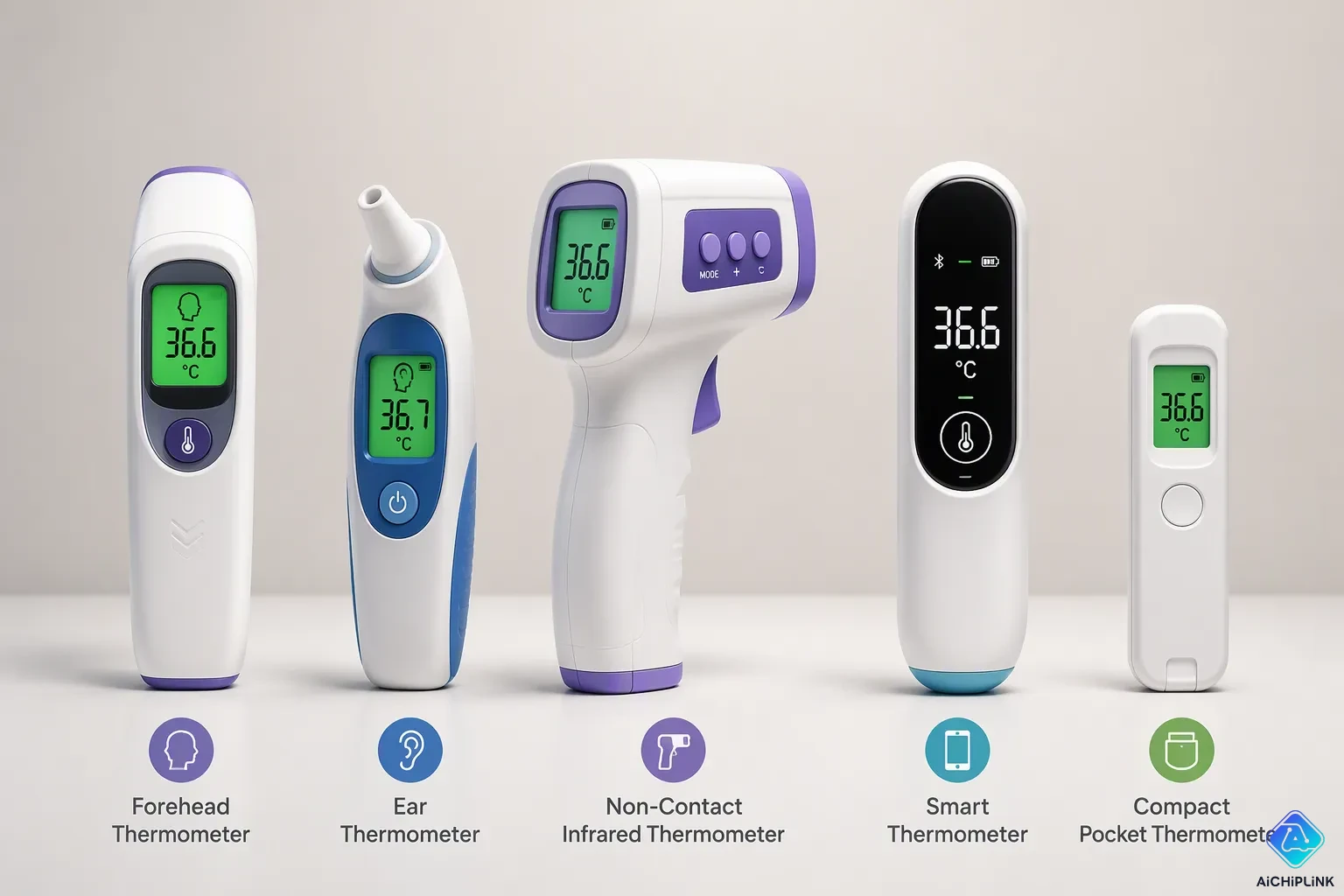
Five main types of thermometers exist in 2026: forehead, ear, non-contact, contact, and smart models. You will see how each one handles accuracy, speed, ease of use, and daily tasks. Lens type and where you measure change how infrared thermometry works, so not every device fits every job. The global market for these devices keeps growing:
| Metric | Value |
|---|---|
| Projected global market size in 2026 | $2.46 billion |
| Market size in 2025 | $2.25 billion |
| CAGR | 9.0% |
Three infrared thermometers often work well for home use. A quick recommendation at the end helps you choose.
Key Takeaways
-
There are five main types of infrared thermometers: forehead, ear, non-contact, contact, and smart models.
-
Forehead thermometers give quick readings without touching the skin. They work well for children who are asleep.
-
Ear thermometers give accurate results for older kids and adults in medical settings.
-
Non-contact thermometers check many people fast and measure surface temperatures in a safe way.
-
Smart thermometers follow temperature changes over time and share the data with doctors easily.
Forehead Thermometers
How Forehead Infrared Thermometers Work
Forehead thermometers check your child's temperature using the temporal artery. This artery goes across the forehead. The device reads the skin above it.
The idea behind temporal artery thermometry is easy. Blood in the temporal artery is close to core temperature. The skin above it should be close to that number too. Here is the medical explanation:
The theory is that the blood in the temporal artery is near core temperature and, therefore, that supervening skin temperature will also approximate core temperature.
This makes the temporal artery thermometer a contactless forehead thermometer. You hold the contactless forehead thermometer near the skin. These contactless forehead thermometers sense heat radiation. The device uses forehead contactless infrared thermometry to find temperature.
This method uses contactless infrared thermometry. Nothing touches the skin. You get a reading in seconds.
Three infrared thermometers often come to mind for home use. The forehead model is one of them. It gives speed without discomfort. These types of thermometers differ in how they are designed.
Accuracy, Speed, and Best Use Cases
You should know the accuracy limits. These devices show a normal difference compared to oral thermometers.
| Metric | Forehead Infrared Thermometer | Oral Digital Thermometer |
|---|---|---|
| Typical temperature difference | ~1°F (0.6°C) cooler than oral readings | Reference standard |
| Clinical bias (1,113-subject study) | −0.9°C to +0.2°C depending on model | N/A |
| Lab accuracy standard | ±0.3°C (ASTM E1965 / ISO 80601-2-56) | N/A |
The numbers show a wide range. Some models give readings cooler than your real temperature. Others give warmer ones. The infrared wavelength detection has limits in clinical settings.
Things around you also change the reading.
| Environmental Factor | How It Affects Forehead Thermometer Readings |
|---|---|
| Temperature swings | Rapid changes can cause incorrect readings |
| Humidity | High humidity reduces accuracy |
| Reflective surfaces | Mirrors and metal can reflect light |
| Air flow and drafts | Drafts remove heat from the skin |
These contactless thermometers need steady conditions. You can follow simple rules to get better results:
-
Place the device in the testing room for 10–30 minutes before use
-
Keep the forehead clean, dry, and easy to reach
-
Avoid direct sunlight and environments below 60°F or above 104°F
Forehead contactless infrared thermometry works best for families with young children. You get a fast reading without waking a sleeping child. No contact means less stress for a fussy toddler.
The temporal artery thermometer is great in home settings. This temporal artery thermometer needs no special training. The process takes seconds. A temporal artery thermometer works best in steady indoor conditions. It works well for quick checks throughout the day. This forehead contactless thermometer fits everyday use well.
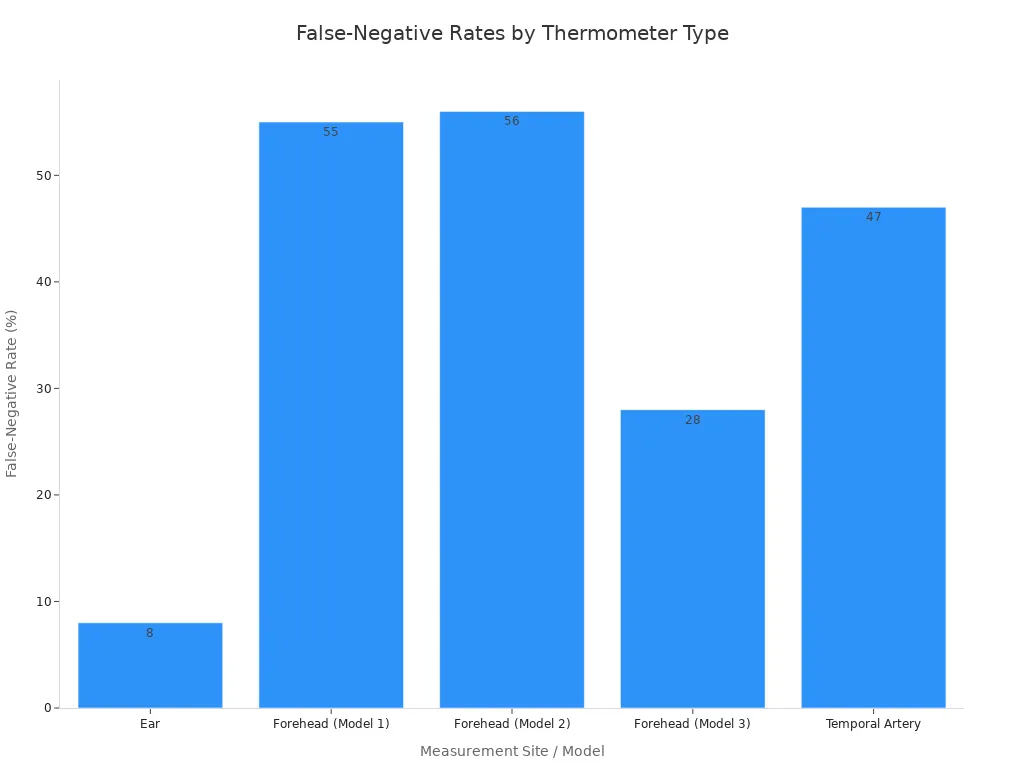
For clinical precision, you may want a different tool. Temporal artery thermometers need proper placement for accuracy. The temporal artery thermometers show higher false-negative rates. Over half of the models in one study missed fevers at the CDC threshold. This matters when you need certainty. The contactless thermometer is made for convenience.
But for everyday home use, this contactless thermometer works well. You get speed and comfort. Your child stays calm. You get a number that guides your next step. These forehead thermometers give a practical solution. These forehead thermometers work well for daily checks. The temporal artery thermometer gives quick results without discomfort.
Ear Thermometers
How Tympanic Infrared Thermometers Work
Ear thermometers check the heat of the tympanic membrane. This membrane sits deep inside the ear canal. It gets blood from the same source as the hypothalamus, which controls body heat. That link makes the ear one of three clinical spots for infrared temperature measurement.
The device has a probe with a lens. You put the probe at the ear opening. The lens picks up infrared radiation from the eardrum. The sensor turns that energy into a temperature reading. This is tympanic infrared thermometry at work.
You must point the probe at the eardrum. A straight path through the canal gives the best signal. You gently pull the ear back to straighten the canal. The reading then shows up in about one to two seconds.
Accuracy, Speed, and Best Use Cases
Clinical studies back the accuracy of tympanic infrared thermometers. Researchers compared them with pulmonary artery catheter temperature in 50 adult critical care patients.
| Metric | Value |
|---|---|
| Correlation with pulmonary artery temperature | r = .87 to .91 |
| Mean offset | -0.7 to 0.5 °C |
| Standard deviation | ±0.5 °C |
The same work found no big difference between readings taken with and without an ear tug. The authors said tympanic temperature measurement works as a good substitute for pulmonary artery temperature in the ICU.
Earwax and technique still matter. These ear thermometers can give wrong readings when problems show up.
Earwax or ear canal shape may affect results.
Factor Effect on Accuracy Presence of earwax Can lead to incorrect readings Excess earwax Ear thermometers should be avoided Improper positioning Can lead to incorrect readings Size and length of ear canal Can lead to incorrect readings Lying on the ear beforehand Can lead to incorrect readings Moisture in the ear Can lead to incorrect readings
Ear thermometers work well for older children and adults. They fit well in clinics and hospitals. A contactless thermometer may suit squirmy infants better. Still, these ear thermometers give speed and solid accuracy when you place them right. Among the types of thermometers out there, they remain a strong clinical choice.
Non-Contact Infrared Thermometers
How Contactless Infrared Thermometry Works
Non-contact infrared thermometers use a lens to focus infrared radiation onto a sensor. That sensor turns the energy into a temperature number. You aim the device at what you want to measure and push a button. The reading shows up in less than one second.
Infrared thermometers come in various optical designs that affect how they focus infrared energy onto the sensor. The choice of optics influences the measurement field and precision for different applications.
Distance plays a big role in accuracy. Fluke says the best distance to measure the forehead is at most 4 inches (10 cm). If you don't know the distance-to-spot ratio, just use 10 cm (4 inches) to get correct body temperature. This rule works for any contactless thermometer you use to check for fever.
Accuracy, Speed, and Best Use Cases
The ASTM E 1965-98 standard sets required accuracy for these devices.
| Measurement Site | Required Accuracy (ASTM E 1965-98) |
|---|---|
| Skin temperature | ±0.3 °C (±0.54 °F) |
| Ear canal temperature | ±0.2 °C (±0.36 °F) |
These contactless infrared thermometers are fast and safe to use. You do not touch anyone, so you lower the risk of spreading germs. Airports, offices, and hospitals count on this feature for mass checks. Factory workers also use the same technology to test surfaces, motors, and electrical panels.
How you use it and where you are still change the results. Drafts, direct sunlight, and shiny surfaces can mess up the reading. You must hold the device steady at the correct distance. A contactless thermometer works best for quick checks, not for a sure diagnosis. Among all thermometer types, this one shines for high-traffic screening and measuring surfaces. A forehead contactless thermometer and other contactless models do different jobs. The three infrared thermometers we covered each fit different needs. This infrared thermometer type gives you flexibility for many tasks.
Contact Infrared Thermometers
How Contact Infrared Thermometers Work
You push a contact infrared thermometer right onto the skin. The probe touches the forehead, temple, or outer ear. This way, it reads heat from the body tissue itself. The probe must warm up to match your skin before the number stops moving.
The sensor inside picks up infrared radiation. The probe sits close to the source. This setup cuts down problems that bother non-contact infrared thermometers. There is no air gap between the sensor and your skin. Drafts, humidity, and shiny surfaces cannot get in the way as much.
Contact models use the same technology as other types of thermometers. You still count on infrared thermometry. The difference is in how you use it. A contactless thermometer measures from inches away. Contact models use a direct form of infrared thermometry. A contact model needs physical touch. The probe must match your skin temperature to give correct results. This contrast shows why contactless infrared thermometry works for screening but contact models give steadier results. When you use a contactless thermometer, you must think about distance and surroundings. Other contactless thermometers, like the forehead model, act alike but have no direct link. Contact versions take away those variables. You get a reading that depends on body heat, not the room around you. Different infrared thermometers handle these conditions in their own ways.
Accuracy, Speed, and Best Use Cases
Contact thermometers are steadier when conditions change. You do not stress about room temperature or airflow. The physical contact locks in the path of measurement. This gives you more consistent readings in different places. The accuracy gets better because you remove outside interference.
The trade-off comes in speed and ease. You must hold the probe in place for several seconds. The device needs time to match the skin's temperature. This makes contact thermometers slower than non-contact models. You also need to clean the probe between uses. Alcohol wipes or disinfectant sprays add steps to each reading. This takes more time and needs supplies.
Some users find the direct contact uncomfortable. Children may fight the pressure against their forehead or temple. The outer ear spot can feel like too much. These issues make contact models less ideal for quick home checks with fussy toddlers.
Contact thermometers work best in clinical settings. Nurses and doctors control the place where they measure. A contactless thermometer works faster but can shift with conditions. They follow proper cleaning steps between patients. They know how to place the probe on different body sites. Users who like direct measurement often pick this type. You get fewer surprises from technique errors. Among the three infrared thermometers often used in clinical practice, the contact model gives the most predictable results when used right. You trade a bit of speed for reliability.
Smart Infrared Thermometers
How Smart Infrared Thermometers Work
Smart infrared thermometers connect to your phone through Bluetooth or Wi-Fi. You point the device at the forehead or another spot. The sensor reads body heat. The device then sends the number to an app. You see the result on your screen right away.
These devices still rely on infrared thermometry. The core science does not change. A lens picks up infrared energy from the skin. The sensor turns that energy into a temperature value. The smart part adds wireless sharing and storage. You get the same measurement with extra digital tools.
The app unlocks features that basic models lack. You can log every reading with a date and time. Trend tracking shows how a fever rises or falls over days. You can set reminders for the next check. Some apps let you store profiles for each family member. This keeps everyone's history in one place.
Accuracy, Speed, and Best Use Cases
A smart model matches the accuracy of a standard contactless thermometer. The sensor quality and your technique still drive the result. You must hold the device at the right distance. You must avoid drafts and direct sunlight. The app cannot fix a bad reading.
Speed stays fast. You get a number in about one second. The app saves it without any typing. This saves time when you check a sick child every few hours.
The pros make daily care easier. You track patterns instead of guessing. You share data with a doctor in seconds. Families with a sick member love this feature. People with chronic conditions also benefit. They watch for trends over weeks.
The cons come with a price. Smart infrared thermometers cost more than basic models. You also depend on your smartphone. A dead battery or a lost phone stops the whole system. Some users find the app setup annoying.
These devices suit tech-savvy users and families. They work well for long-term monitoring. Among the three infrared thermometers used at home, the smart type gives the best tracking. A contactless thermometer with app support turns a single reading into a health record. That makes infrared thermometry more useful over time.
Comparison Table for Infrared Thermometers
Accuracy, Speed, and Ease of Use
You need a clear way to see how these devices compare. The table below shows all five types on the things that matter most.
| Type | Accuracy | Speed | Ease of Use |
|---|---|---|---|
| Forehead | ±0.3°C lab standard; clinical bias −0.9°C to +0.2°C | 1–3 seconds | Very easy; no contact |
| Ear | Mean difference −0.044°C vs. gold standard | 1–2 seconds | Moderate; needs correct angle |
| Non-Contact | ±0.3°C skin; ±0.2°C ear canal | Under 1 second | Easy; technique-sensitive |
| Contact | High; less affected by environment | Several seconds | Moderate; needs cleaning |
| Smart | Matches standard contactless | About 1 second | Easy; requires app setup |
How accurate a temperature reading is depends on the lens design, the measurement site, and the conditions around you. Various optical designs suit different applications. Clinical accuracy changes at the ear, forehead, and temporal sites. Ear thermometers match reference standards most closely. Forehead and temporal artery thermometers tend to show more bias.
Price and Best Use Cases
Your budget and daily needs guide your final choice. This table shows where each type works best.
| Type | Price Range | Best Use Cases |
|---|---|---|
| Forehead | Varies | Families with young children |
| Ear | Varies | Older children, adults, clinics |
| Non-Contact | Varies | Mass screening, industrial surfaces |
| Contact | Varies | Clinical settings, steady conditions |
| Smart | Varies | Trend tracking, chronic conditions |
A contactless forehead thermometer works well for quick home checks. Ear thermometers serve clinical settings well. Non-contact models handle high-traffic screening and surface readings. Contact models give steady results in controlled spaces. Smart models track health data over time.
The five types have different jobs and ways of working. All infrared thermometers need good technique to give correct readings. The three infrared thermometers for home use are fast and easy. Pick forehead thermometers for fast checks on young kids. Doctors use ear thermometers for accurate clinic results. How you use the device matters most. Infrared models are more affected by the room than digital contact ones. A temporal artery thermometer gives fast readings without touching. Use a temporal artery thermometer in steady conditions. It works well for family use. Industrial users pick non-contact models for checking surfaces. Smart models track temperature patterns. Budget buyers find basic models cheap. Think about your own needs first. Any type works if it fits the right situation.

Written by Jack Elliott from AIChipLink.
AIChipLink, one of the fastest-growing global independent electronic components distributors in the world, offers millions of products from thousands of manufacturers, and many of our in-stock parts is available to ship same day.
We mainly source and distribute integrated circuit (IC) products of brands such as Broadcom, Microchip, Texas Instruments, Infineon, NXP, Analog Devices, Qualcomm, Intel, etc., which are widely used in communication & network, telecom, industrial control, new energy and automotive electronics.
Empowered by AI, Linked to the Future. Get started on AIChipLink and submit your RFQ online today!
Frequently Asked Questions
Which infrared thermometer gives the most accurate reading?
Ear thermometers match reference standards most closely. A study found a mean difference of −0.044°C versus the gold standard. Forehead and temporal artery models show more bias. Your technique and the measurement site still drive the final result.
Can I use a non-contact thermometer for my child?
Yes. A non-contact model works well for a quick check on a sleeping or fussy child. Hold the device at most 4 inches (10 cm) from the forehead. Avoid drafts and direct sunlight. The reading guides your next step, not a diagnosis.
Why does my forehead thermometer give different numbers each time?
Several things can change the reading. Sweat, hair, and room temperature all get in the way. Fast temperature changes and high humidity make it less accurate. Let the device sit in the room for 10–30 minutes before you use it. Keep the forehead clean and dry.
Do smart thermometers work without a phone?
No. Smart models need a Bluetooth or Wi-Fi connection to send data to an app. A dead battery or a lost phone stops the system. The sensor still reads body heat, but you lose logging and trend tracking.
Are contact thermometers better than non-contact ones?
Contact models stand up to drafts and humidity better. They need several seconds to match skin temperature. You must clean the probe between uses. Non-contact models work faster for screening. Among the three infrared thermometers for home use, contact types give steadier results in controlled spaces.