100 Amp Wire Size Guide: NEC Ampacity, Subpanels, and Voltage Drop
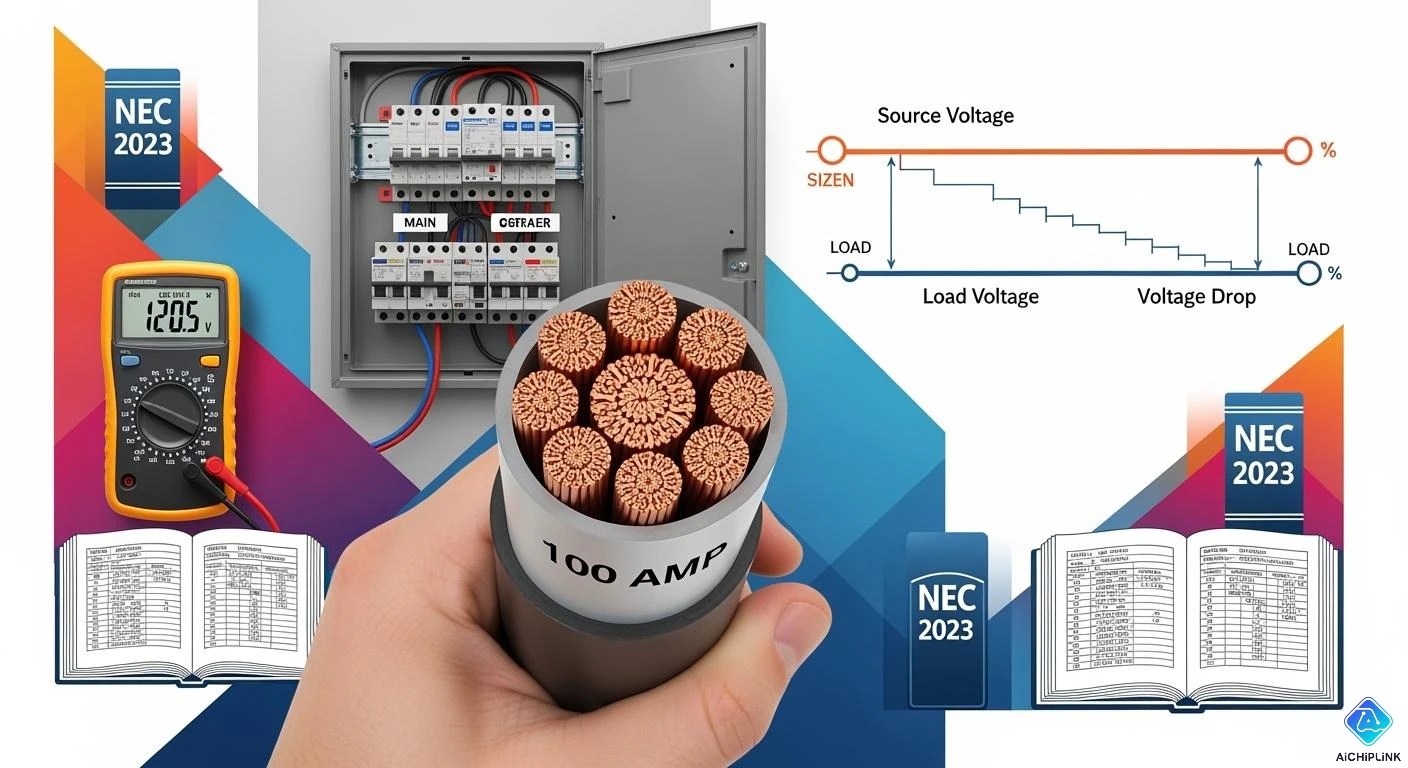
You need the right wire size guide to keep your electrical system safe. It also helps you follow the rules. For a 100-amp circuit, the nec says use 2 AWG copper or 1/0 AWG aluminum with NM-B cable. If you power a whole house, the nec lets you use 4 AWG copper or 2 AWG aluminum with the 83% rule. Picking the right size stops wires from getting too hot. It also lowers voltage drop and follows the nec ampacity chart. This 100 amp wire size guide gives you clear answers. It helps you not make expensive mistakes.
-
Copper wires carry electricity better and fit in small spaces.
-
Aluminum wires cost less for long distances but must be installed right.
Key Takeaways
-
Pick 2 AWG copper or 1/0 AWG aluminum wire for most 100-amp circuits. This helps you follow NEC safety rules.
-
If your wire run is longer than 100 feet, use bigger wires. Choose 2 AWG copper or 1/0 AWG aluminum to lower voltage drop.
-
Always look at the NEC ampacity chart. Make sure your wire size fits the circuit’s current and temperature rating.
-
Keep neutral and ground wires apart in subpanels. This follows the code and stops safety problems.
-
Put anti-oxidant paste on aluminum wire connections. This keeps them from getting too hot and makes them safer.
100 Amp Wire Size Guide
NEC Minimums for Copper and Aluminum
You have to follow the NEC rules when picking wire size for a 100-amp circuit. The NEC makes sure you use the right wire gauge so your system stays safe and does not get too hot. For most 100 amp feeders, you need 2 AWG copper or 1/0 AWG aluminum. These wire sizes work for 100 amps at 75°C. If you use NM-B cable, you still need 2 AWG copper or 1/0 AWG aluminum. The NEC lets you use 4 AWG copper or 2 AWG aluminum for main homes, but you must check the ampacity and where you use it.
Here is a table that shows the NEC minimums and ampacity ratings for copper and aluminum wires:
| Wire Type | Minimum Size | Ampacity Rating | Application |
|---|---|---|---|
| Copper | 2 AWG | 95A (acceptable under next-size-up rule) | Standard feeders |
| Aluminum | 1/0 AWG | 90A at 75°C | Standard feeders |
| Copper | 4 AWG | 85A at 75°C | Main residential service only |
| Aluminum | 2 AWG | 90A at 75°C | Main residential service only |
Always look at the NEC ampacity chart before you put in any wire. The right wire size keeps your home safe and follows the rules.
Recommended Wire Sizes for Subpanels
You need to pick the correct wire gauge for 100 amp sub panels. Experts and the NEC say these sizes are best for subpanels:
-
#4 AWG copper for runs under 100 feet.
-
#2 AWG aluminum for longer runs.
-
If your subpanel is more than 50 feet from the main panel, voltage drop matters.
-
For runs over 100 feet, use 2 AWG copper or 1/0 aluminum to keep voltage drop under 3%.
You should think about ampacity and voltage drop when choosing wire gauge. Using bigger wire helps stop power loss and keeps your system safe.
Tip: If your 100 amp sub panel is more than 100 feet away, use a bigger wire gauge to keep ampacity right and lower voltage drop.
Quick Reference Table
This quick reference table helps you compare NEC minimums and recommended wire sizes for 100 amp sub panels and feeders. It helps you pick the right wire for your job.
| Wire Type | Size | Rated Amps at 75°C | Application |
|---|---|---|---|
| Copper | #4 AWG | 85 | Main Residential Service only |
| Copper | #3 AWG | 100 | Minimum for THHN/THWN feeders |
| Copper | #2 AWG | 115 | Recommended for subpanels |
| Copper | #1 AWG | 130 | Safe for long runs or continuous loads |
| Aluminum | #2 AWG | 90 | Main Residential Service only |
| Aluminum | #1 AWG | 100 | Minimum for standard feeders |
| Aluminum | 1/0 | 120 | Industry standard for subpanels |
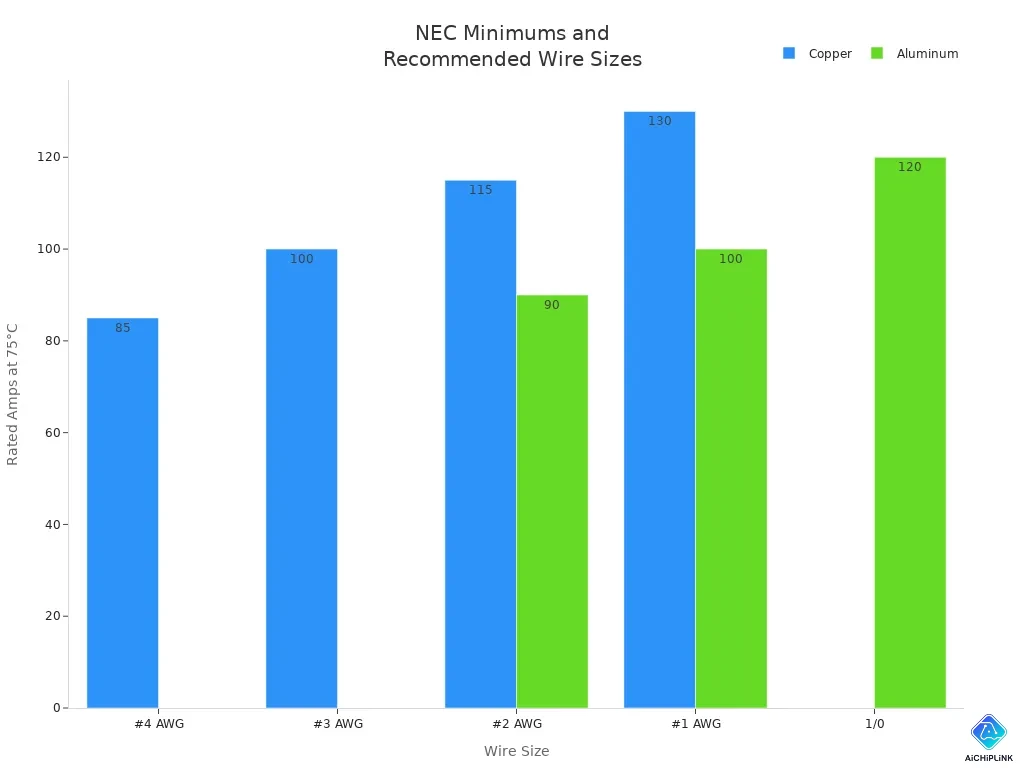
You need to remember that voltage drop changes ampacity and wire ratings. If your 100 amp sub panel is far from the main panel, use bigger wire. For runs over 100 feet, use 2 AWG copper or 1/0 aluminum. This keeps voltage drop under 3% and keeps ampacity safe.
Note: Always use wire rated for 75°C for 100 amp circuits. Check the NEC for the minimum wire gauge and ampacity before you start your work.
This wire size guide gives you the facts you need to make a good choice. You keep your home safe, follow the NEC, and protect your 100 amp sub panel.
Why Wire Size Matters
Safety and Overheating Risks
You need to pick the right wire size for 100 amp service. If you use a wire that is too thin, your home could be in danger. Wires that are not made for 100 amps get hot quickly. Hot wires can melt their covering and start a fire.
If you use 60 amp wiring with a 100 amp breaker, the wires are not safe. They can get too hot and catch fire before the breaker shuts off. The main problem is not enough protection. 60 amp wires are made to carry only 60 amps safely. A 100 amp breaker will not turn off until the current goes over 100 amps. If your house uses 70, 80, or 90 amps, the 60 amp wires will get very hot. The breaker stays on and does not know there is a problem.
The National Fire Protection Association says electrical problems cause many house fires. Using the wrong wire size makes this risk worse.
You should also think about other things that make wires get hot. The table below shows what can raise the risk:
| Factor | Description |
|---|---|
| Ambient Temperature | Hot weather means you need thicker wires to stop overheating. The NEC has rules for this. |
| Conduit Fill | Putting lots of wires together makes them hotter. The NEC says how many wires you can put in a conduit. |
| Installation Quality | Bad installation can cause fires. Aluminum wires are linked to many fires. |
Code Compliance
You need to follow the NEC rules for wire size and ampacity. The code keeps you safe from fire and damage. If you use the wrong wire, you break the rules and put yourself in danger.
-
The NEC makes sure wires are safe for the job.
-
Small wires can get too hot and cause fires.
-
Wires that are too thin can drop voltage and hurt your devices.
The NEC Table 310.15(B)(16) helps you pick the right wire for 100 amp service. This table shows how much current copper and aluminum wires can carry. Always check this table before you start your work.
Voltage Drop Effects
Voltage drop happens when electricity travels far in a wire. If the wire is too thin, the drop gets worse. You lose power and your devices may not work right.
-
Voltage drop wastes energy and makes the circuit less efficient.
-
More current can flow because of voltage drop, which can make wires hot.
-
Electronics and motors may turn off if the voltage is not steady.
You can fix voltage drop by using a bigger wire. Long wires need thicker wires to keep the drop low. If you ignore voltage drop, you risk hot wires, wasted energy, and broken equipment.
NEC Ampacity and Gauge Guide
NEC Ampacity Table for 100 Amps
You need to check the nec ampacity table before you pick a wire for your 100-amp circuit. The table shows how much current each wire size can carry. This is called ampacity. The ampacity depends on the wire material, insulation type, and temperature rating. For example, 3 AWG copper wire has an ampacity of 85 amp at 60°C, 100 amp at 75°C, and 110 amp at 90°C. Most homes use 75°C rated insulation, like THW or THWN. The nec says you must follow the lowest temperature rating of your equipment. Most breakers and panels are rated for 75°C or 60°C.
Here is a quick table for ampacity by conductor material:
| Wire Type | Insulation Rating | Wire Size for 100 Amps |
|---|---|---|
| Copper | 75°C | 3 AWG |
| Aluminum | 75°C | 1 AWG |
You should always match the wire ampacity to the maximum current your circuit will use. This guide helps you avoid mistakes with gauge and ampacity.
The 83% Rule and Exceptions
The nec lets you use the 83% rule for main service wires in homes. This means you can size the wire for 83% of the service rating. For a 100-amp circuit that supplies the whole house, you can use 4 AWG copper (85 amp) or 2 AWG aluminum (90 amp). This rule is in nec 310.12. You cannot use this rule for subpanels or detached buildings. Many people fail inspections because they use 4 AWG copper for a garage subpanel. Subpanels must use the standard gauge: 3 AWG copper or 1 AWG aluminum. Always check if your panel supplies the entire load before using the 83% rule.
-
The 83% rule only works for main service wires to a house.
-
Do not use the 83% rule for subpanels or secondary buildings.
-
Using the wrong gauge can cause a fire or fail inspection.
When to Up-Size Wire
Sometimes you need to up-size your wire for a 100-amp circuit. If your subpanel is more than 50 feet away, voltage drop becomes important. For a 100-foot run, you should use 2 AWG copper or 1/0 aluminum to keep voltage drop under 3%. Hot weather also lowers wire ampacity. If the air is hotter than 40°C, you must use a bigger wire. For example, 3 AWG copper drops from 100 amp to 88 amp at 40°C, so you need 2 AWG copper. If you put many wires in one conduit, heat builds up and lowers ampacity. You must up-size the wire to keep everything safe.
-
Up-size wire for long runs to reduce voltage drop.
-
Use a bigger gauge in hot places or crowded conduits.
-
Always check the nec ampacity table and voltage drop for your project.
This guide helps you pick the right gauge, follow nec rules, and keep your 100-amp circuit safe.
100 Amp Sub Panel Wire Size
Copper vs. Aluminum Comparison
You need to choose between copper and aluminum when you install a 100 amp sub panel. Each type of wire has its own strengths and weaknesses. Copper wire carries electricity better and fits in smaller spaces. Aluminum wire costs less and works well for long runs, but you must install it with care. The table below shows the main differences for a 100 amp sub panel:
| Wire Type | Common Sizes for 100 Amp Service | Installation Notes |
|---|---|---|
| Copper | 4 AWG, 2 AWG | Best copper cable rated at 15A @ 75°C |
| Aluminum | 2 AWG, 1 AWG, 1/0 AWG | 1/0 AWG is best practice for aluminum |
| Copper-Clad | 2 AWG, 1 AWG, 1/0 AWG | Suitable for direct burial |
You find copper wire types like THHN/THWN-2, XHHW, and MC cable. For aluminum, you see 2-2-2-4 Dyke Quadruplex, SER cable, and USE-2. If your 100 amp sub panel is over 100 feet away, you should use a larger wire size to keep voltage drop low.
Installation Tips
You want your 100 amp sub panel to work safely and last a long time. Here are some tips to help you:
-
Pick the right wire size for your 100-amp circuit. Use 2 AWG copper or 1/0 AWG aluminum for most 100 amp sub panel jobs.
-
For wire runs over 100 feet, use a bigger wire to keep voltage drop under control.
-
Use copper-clad wire for direct burial if you need to run wire underground.
-
Always check the amp rating on your wire and match it to your 100 amp sub panel.
-
Make sure your wire insulation matches the temperature rating of your panel and breaker.
You should also use the right tools and connectors. Tighten all connections well. If you use aluminum wire, apply anti-oxidant compound to each connection.
Common Mistakes
Many people make mistakes when they install a 100 amp sub panel. You can avoid these problems if you know what to watch for:
-
Using undersized wire, like #6 AWG copper or #4 AWG aluminum, for a 100 amp sub panel. This can cause overheating and fire.
-
Bonding neutral to ground in the subpanel. You must keep them separate to follow code and stay safe.
-
Skipping anti-oxidant compound on aluminum wire. This can lead to overheating and failure.
-
Ignoring voltage drop on long runs. Always upsize your wire for a 100 amp sub panel if the distance is over 100 feet.
You keep your home safe when you follow these tips. Always check the NEC code before you start your 100 amp sub panel project. If you have questions, ask a licensed electrician.
Voltage Drop and Long Runs
Calculating Voltage Drop
When you install a 100 amp sub panel, you must think about voltage drop. This drop happens when electricity travels through a wire over a long distance. If the wire is too small or the run is too long, the voltage at the end will be lower than at the start. You can use the voltage drop formula to find out how much voltage you lose:
| Calculation Type | Formula |
|---|---|
| Single-Phase Voltage Drop | Vdrop = 2 × I × R × L |
| Voltage Drop Percentage | %Vdrop = (Vdrop / Vsystem) × 100 |
Here, I stands for amp, R is resistance per foot, and L is the length of the wire in feet. For a 100 amp sub panel, calculating voltage drop helps you pick the right wire size. If you ignore voltage drop for long runs, you risk overheating and power loss. The NEC recommends keeping voltage drop under 3% for safety and efficiency.
Reference Table for Distance
You can use this table to choose the right wire size for your 100 amp sub panel based on distance. This helps you keep voltage drop low and ampacity safe.
| Wire Type | Distance (feet) | Wire Size |
|---|---|---|
| Copper | Up to 25 | 1 AWG |
| Copper | Up to 200 | 4/0 AWG |
| Aluminum | Up to 25 | 1/0 AWG |
| Aluminum | Up to 200 | 300 MCM |
If your 100 amp sub panel is far from the main panel, you need a larger wire. This keeps voltage drop for long runs within the NEC limit.
Practical Examples
You can see how voltage drop affects a 100 amp sub panel with these examples:
-
For a 100 amp continuous load at 240V using copper wire with 75°C insulation over a 100-foot run, you need 2 AWG copper. The voltage drop is 3.88V, or 1.62%. This is under the 3% rule.
-
This setup works well for a home, a commercial kitchen, or a small shop.
-
If you use a smaller wire or run it farther, the drop goes up. You may need to use a larger wire to keep voltage drop for long runs below 3%.
When you plan your 100 amp sub panel, always check ampacity, wire size, and voltage drop. This keeps your system safe and your equipment running well.
Conduit, Breaker, and Ground Wire
Conduit Sizing
You need to pick the right conduit size for your 100 amp wire. The conduit protects your wires and makes pulling them easier. The nec gives clear rules for conduit fill and size. For most 100 amp subpanel feeders, you use copper THHN wire. If you use #4 AWG copper, a 1-inch EMT conduit works for short runs. For longer runs or easier pulling, many electricians use a 1.25-inch or 1.5-inch EMT conduit. Aluminum wires are thicker, so you need a bigger conduit. For #2 AWG aluminum, use at least a 1.25-inch EMT conduit.
| Wire Type | Conductor Size | Minimum Conduit Size | Notes |
|---|---|---|---|
| Copper (THHN) | #4 AWG | 1-inch EMT | For 100 amp subpanel feeder, follows 40% fill limit for 3+ conductors |
| Aluminum | #2 AWG | 1.25-inch EMT | Larger conductor diameter requires larger conduit size |
| Copper (THHN) | #4 AWG | 1.25-inch or 1.5-inch EMT | Common practice for easier wire pulling on long runs |
Tip: Always check the nec gauge guide for conduit fill before you start your project.
Breaker Selection
You must choose the right breaker for your 100 amp circuit. The nec says you need a 100 amp double-pole breaker for most 240V loads. This breaker handles both hot wires and keeps your system safe. For continuous loads, the breaker should not run over 80% of its rating. That means you should not use more than 80 amps on a 100 amp double-pole breaker for long periods. You also need to match the breaker brand to your panel. Mixing brands can cause safety problems and fail inspection.
-
Use a 100 amp double-pole breaker for 240V circuits.
-
Do not load the breaker over 80 amps for continuous loads.
-
Match the breaker brand to your panel.
-
Separate ground and neutral bars in subpanels.
You also need to check the ampacity of your wires. The wire size must match the breaker size. For most 100 amp circuits, use #1 AWG copper or 1/0 AWG aluminum. For main service wires, the nec allows #4 AWG copper or #2 AWG aluminum.
NEC Gauge Guide for Ground Wire
You must install the right ground wire for your 100 amp circuit. The nec gauge guide says you need at least 8 AWG copper or 6 AWG aluminum for the equipment grounding conductor. If you upsize your main wires for voltage drop, you must also upsize the ground wire. This keeps the ampacity safe and follows nec rules.
| Requirement | Details |
|---|---|
| Minimum EGC for 100-amp circuit | 8 AWG Copper or 6 AWG Aluminum |
| NEC Reference | NEC Table 250.122 |
| Voltage Drop Upsizing Rule | Upsize EGC if main wires are upsized |
| Code Section for Upsizing | NEC 250.122(B) |
Note: Always check the nec gauge guide and upsize your ground wire if you use larger conductors for voltage drop.
You keep your system safe when you follow these ampacity and gauge rules for conduit, breakers, and ground wires.
Installation Steps Overview
Planning and Measuring
You need a clear plan before you start your 100 amp sub panel project. Follow these steps to make sure your installation goes smoothly:
-
Calculate your load. A 100 amp sub panel usually works for a detached garage or a home under 2,500 square feet. If you think you might add electric heat or an EV charger, consider a larger panel now.
-
Pick an accessible location. You need 36 inches of clear space in front of the 100 amp sub panel. Do not place it behind stored items or near gas meters. Mount the panel at eye level so you can read the labels.
-
Secure your permit early. Most towns require a permit and inspection for a 100 amp sub panel. Inspections protect you and help you avoid costly mistakes.
-
Plan the cable route. Measure the length from your main panel to the 100 amp sub panel. Note if the route passes through hot or cold areas. For runs up to 50 feet, #4 copper wire works. For longer runs, use #2 aluminum or larger to prevent voltage drop.
-
Schedule your work for good weather. Underground trenching is easier and cheaper when the ground is not frozen.
Pulling and Securing Wire
You need to pull the wire from your main panel to your 100 amp sub panel. Use fish tape or a pulling tool to guide the wire through conduit. Secure the wire every 4.5 feet with straps or clamps. Avoid sharp bends that can damage the wire. Check that the wire stays tight and does not sag. If you run the wire underground, use conduit rated for direct burial. Always keep the wire away from water and heat sources.
Tip: Label each wire before you connect it to the 100 amp sub panel. This makes troubleshooting easier later.
Panel Connections
You must connect the wires to the 100 amp sub panel following code requirements. The table below shows what you need to check:
| Requirement | Description |
|---|---|
| Continuous Ampere Rating | The panel must have a rating that matches or exceeds your 100 amp sub panel. |
| Terminal Identification | Each terminal must show which wire size and type it accepts. |
| Torque Marking | Tighten each connection to the marked torque value. |
| Neutral Conductor Terminals | Each neutral wire needs its own terminal. |
| Temperature Ratings | Use wires that match the panel’s temperature rating. |
You should double-check every connection in your 100 amp sub panel. Tighten all screws to the correct torque. Keep neutral and ground wires separate. This helps your 100 amp sub panel pass inspection and keeps your system safe.
Picking the right wire size for your 100 amp service keeps your home safe. It also makes your system work well. Using the correct gauge and nec ampacity stops wires from getting too hot. This helps prevent fires and saves energy. Always look at the nec tables. Use the recommended gauge to keep voltage drop low.
-
The right wire size stops voltage drop and keeps things working.
-
Most new homes use the correct gauge to meet nec rules.
-
The American Wire Gauge system helps you choose the best wire.
You should:
-
Check the nec tables before you start any project.
-
Figure out voltage drop for long wires and use a bigger gauge if needed.
-
Get help from a licensed electrician if your layout is tricky or if your system does not work right.
Safety and following the rules are most important. Use this guide to make good choices and keep your electrical system safe and smooth.

Written by Jack Elliott from AIChipLink.
AIChipLink, one of the fastest-growing global independent electronic components distributors in the world, offers millions of products from thousands of manufacturers, and many of our in-stock parts is available to ship same day.
We mainly source and distribute integrated circuit (IC) products of brands such as Broadcom, Microchip, Texas Instruments, Infineon, NXP, Analog Devices, Qualcomm, Intel, etc., which are widely used in communication & network, telecom, industrial control, new energy and automotive electronics.
Empowered by AI, Linked to the Future. Get started on AIChipLink and submit your RFQ online today!
Frequently Asked Questions
What size wire do you need for a 100 amp sub panel 100 feet away?
You need 2 AWG copper or 1/0 AWG aluminum for a 100-foot run. This keeps voltage drop under 3%. Always check the NEC table before you buy wire.
Can you use aluminum wire for a 100 amp service?
Yes, you can use aluminum wire. Pick at least 1/0 AWG for most 100 amp jobs. Make sure you use anti-oxidant paste on all connections.
Do you need a ground rod for a 100 amp sub panel?
Yes. You must install a ground rod at a detached building with a sub panel. Connect it with a ground wire sized by the NEC table.
What breaker do you use for a 100 amp panel?
You use a 100 amp double-pole breaker. This breaker matches the panel and wire size. Always use the same brand as your panel.
How do you reduce voltage drop on long wire runs?
* Use a larger wire size. * Keep wire runs as short as possible. * Check voltage drop with a calculator before you start.