BMP280 Barometric Pressure and Temperature Sensor Module Explained
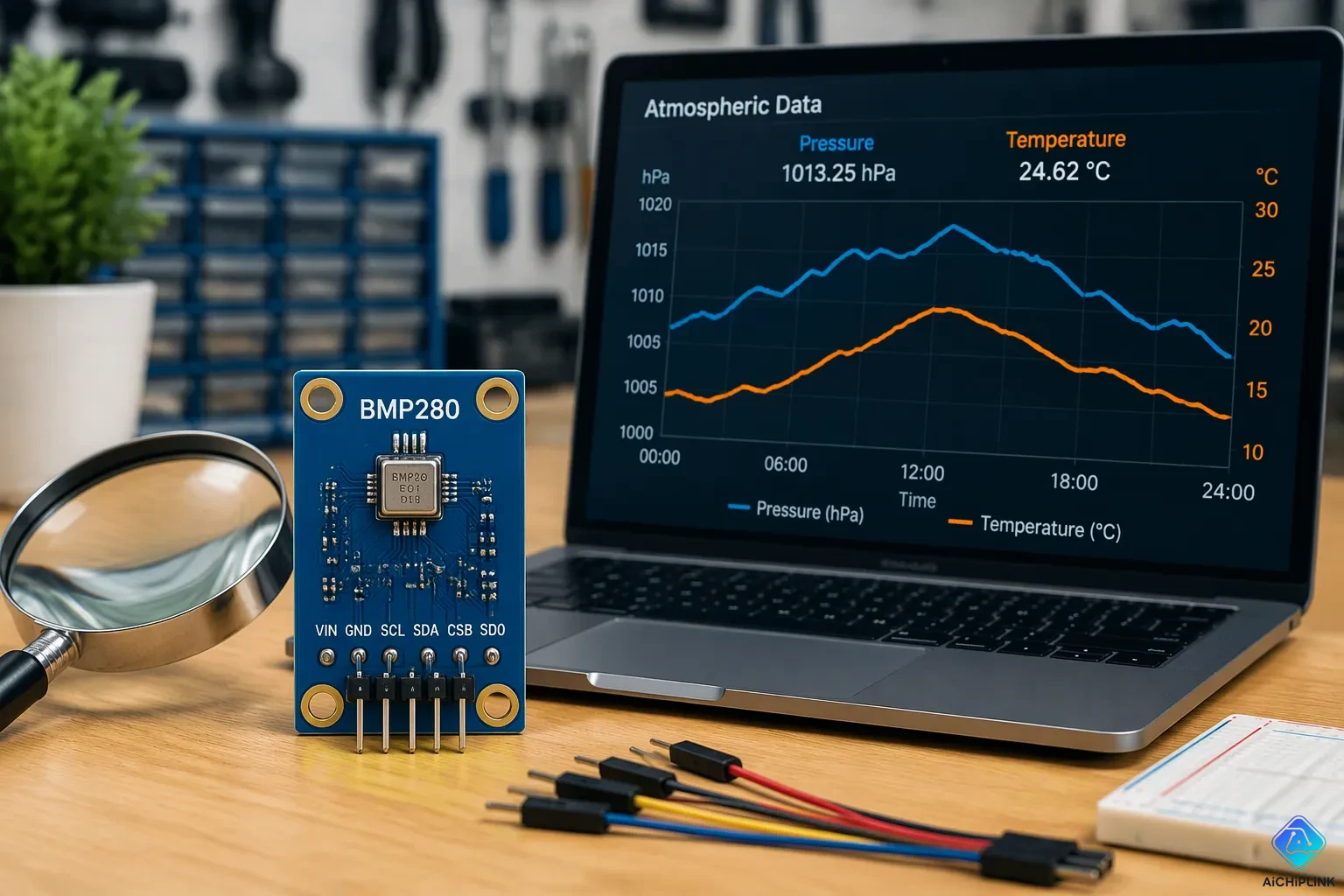
The BMP280 barometric pressure sensor module is a small digital device made by Bosch Sensortec. It measures pressure and temperature with high accuracy and uses very little power. Mobile devices, weather stations, and IoT projects depend on it.
This sensor module covers a 300–1100 hPa range and reaches ±0.12 hPa relative accuracy, according to Shillehtek. That resolution can detect altitude changes as small as one meter. Bosch designed the module for mobile use, and its 2.7 µA draw at 1 Hz sampling works well for battery-powered designs.
Later sections explain how the module works, its specifications and pinout, the BME280 comparison, and wiring for Arduino, ESP32, and Raspberry Pi.
Key Takeaways
-
The BMP280 measures air pressure and temperature very accurately and uses very little power.
-
A tiny diaphragm inside bends when air pressure changes, and the sensor turns that bend into digital data.
-
The module is small and uses little power, so it is great for battery-powered projects like drones and weather stations.
-
Pick the BMP280 if you only need pressure and temperature; choose the BME280 if you also need humidity readings.
-
You can easily connect the BMP280 to Arduino or ESP32 using I2C or SPI. Then you can start reading data in minutes.
What Is the BMP280 Barometric Pressure Sensor Module
Core Function of the Module
Bosch Sensortec makes the BMP280. This digital barometric pressure and temperature sensor is very precise and uses very little power. The device detects two things: the weight of the air around it and the surrounding temperature. That air weight is atmospheric pressure, and it drops as a device goes higher up. So the chip also works as an altimeter with about ±1 meter accuracy, according to OurPCB. The temperature operating range is -40 to 85 °C with ±1 absolute accuracy, per OurPCB. Engineers see the part as a basic module for detecting atmospheric pressure and temperature. Mobile applications value the part for altitude tracking and weather monitoring.
The BMP280 barometric pressure sensor module uses piezo-resistive technology. A tiny flexible film inside the package bends when the air pressure changes. That bend changes the resistance of the sensing element. Internal circuitry turns the resistance change into a voltage signal. A calibration stage then corrects the raw value and outputs a digital reading. A thermistor handles the temperature side of the measurement. So the module provides barometric pressure and temperature measurement in one compact part. The chip handles both pressure and temperature channels, so one part covers two measurements. The digital output removes the need for external analog-to-digital conversion.
Key attributes summarize the device:
| Attribute | Description |
|---|---|
| Manufacturer | Bosch Sensortec |
| Key description | Absolute pressure and altitude measuring chip; small SMD for mobile devices and microcontrollers |
| Function | Measures barometric pressure and temperature; altimeter with ±1 meter accuracy |
| Technology | Piezo-resistive pressure sensor |
| Pressure range | 300 hPa to 1100 hPa |
| Temperature range | -40 to 85 °C |
| Supply voltage | 3V/3.3V DC |
| Current draw | 2.7 µA at 1 Hz sampling |
Compact Design and Common Uses
The device outline is 2.0 mm by 2.5 mm, per OurPCB. Flywing Tech notes a height of 0.95 mm. That small form factor lets engineers fit the sensor module into products with little space. The surface-mount package works well with mobile devices and microcontrollers. The lightweight build makes the part easy to add to various electronic devices and systems, according to eStartrade IC. Low power consumption makes it even better for battery-powered designs. The 2.7 µA draw at 1 Hz sampling keeps the module efficient over long deployments.
Practical applications cover many areas:
-
Weather stations use the barometric pressure sensor module to track atmospheric pressure for forecasting.
-
Drones and UAVs depend on it for altitude control and stable flight.
-
GPS devices get altitude data from the chip.
-
Indoor navigation systems read pressure changes to find floor levels in buildings.
-
IoT devices, smart homes, wearables, and environmental monitoring systems adopt the module for its size and low current draw.
-
Industrial automation and pneumatic systems use it to monitor air pressure in manufacturing processes.
Portable sensor modules and small drones also benefit from the compact size. The sensor module also suits embedded systems and electronic prototypes.
The BMP280 barometric pressure sensor module meets a basic need. It turns air pressure and temperature into digital data that any microcontroller can process. A few lines of code then unlock pressure and temperature readings.
Working Principle and Pressure Sensing
The working principle of this device rests on one physical fact: air pressure bends a thin silicon membrane. That bend becomes an electrical signal, and the chip turns the signal into numbers a microcontroller can read. Understanding this chain helps engineers trust the readings and debug wiring problems faster. The barometric pressure sensor module follows the same basic idea as most modern digital devices. Two sensing channels share one package, so a single read cycle returns both values.
The Piezoresistive Effect
The piezoresistive effect describes how mechanical stress changes the electrical resistance of a material. Inside the sensor sits a diaphragm made from a piezoresistive material with a silicon semiconductor, according to APMonitor. Atmospheric pressure pushes on this diaphragm, and the membrane deforms slightly. Electroniclinic reports that four piezoresistive elements sit at points along intersecting perpendicular axes on the diaphragm. The deformation strains these elements and changes their resistance inside a bridge circuit. The output voltage of the bridge shifts as a result. A bridge layout offers a practical bonus. Two elements stretch while two compress, so the voltage swing grows and common drift cancels. The resistance change is proportional to the amount of pressure exerted, so the electrical output maps to specific pressure values. A tiny flexible film that bends under pressure drives the whole measurement, as EasyElecModule explains. Silicon serves well here because it springs back to its original shape after each bend. A thinner or wider diaphragm flexes more under the same load, so geometry sets the usable range. The bridge sits on the same die as the conversion circuitry, which keeps signal paths short and noise low. This design gives the sensor module a direct, repeatable link between load and voltage.
Signal Processing and Digital Output
Raw bridge voltage alone means little to a microcontroller. The sensor amplifies the signal and passes it through an analog-to-digital converter, per APMonitor. The module handles this step internally. On-chip calibration data then corrects the raw counts. Bosch writes these coefficients into the chip at the factory, and each unit carries its own values. Built-in temperature compensation adjusts the reading for thermal drift, and the same compensation feeds altitude formulas. The result is a calibrated digital value for pressure and temperature. Engineers get pressure and temperature from one register map, which keeps host code short. The module sends this data over I2C and SPI protocols, so one board fits many host designs. The I2C bus needs only two signal lines, and SPI suits faster or longer links. Both interfaces deliver pressure measurements and temperature readings as plain register values. Oversampling settings let a designer trade speed for a quieter signal, and an internal filter smooths sudden spikes. Altitude follows from the ratio between the reading and a sea-level reference, and weather shifts that reference over time. Averaging several samples in software further reduces noise on a quiet bench. The working principle stays the same across hosts: bend, bridge, convert, calibrate, output. Calibration happens before the data leaves the sensor, so the host never handles raw counts. A reader who grasps that chain can trust the barometric pressure data and spot faults such as a stuck diaphragm or a miswired bus.
Specifications and Working Details
Accuracy, Range, and Power
The BMP280 gives steady results within its normal working limits. LCSC lists the absolute pressure accuracy at ±1.0 hPa across a 0–65 °C span. The barometric pressure range goes from 300 to 1100 hPa. Temperature accuracy stays at ±1.0 °C at 25 °C, and the calibrated temperature range covers -40 to +85 °C. Power use stays low: 3.6 µA in normal mode at 1 Hz sampling and only 0.1 µA in standby. These numbers make the sensor module a great choice for battery-powered designs.
| Parameter | Range | Accuracy | Notes |
|---|---|---|---|
| Pressure | 300–1100 hPa | ±1.0 hPa | 0–65 °C |
| Temperature | -40 to +85 °C | ±1.0 °C | At 25 °C |
| Current (normal) | 3.6 µA | — | 1 Hz sampling |
| Standby current | 0.1 µA | — | Sleep mode |
The supply voltage stays at 3.3V DC, as noted earlier. A designer can swap measurement speed for lower noise by using oversampling settings. The pressure and temperature channels share one conversion pipeline, so both readings come in at the same time.
Interfaces and Pinout
The module works with both I2C and SPI protocols, and this flexibility makes it stand out from many rival sensors. Robocraze notes that most similar sensors offer only one of the two. The CSB pin picks the interface: pull it high for I2C, drive it low for SPI. A pull-up resistor on the board keeps CSB high by default, so I2C works with that pin left unconnected.
The six-pin layout is simple. VCC and GND handle power. SCL carries the serial clock for both the I2C interface and the SPI interface. SDA moves serial data in either mode. CSB selects the bus, and SDO sets the device address or acts as SPI data out. Electrocredible explains that grounding SDO gives the default address 0x76; tying it to 3.3V gives 0x77. CircuitDigest adds that the SCL, SDA, and CSB lines need 10K pull-up resistors, while SDO needs a pull-down. Two 100nF capacitors filter the analog and digital power lines. The BMP280 works only as a slave device on both buses.
BMP280 vs. BME280
The Humidity Difference
Both chips are made by Bosch Sensortec and use the same core to sense pressure and temperature. The BME280 adds a third channel: relative humidity. EasyElecModule lists the BMP280 as a pressure and temperature device, while the BME280 covers pressure, temperature, and humidity. That one extra channel is the main reason people choose between them.
| Feature | BMP280 | BME280 |
|---|---|---|
| Measurements | Pressure and temperature | Pressure, temperature, humidity |
| Humidity range | Not supported | 0–100% RH, non-condensing |
| Humidity accuracy | Not applicable | ±3% RH at 20–80% RH, 25 °C |
OurPCB notes that the BME280 humidity accuracy of ±3% RH applies from 20 to 80% RH at 25 °C, including hysteresis. The full 0–100% RH span is a working range, not a promise of accuracy. The humidity it can handle also depends on temperature below 0 °C and above 60 °C. The BMP280 does not measure moisture at all.
Choosing the Right Sensor
The right pick depends on the environment the sensor module will monitor. IC Components groups the BMP280 with weather and industrial uses, where pressure and temperature data do most of the work. That sensor also costs less. A weather station, a drone altimeter, or a GPS aid rarely needs moisture data, so the BMP280 fits well.
The BME280 suits spaces where moisture levels matter. Greenhouses, indoor climate control, agriculture, HVAC systems, and environmental monitoring all gain from the humidity reading. IC Components notes a higher starting cost for the BME280, balanced by its wider data range. That source also points out that the BME280 needs more careful calibration across all three parameters. Teams that need humidity should plan for that effort. Teams that do not can keep the simpler, lower-cost barometric pressure sensor module and lose nothing.
Using the BMP280 with Arduino and ESP32
Wiring with I2C and SPI
The BMP280 barometric pressure sensor module connects to an Arduino or ESP32 over either bus, and the wiring is easy. For I2C, four jumper wires are all you need: VCC to 3.3V, GND to ground, SCL to the clock pin, and SDA to the data pin. The module runs on 3.3V. The ESP32 uses GPIO 22 for SCL and GPIO 21 for SDA, and an Arduino Uno uses A5 and A4. Shillehtek notes that the example code starts the sensor at I2C address 0x76, so SDO stays grounded.
SPI wiring uses more lines but runs faster. The sketch from Shillehtek sets BMP_SCK on pin 13, BMP_MISO on pin 12, BMP_MOSI on pin 11, and BMP_CS on pin 10. A Raspberry Pi can be another host, and it offers I2C on GPIO 2 and GPIO 3 with the same address 0x76. Pull CSB high for I2C and low for SPI on every board. The SPI bus needs four signal lines, and SPI mode works well for faster sampling.
Reading Pressure and Temperature
The Adafruit BMP280 library cuts the software side down to a few calls. Shillehtek explains the setup: install the ESP32 board package from Espressif Systems, add the Adafruit library, and open the bmp280test example. The sketch calls readTemperature for Celsius and readPressure for pascals, so atmospheric pressure comes in plain units. The library returns pressure and temperature from one register map. It prints both values every 2 seconds. A failed begin call usually means a wrong address or loose wiring.
Altitude comes from the barometric pressure readings. The sketch passes a local sea-level reference of 1011.9 hPa to readAltitude, and the result comes back in meters. That reference changes with weather, so users should update it from a local forecast. Air pressure drops as a device climbs, and this link turns the sensor into a simple altimeter. These pressure measurements feed weather logs and altitude estimates, and the temperature readings come along too. The working code needs no calibration work from the user, because the sensor module corrects raw counts internally.
The BMP280 barometric pressure sensor module changes air pressure into digital data. A piezoresistive diaphragm bends when pressure pushes on it. A bridge circuit turns that bend into voltage. On-chip calibration then gives clean readings over I2C or SPI. Engineers get ±1.0 hPa accuracy, a 2.0 by 2.5 mm footprint, and 3.6 µA current draw in one part.
Choose this sensor when you only need pressure and temperature work. Pick the BME280 when a project also needs humidity data.
Readers can wire the module to an Arduino, ESP32, or Raspberry Pi at address 0x76 and print barometric pressure within minutes.

Written by Jack Elliott from AIChipLink.
AIChipLink, one of the fastest-growing global independent electronic components distributors in the world, offers millions of products from thousands of manufacturers, and many of our in-stock parts is available to ship same day.
We mainly source and distribute integrated circuit (IC) products of brands such as Broadcom, Microchip, Texas Instruments, Infineon, NXP, Analog Devices, Qualcomm, Intel, etc., which are widely used in communication & network, telecom, industrial control, new energy and automotive electronics.
Empowered by AI, Linked to the Future. Get started on AIChipLink and submit your RFQ online today!
Frequently Asked Questions
What does the BMP280 barometric pressure sensor module measure?
The sensor module measures atmospheric pressure and temperature. Its sensing element covers 300 to 1100 hPa. A piezoresistive diaphragm bends when air pushes on it, and on-chip calibration turns that bend into digital values. Engineers use the readings to track weather and estimate altitude.
How does a reader wire the sensor module to a microcontroller?
For i2c, the reader connects VCC to 3.3V, GND to ground, SCL to the clock line, and SDA to the data line. The ESP32 uses GPIO 22 and GPIO 21. An Arduino Uno uses A5 and A4. The spi option needs four signal lines instead.
Which i2c address does the module use?
Grounding the SDO pin sets address 0x76. Tying SDO to 3.3V sets address 0x77. Most example sketches start at 0x76, so the reader should keep SDO grounded. A failed startup call usually means a wrong address or a loose wire.
When should a project pick the BME280 instead?
The BME280 adds a humidity channel with ±3% RH accuracy from 20 to 80% RH at 25 °C. Greenhouses, HVAC systems, and indoor climate control gain from that data. Projects that need only pressure and temperature save cost with the BMP280.
How accurate are the pressure and temperature readings?
The barometric pressure sensor module holds ±1.0 hPa absolute accuracy from 0 to 65 °C. Temperature accuracy stays at ±1.0 °C at 25 °C. That resolution supports altitude changes near one meter, so the sensor works well as a simple altimeter.