BB5 Series MCU: Features and Specifications
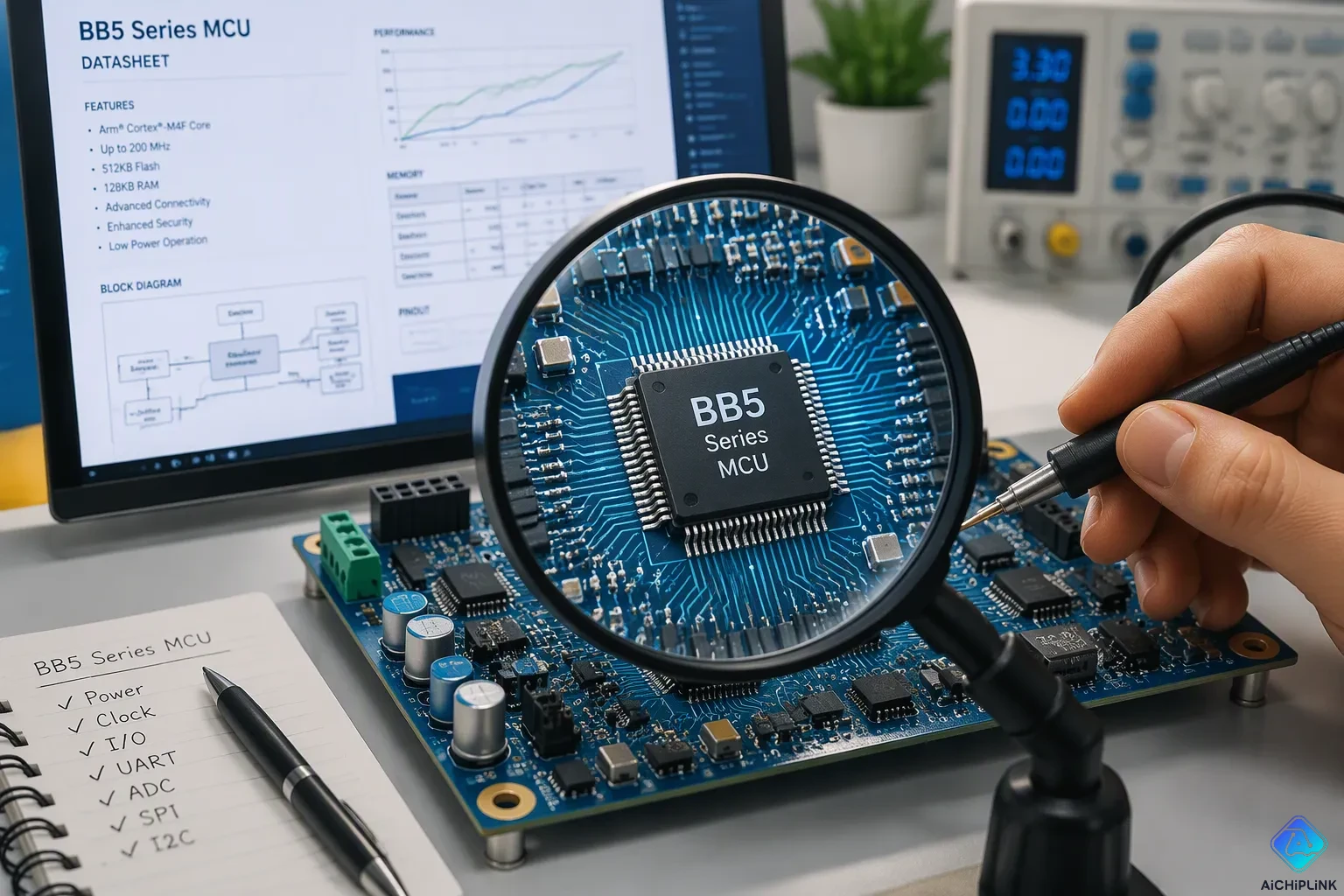
The BB5 Series MCU is a high-performance 8-bit solution in today's embedded market. Its 50 MHz core frequency makes it stand out from typical competitors. This device uses a pipelined C8051 core architecture. That design gives 36% more processing power than competing solutions. Engineers get faster execution without moving to a complex 32-bit platform. The chip also has a 50 MHz internal clock crystal oscillator with 2% inaccuracy. These features make this MCU a strong choice for cost-sensitive designs. This 8-bit MCU combines speed, accuracy, and rich peripherals in one compact package. Designers value this balance of power and simplicity.
Key Takeaways
-
The BB5 Series MCU runs at 50 MHz. This speed is faster than many other 8-bit chips.
-
It has an internal clock oscillator with 2% accuracy. This saves space and cost.
-
The chip includes 32 Kb flash memory and 2.304 Kb RAM. This is enough for many control tasks.
-
It offers analog features like a 10-bit DAC and 12-bit ADC. These help connect sensors and control outputs.
-
The BB5 Series MCU is great for battery-powered devices. It uses low power and runs from 1.8 to 5.5 volts.
BB5 Series MCU Architecture and Core Features
C8051 Core Architecture
The BB5 Series MCU uses a pipelined C8051 core. A pipeline breaks instruction handling into separate stages. The processor grabs one instruction while it runs another. This overlap keeps the 8051 core busy almost every clock cycle. Most old 8051 parts wait for one instruction to finish before starting the next one. The pipelined design gets rid of that wait. So, the MCU finishes more tasks in less time.
Full compatibility with the original 8051 instruction set is still a key feature. Engineers can move old code to this platform without a big rewrite. The improved 8051 core cuts system effort too. Closely connected peripherals lower the number of outside parts. A smaller bill of materials shrinks board area. This architecture gives older designs a clean upgrade path.
The instruction set has familiar register and memory operations. Programmers can reach data in several ways. Direct addressing gets to one register. Indirect addressing handles tables and arrays. This flexibility allows compact firmware. Smaller code uses less flash memory. Short programs lower the total system cost. The 8-bit data path keeps arithmetic simple.
The pipeline gives more than speed. It also smooths current draw. A non-pipelined design often bursts power at each instruction fetch. A pipelined design spreads that work out. This trait makes power-supply design easier. It also cuts electromagnetic emissions. Predictable timing helps real-time responses. Interrupt latency stays short. Loop timing becomes repeatable. A steady pipeline also helps debugging. The developer can predict when a read happens. Logic analyzers show clean signal transitions. This clarity shortens development time.
Clock Speed and Processing Power
The device hits a maximum clock frequency of 50 MHz. This clock comes from an internal clock crystal oscillator. Engineers do not need an outside crystal. The internal source saves two I/O pins. It also lowers component cost. The oscillator keeps high accuracy for serial protocols. Its inaccuracy stays within 2%. With this precision, UART and I2C communication stay reliable.
| Parameter | Specification |
|---|---|
| Internal clock crystal oscillator frequency | 50 MHz |
| Accuracy (inaccuracy/error) | 2% |
The system clock drives the CPU and peripherals directly. No external oscillator circuit is needed. This setup simplifies the printed circuit board layout. Designers save board space for other functions. The internal clock also starts faster than an outside crystal. So, the processor reaches full speed quickly after power-on.
External crystals can fail at solder joints. The internal oscillator removes that risk. It boosts reliability in small devices. Developers skip clock tuning work.
Speed creates a measurable lead in performance. The pipelined design gives 36% more processing power than competing solutions. A regular 8-bit MCU often needs more instruction cycles for the same job. This device finishes the job sooner. This advantage shows up in sensor polling, protocol handling, and control loops. Response times get better without moving to a complex 32-bit platform.
The 50 MHz clock works with the pipeline to boost throughput. A typical 8-bit design in the 16-25 MHz range needs more cycles per task. The higher clock, plus instruction overlap, closes the gap with larger processors. For many products, an 8-bit design gives enough performance at a lower price. This device shows that low-priced parts do not have to feel slow. Engineers keep a simple software model and gain real processing power.
Technical Specifications and Integrated Features
Memory and I/O Configuration
The BB5 Series MCU comes with a strong set of built-in resources. Flash memory keeps the program code. RAM memory holds variables and stack data while the program runs. The table below shows the exact amounts.
| Memory resource | Capacity |
|---|---|
| Flash memory | 32 Kb |
| RAM | 2.304 Kb |
The flash memory capacity reaches 32 Kb. That sits at the top of the flash 4-32kb range common in this class. The RAM sits at 2.304 Kb. This value fits inside the ram 0.5-2kb band that many small designs aim for. Together, the flash and RAM give the 8-bit MCU enough room for control firmware, protocol stacks, and sensor tables. A developer can store lookup tables in flash and keep working data in RAM. The memory layout supports simple, flat addressing. That keeps code small and fast.
The chip offers up to 29 multifunction I/O pins. These general-purpose I/Os are 5V tolerant. That tolerance lets the MCU connect to legacy sensors and drivers without level shifters. The GPIO ports handle digital input and output tasks. A UART serial port supports asynchronous communication. A SPI port drives fast peripherals like external flash or display controllers. Two I2C ports link to sensors, EEPROMs, and other low-speed devices. A watchdog timer guards against software lockups. It resets the MCU if the code stops responding. The device also supports a low power consumption mode. That mode cuts current draw during idle periods. Engineers value low power consumption for battery-powered products.
Timers, DAC, and PWM Capabilities
The BB5 Series MCU includes a rich timer set. Four 16-bit timers handle long-duration events. Two 8-bit timers manage shorter intervals. These six timers cover most timing needs without external parts. A 3-channel PCA provides PWM output. The PCA also supports capture and compare functions. A separate 3-channel PWM engine adds more modulation channels. Together, these features let the MCU control motors, dim LEDs, and regulate power supplies.
A 10bit dac option is available on selected variants. The 10bit dac converts digital values to analog voltages. That output drives bias circuits, audio tones, or control loops. An integrated temperature sensor rounds out the analog block. It measures the die temperature directly. The sensor helps with thermal protection and calibration. Some versions also offer 12-bit adcs for precise analog sampling. The 12-bit adcs capture signals from sensors with fine resolution. Designers pick the 12-bit adcs when they need better accuracy than a basic converter provides.
These features make the MCU a complete signal chain on one die. The device handles digital control, analog sensing, and power modulation. That integration shrinks board size and lowers cost. An engineer can build a full control loop with one chip. The mcu family covers many application needs. Each mcu variant shares the same core and toolchain. That consistency speeds up development across projects.
Performance Comparison with Mainstream MCUs
Speed and Efficiency Benchmarks
The BB5 Series MCU runs at 50 MHz. Typical 8-bit MCU parts often run between 16 MHz and 25 MHz. This gap matters for real work. A faster core clock frequency means the chip finishes tasks sooner. The table below shows how the BB5 compares to common parts.
| Feature | BB5 Series | N761003 | MS51 | STM8 |
|---|---|---|---|---|
| Core | 8051 | 8051 | 8051 | STM8 |
| Max Frequency | 50 MHz | N/A | 24 MHz | 16 MHz |
| Flash | 32 kB | N/A | N/A | N/A |
| Crystal Error | 2% @ 50 MHz | N/A | 4% @ 24 MHz | 5% @ 16 MHz |
| ADC | 12-bit, 600 ksps | N/A | 12-bit, 500 ksps | 10-bit, 420 ksps |
| DAC | 10-bit supported | Not supported | Not supported | Not supported |
| Wake-up Time | 30 μs @ 50 MHz | N/A | 30 μs @ 24 MHz | 55 μs |
The BB5 also wakes in 30 μs at 50 MHz. The STM8 needs 55 μs. Faster wake-up saves energy in battery devices. The 2% crystal error beats the MS51 at 4% and the STM8 at 5%. A tight system clock helps serial ports work without errors.
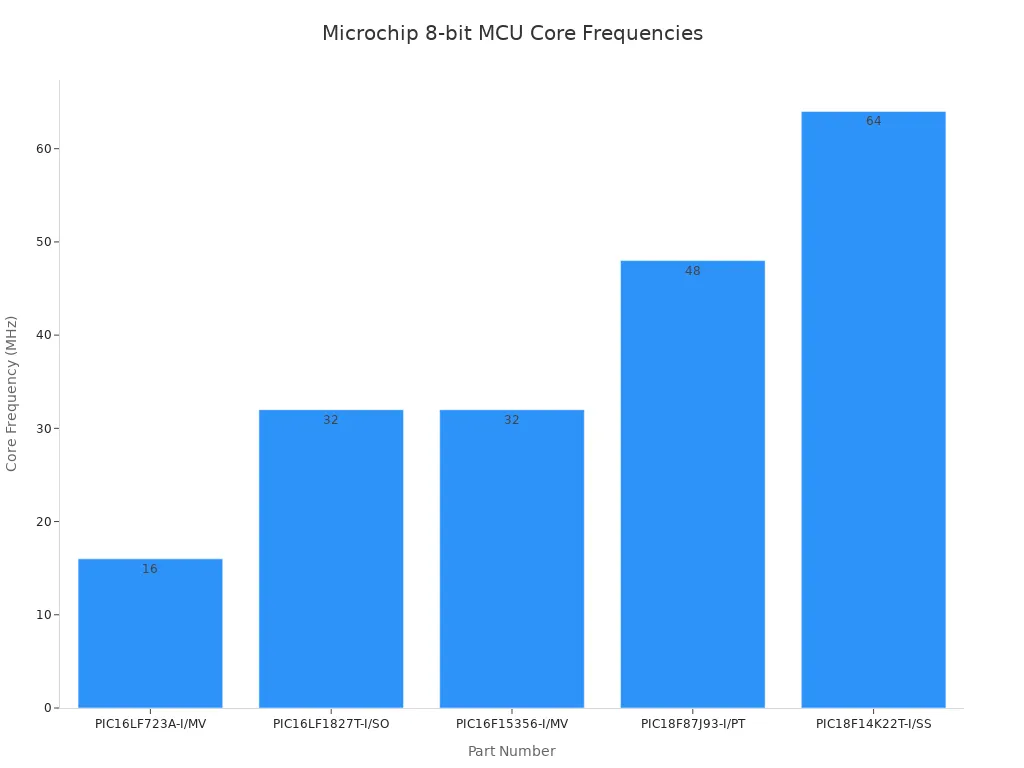
8-bit microcontrollers typically operate at clock frequencies ranging from 1MHz to 50MHz, offering basic computational capabilities suitable for simple control applications.
Cost vs. 32-bit Solutions
A 32-bit chip costs more and needs complex software. The BB5 Series MCU keeps the simple 8051 model. Engineers reuse old code and tools. That saves time and money. The BB5 also supports low power consumption modes. Small devices run longer on one battery.
For small form factor products, a 32-bit part adds needless work. The BB5 handles sensor polling, motor control, and LED dimming with its rich features. Its 10-bit DAC and 12-bit ADC remove extra chips. That shrinks the board and cuts cost. An 8-bit MCU with this speed covers most control jobs. Engineers get performance without the 32-bit burden.
Target Applications and Use Cases
Industrial and Consumer Electronics
The BB5 Series MCU is made for small form factor devices. These devices need solid performance without 32-bit complexity. It fits battery-powered uses like power tools, handheld kitchen tools such as immersion blenders, and children's toys. It runs from 1.8 to 5.5 volts. That wide range lets a coin-cell battery power a device for years in the field.
The new BB5 family includes the most powerful 8-bit MCUs available on the market. The 50 MHz core frequency in the BB5 family gives 36 percent more compute power than any other general 8-bit MCU. The family is ideal for battery-powered applications like power tools, handheld kitchen tools like immersion blenders, and even children's toys. It supports a wide range of voltage options, from 1.8 to 5.5 volts, so a coin-cell battery can power these devices for years in the field. They also come in a variety of packaging sizes, from 2 mm x 2 mm for the BB50 MCU, while the BB51 and BB52 MCUs are 3 mm x 3 mm offering additional GPIOs and increased analog functionality. The 8-bit BB52 even offers greater price-performance than competitive 32-bit MCUs for certain applications.
This chip also helps industrial sensors. A factory sensor node needs fast response and low power consumption. The 50 MHz core handles sensor polling and protocol tasks with ease. The on-chip 12-bit ADC captures analog signals from pressure or temperature sensors. The 10-bit DAC drives control outputs. These features remove extra chips from the circuit board. That saves space and cuts cost.
| Application Category | Suitability Description |
|---|---|
| Space-constrained embedded applications | Small packages down to 2 mm x 2 mm; advanced analog and communication peripherals in small packages |
| Cost-conscious / budget applications | Competitive pricing; flexible platform without overhead of a 32-bit platform |
| General IoT / mixed-signal / low-latency uses | Ideal for a broad range of IoT applications; low-latency embedded challenges |
| Augmenting existing products | Excels as a way to add simple features to existing products |
| Primary MCU role | Can serve as the main MCU in embedded designs |
| Battery-powered consumer devices | Power tools, handheld kitchen tools (e.g., immersion blenders), children's toys; runs from 1.8 to 5.5 V on a coin-cell battery |
IoT and Smart Device Integration
Edge devices in IoT networks need a low-cost 8-bit MCU solution, and the BB5 Series MCU fits that role. It handles mixed-signal tasks and low-latency challenges. A smart sensor node can run for years on a coin-cell battery. The device supports a low power consumption mode. That mode cuts current draw during idle periods. Engineers value low power consumption for remote deployments.
This chip can also add simple features to an existing product. A designer can put a BB5 Series MCU into a legacy system. It can act as the main MCU in many embedded designs. It provides flash memory for code and RAM for runtime data. The 32 Kb flash stores protocol stacks and lookup tables. The 2.304 Kb RAM manages variables and stack data. These memory resources support small IoT edge devices. The core runs at 50 MHz. That speed handles communication tasks without delay. For certain jobs, the BB52 variant beats competitive 32-bit MCUs on price-performance.
Development Ecosystem and Tools
The BB5 Series MCU comes with a full set of tools for building your project. This setup covers software, hardware, and help when you need it. Engineers can go from a first idea to a working model with very little setup. These tools take away the usual problems.
Software Development Kits and IDEs
A software development kit (SDK) gives you the basic pieces you need. The kit has drivers, libraries, and example projects. Developers use a common IDE to write, build, and organize their code. The IDE works with the pipelined C8051 core. The tool chain keeps the process easy to follow. Engineers write firmware in C. The compiler changes that code into instructions the 8-bit MCU can run.
The two-wire debug interface handles downloading, debugging, and emulating. This interface only needs two pins. It links the host PC to the device. The interface loads firmware into flash memory. It can also read and write RAM. Developers can check variables and try out different cases. Breakpoints stop the program so you can look at it. Step commands follow the code line by line. This work saves hours of testing by hand. The IDE also comes with project templates. These templates set up startup code and linker files. This setup lets a new project build on the first try. The templates also define code and data sections.
Hardware Evaluation Boards and Support
Evaluation boards give engineers a test platform that is ready to use. The boards bring out the multifunction I/O pins. They have headers and often add status LEDs. A designer can hook up sensors and loads fast. The debug interface works with the board. It gives a direct link to the IDE.
Support for real-time operating systems makes the platform bigger. Small RTOS kernels handle more than one task. The SDK has integration files that are ready to use. Reference designs show complete circuit layouts. These examples cover sensor nodes, LED controllers, and small motor drivers. The reference files cut down design time. They also point out the main features of the BB5. There is enough code space for many tasks. Engineers can use a proven layout instead of starting from nothing.
No 8-bit chip on the market is stronger than the BB5 Series MCU. It has 50 MHz speed, 2% oscillator accuracy, and strong features. Inside one small package, engineers get 32 Kb flash and 2.304 Kb RAM. RAM is used for variables, and flash is used for code. This 50 MHz core gives 36% more processing power than rivals. Designers like this MCU for low power use in battery devices. This design has no 32-bit complexity. Instructions stay familiar, and the memory model is simple. For low-cost jobs and small products, the BB5 is hard to beat. Teams wanting performance and simplicity should pick this MCU.

Written by Jack Elliott from AIChipLink.
AIChipLink, one of the fastest-growing global independent electronic components distributors in the world, offers millions of products from thousands of manufacturers, and many of our in-stock parts is available to ship same day.
We mainly source and distribute integrated circuit (IC) products of brands such as Broadcom, Microchip, Texas Instruments, Infineon, NXP, Analog Devices, Qualcomm, Intel, etc., which are widely used in communication & network, telecom, industrial control, new energy and automotive electronics.
Empowered by AI, Linked to the Future. Get started on AIChipLink and submit your RFQ online today!
Frequently Asked Questions
What makes the BB5 Series MCU faster than other 8-bit chips?
The pipelined C8051 core runs at 50 MHz. That speed is higher than the 16-25 MHz range common in rival 8-bit parts. The pipeline processes instruction steps together, so the chip does more work each cycle. These traits give 36 percent more processing power than competing solutions.
Does the BB5 Series MCU need an external crystal?
No. The chip has an internal clock crystal oscillator that runs at 50 MHz. Its accuracy stays within 2%. This design saves two I/O pins and removes an outside part. It uses less board space and lowers cost.
Which analog features does the BB5 Series MCU include?
Some versions offer a 10-bit DAC and a 12-bit ADC that samples at 600 ksps. A built-in temperature sensor reads chip temperature for thermal protection. These blocks let one chip handle digital control, analog sensing, and power modulation.
Can the BB5 Series MCU replace a 32-bit part?
For many small product designs, yes. The BB52 variant gives better price-performance than rival 32-bit MCUs in some applications. Engineers keep the simple 8051 model and reuse old code. They avoid the cost and software burden of a 32-bit platform.
What memory and I/O resources does the BB5 Series MCU provide?
The device stores code in 32 Kb of flash and keeps working data in 2.304 Kb of RAM. It offers up to 29 multifunction I/O pins that handle 5V. Four 16-bit timers, two 8-bit timers, and PWM channels complete the peripheral set.