Introduction
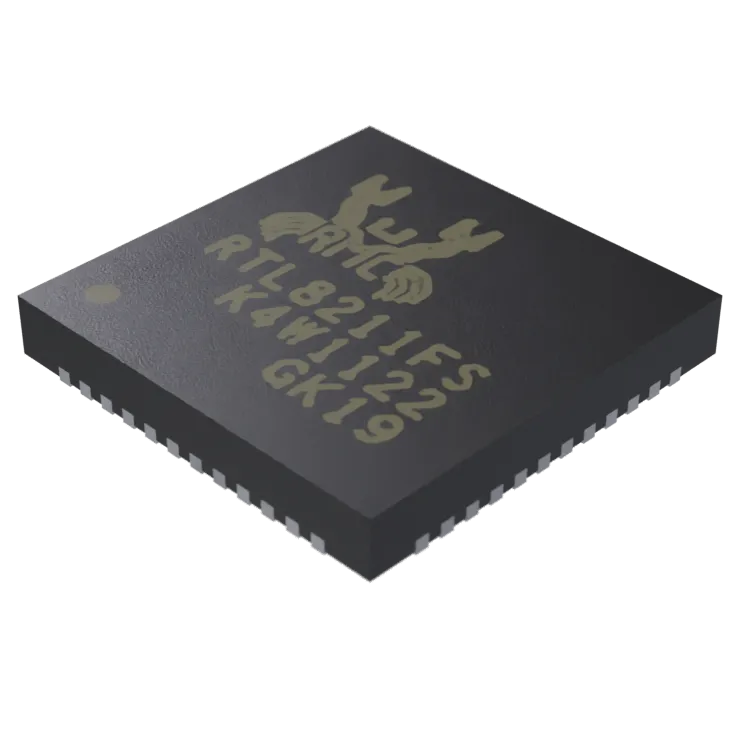
The RTL8211FS-CG is a single-port Gigabit Ethernet PHY transceiver manufactured by Realtek Semiconductor, supporting 10/100/1000 Mbps operation over twisted-pair copper cables with integrated MAC interface (RGMII/GMII), auto-negotiation, and IEEE 802.3 compliance for embedded systems, single-board computers, routers, switches, and IoT devices requiring cost-effective, reliable Ethernet connectivity.
Technical Overview
Core Specifications
| Parameter | Specification |
|---|---|
| Data Rates | 10/100/1000 Mbps |
| Standards | IEEE 802.3 (10BASE-T), 802.3u (100BASE-TX), 802.3ab (1000BASE-T) |
| MAC Interface | RGMII (Reduced Gigabit MII), GMII |
| MDI Interface | RJ-45 (twisted-pair copper) |
| Cable Support | Cat 5e/6 (up to 100m) |
| Supply Voltage | 3.3V (I/O), 1.2V (core) |
| Package | 40-pin QFN (6×6mm) |
| Operating Temp | 0°C to +70°C (commercial), -40°C to +85°C (industrial) |
Part Number Decoder
RTL8211FS-CG:
- RTL8211 = Realtek Gigabit PHY family
- F = Single-port variant
- S = Cost-optimized version
- -CG = Package type (QFN-40) and grade
Key Features
Multi-Speed Support:
- 1000BASE-T (1 Gbps) Gigabit Ethernet
- 100BASE-TX (100 Mbps) Fast Ethernet
- 10BASE-T (10 Mbps) Ethernet
- Auto-negotiation (speed, duplex, flow control)
Flexible MAC Interface:
- RGMII: Reduced pin count (12 signals), 125 MHz
- GMII: Full interface (24 signals), 125 MHz
- Clock output: 125/50/25 MHz (for MAC)
Integrated Features:
- IEEE 802.3az Energy Efficient Ethernet (EEE)
- Wake-on-LAN (WoL) support
- MDI/MDIX auto-crossover
- Cable diagnostics (TDR)
- Loop-back modes (internal/external)
Low Power:
- Active: ~300-400 mW @ 1000 Mbps
- Idle: ~100 mW (EEE enabled)
- Power-down: <10 mW
Complete Specifications
Supported Standards
| Standard | Data Rate | Medium | Cable |
|---|---|---|---|
| IEEE 802.3ab | 1000 Mbps | Twisted-pair | Cat 5e/6 (100m) |
| IEEE 802.3u | 100 Mbps | Twisted-pair | Cat 5 (100m) |
| IEEE 802.3 | 10 Mbps | Twisted-pair | Cat 3 (100m) |
| IEEE 802.3az | EEE (Energy Efficient Ethernet) | - | - |
MAC Interface Specifications
RGMII (Reduced GMII):
- Data width: 4-bit (RXD[3:0], TXD[3:0])
- Clock: 125 MHz @ 1000 Mbps, 25 MHz @ 100 Mbps, 2.5 MHz @ 10 Mbps
- Signals: TX_CLK, TX_CTL, TXD[3:0], RX_CLK, RX_CTL, RXD[3:0]
- Total pins: 12 (vs 24 for GMII)
GMII (Gigabit MII):
- Data width: 8-bit (RXD[7:0], TXD[7:0])
- Clock: 125 MHz @ 1000 Mbps
- Signals: TX_CLK, TX_EN, TX_ER, TXD[7:0], RX_CLK, RX_DV, RX_ER, RXD[7:0]
Electrical Specifications
| Parameter | Min | Typ | Max | Unit |
|---|---|---|---|---|
| VDDA (Analog) | 3.135 | 3.3 | 3.465 | V |
| VDDIO (I/O) | 2.375 | 2.5/3.3 | 3.465 | V |
| VDD12 (Core) | 1.14 | 1.2 | 1.26 | V |
| Power (1000BASE-T) | - | 350 | 450 | mW |
| Power (100BASE-TX) | - | 150 | 200 | mW |
| Power (10BASE-T) | - | 80 | 120 | mW |
Performance Specifications
| Parameter | Specification |
|---|---|
| Latency (PHY) | <1 µs (typical) |
| Jitter (TX) | <1.4 ns (1000BASE-T) |
| Return Loss | >10 dB @ 1-100 MHz |
| Cable Length | 100m max (Cat 5e/6) |
Applications
Embedded Systems
Single-Board Computers (SBC):
- Raspberry Pi alternatives (custom SBCs)
- BeagleBone-style boards
- Industrial SBCs (x86, ARM)
- Edge computing platforms
Typical Configuration:
SoC/CPU (ARM Cortex-A, x86)
    ↓ RGMII (12 signals)
RTL8211FS-CG PHY
    ↓ MDI (twisted-pair)
RJ-45 Connector → Ethernet Network
Routers & Switches
Home/SOHO Routers:
- WAN port (Gigabit uplink)
- LAN ports (multiple RTL8211FS)
- Mesh WiFi routers
- VPN gateways
Managed Switches:
- 4-8 port Gigabit switches
- PoE switches (with external PoE controller)
- Industrial Ethernet switches
IoT & Industrial
Industrial Automation:
- PLC (Programmable Logic Controllers)
- HMI (Human-Machine Interfaces)
- Ethernet I/O modules
- Industrial cameras
IoT Gateways:
- Smart building controllers
- Energy monitoring systems
- Security systems (NVR/DVR)
- Edge AI devices
Network Attached Storage (NAS)
NAS Systems:
- Entry-level NAS (2-4 bay)
- Home media servers
- Backup appliances
- File servers
Design Implementation
Hardware Circuit
Typical Reference Design:
        SoC/Processor
            ↓ RGMII (3.3V)
        RTL8211FS-CG
            ↓ MDI (differential)
        Magnetics Module
            ↓
        RJ-45 Connector (with LEDs)
Power Supply:
5V Input
   ↓ LDO (3.3V, 300mA)
3.3V → VDDA, VDDIO
   ↓ LDO (1.2V, 150mA)
1.2V → VDD12 (core)
Pin Configuration
Essential Connections:
- RGMII Signals (12 pins): TX_CLK, TX_CTL, TXD[3:0], RX_CLK, RX_CTL, RXD[3:0]
- MDI (4 pairs): TXP/TXN (2 pairs), RXP/RXN (2 pairs)
- Management: MDC (clock), MDIO (data) for PHY configuration
- Control: RESET_N (active-low reset), CLK_OUT (optional)
- Power: VDDA, VDDIO, VDD12, multiple GND
Magnetics & RJ-45:
- Isolation transformer: 1:1 turns ratio, 350µH minimum
- Common-mode chokes: Filter noise on TX/RX pairs
- RJ-45 with integrated magnetics (e.g., HanRun HR911105A)
PCB Layout Guidelines
Critical Design Rules:
- RGMII traces: 50Ω single-ended impedance, <6 inch length, matched timing
- MDI traces: 100Ω differential impedance (±10%), symmetrical routing
- Ground plane: Solid ground plane beneath PHY, stitching vias every 200 mils
- Power decoupling: 0.1µF + 1µF ceramic caps close to VDD pins
- Crystal (optional): 25 MHz crystal with 18pF load caps if external clock needed
Layer Stack-Up (4-layer PCB):
Top Layer:    Signal (RGMII, control)
Layer 2:      GND
Layer 3:      Power (3.3V, 1.2V)
Bottom Layer: Signal (MDI, less critical)
Software Configuration
MDIO Register Access:
// Example: Read PHY ID
uint16_t phy_id1 = mdio_read(PHY_ADDR, 0x02); // PHYID1
uint16_t phy_id2 = mdio_read(PHY_ADDR, 0x03); // PHYID2
// RTL8211FS: ID = 0x001CC916

// Enable auto-negotiation
mdio_write(PHY_ADDR, 0x00, 0x1000); // BMCR: Auto-neg enable

// Read link status
uint16_t bmsr = mdio_read(PHY_ADDR, 0x01); // BMSR
bool link_up = (bmsr & 0x0004) ? true : false;
Linux Driver:
- Kernel driver:
drivers/net/phy/realtek.c - Device tree entry (example):
&fec {
phy-mode = "rgmii";
phy-handle = <ðphy0>;
status = "okay";
mdio {
ethphy0: ethernet-phy@1 {
reg = <1>;
compatible = "ethernet-phy-ieee802.3-c22";
};
};
};
Comparison & Alternatives
vs RTL8211E (Previous Generation)
| Feature | RTL8211FS-CG | RTL8211E |
|---|---|---|
| Package | QFN-40 (6×6mm) | QFN-48 (7×7mm) |
| Power (1000BASE-T) | 350 mW | 450 mW |
| EEE Support | ✅ Yes | ✅ Yes |
| Cost | Lower | Higher |
| Use Case | Cost-optimized | General purpose |
vs Microchip LAN8720A (100 Mbps)
| Feature | RTL8211FS-CG | LAN8720A |
|---|---|---|
| Max Speed | 1000 Mbps | 100 Mbps |
| MAC Interface | RGMII/GMII | RMII |
| Power | 350 mW @ 1G | 130 mW @ 100M |
| Cost | ~$2-3 | ~$1-1.5 |
| Application | Gigabit required | Fast Ethernet sufficient |
Conclusion
The RTL8211FS-CG provides cost-effective Gigabit Ethernet PHY functionality with 10/100/1000 Mbps support, RGMII/GMII MAC interface, Energy Efficient Ethernet, and comprehensive features for embedded systems, routers, IoT devices, and industrial applications requiring reliable, standards-compliant Ethernet connectivity in compact 40-pin QFN package.
Key Advantages:
✅ Gigabit Performance: 1000 Mbps over Cat 5e/6
✅ Flexible Interface: RGMII (12 pins) or GMII (24 pins)
✅ Low Power: 350 mW active, EEE support
✅ Auto-Negotiation: Speed, duplex, flow control
✅ Cost-Effective: ~$2-3 for Gigabit PHY
✅ Small Package: QFN-40 (6×6mm) saves PCB space
✅ Linux Support: Mainline kernel driver
Designing Ethernet systems? Visit AiChipLink.com for Ethernet PHY sourcing and network hardware design consultation.

Written by Jack Elliott from AIChipLink.
AIChipLink, one of the fastest-growing global independent electronic components distributors in the world, offers millions of products from thousands of manufacturers, and many of our in-stock parts is available to ship same day.
We mainly source and distribute integrated circuit (IC) products of brands such as Broadcom, Microchip, Texas Instruments, Infineon, NXP, Analog Devices, Qualcomm, Intel, etc., which are widely used in communication & network, telecom, industrial control, new energy and automotive electronics.
Empowered by AI, Linked to the Future. Get started on AIChipLink.com and submit your RFQ online today!
Frequently Asked Questions
What is RTL8211FS-CG used for?
The RTL8211FS-CG from Realtek Semiconductor is used as a Gigabit Ethernet PHY in embedded systems such as single-board computers, routers, IoT gateways, NAS devices, and switches. It converts digital MAC signals into analog signals for Ethernet cables, enabling 10/100/1000 Mbps network connectivity.
What is the difference between RGMII and GMII?
RGMII (Reduced GMII) uses 12 signals, while GMII uses 24 signals. RGMII achieves the same Gigabit speed using DDR signaling, reducing pin count and PCB complexity. RGMII: 4-bit DDR @ 125 MHz → 1 Gbps (preferred in modern designs) GMII: 8-bit SDR @ 125 MHz → 1 Gbps (simpler but larger footprint) The RTL8211FS-CG supports both, though RGMII is more commonly used.
How to connect RTL8211FS-CG to Raspberry Pi?
The RTL8211FS-CG cannot be directly used with standard Raspberry Pi boards, as they already include built-in Ethernet solutions. However, it can be used in custom SBC designs based on Raspberry Pi SoCs by connecting via the RGMII interface and configuring the system through device tree and MDIO.
Does RTL8211FS-CG support PoE?
No, the RTL8211FS-CG does not support PoE by itself. It only handles Ethernet data transmission. To implement PoE, you must add external PoE controller ICs (PSE or PD) alongside the PHY and magnetics.
What software drivers are needed?
The RTL8211FS-CG is supported by the Linux kernel’s built-in Realtek PHY driver, so no additional drivers are typically required. Configuration is done via device tree settings (e.g., RGMII mode and PHY address), and it is also supported in bootloaders like U-Boot and most embedded OS environments.