PIC32CM GV Low-Power 32-bit Microcontrollers Explained for Embedded Control
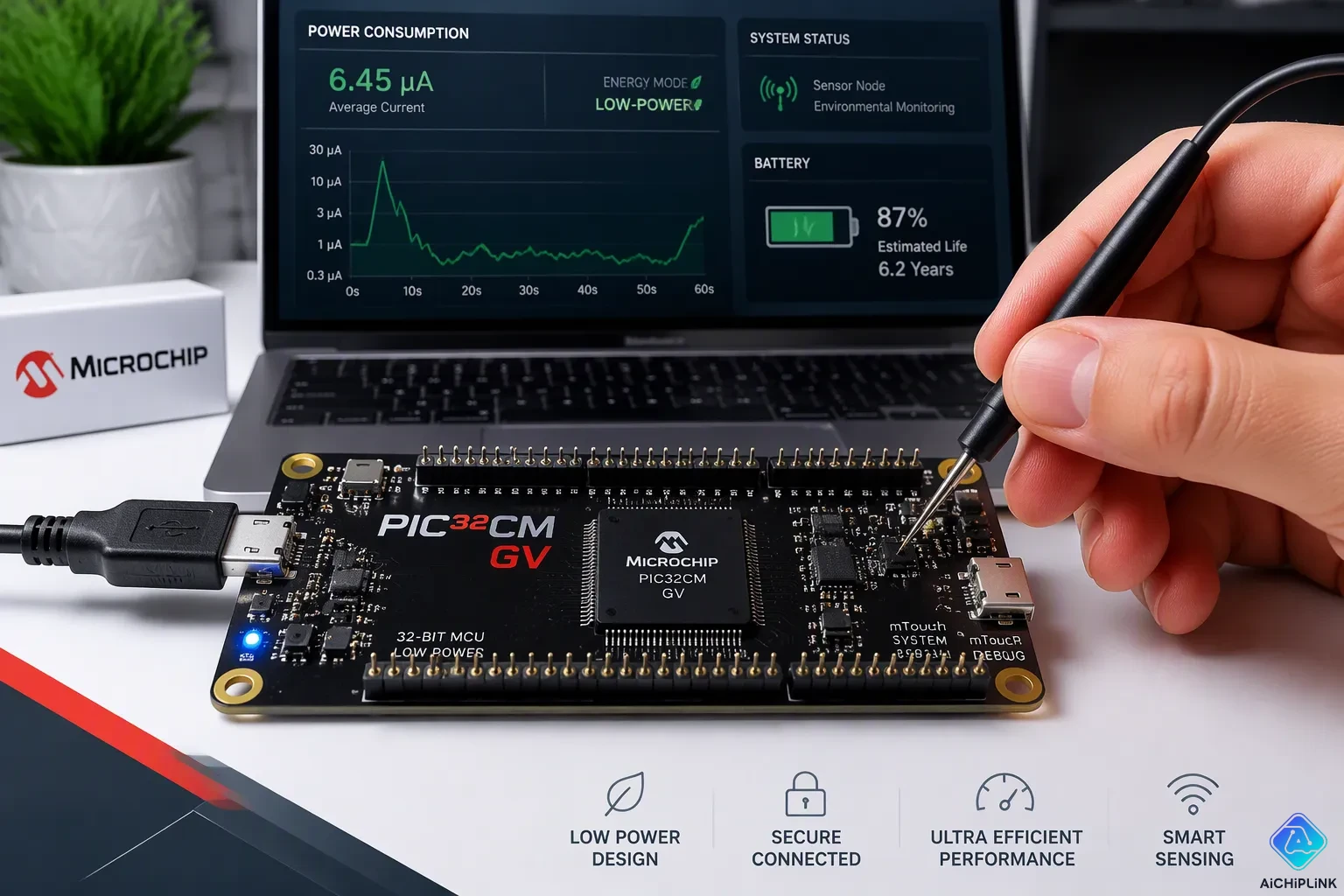
The PIC32CM GV is a family of pic32cm gv low-power 32-bit microcontrollers from Microchip. Microchip builds these chips on the Arm Cortex-M0+ core. Designers use them for embedded control jobs in small products where cost matters.
Three questions shape this guide. What is in the family? How do its power saving features work? Why does it fit always-on designs?
The core runs at low voltage and uses little current while it works. A sleep mode cuts power use even more when the chip waits for an event. Peripherals keep running on very little power, so the device stays quick to respond without waking the CPU. Firmware support and tools round out the package.
Key Takeaways
-
The PIC32CM GV family uses a 32-bit core for fast processing and low power use.
-
Sleep modes cut power when the chip waits, and peripherals keep sensing during sleep.
-
The event system lets peripherals talk directly, so the CPU stays asleep and saves power.
-
Touch sensing and safety features make the chip reliable for always-on products.
-
Keil tooling helps teams move from 8-bit to 32-bit designs quickly and easily.
What PIC32CM GV Low-Power 32-bit Microcontrollers Are
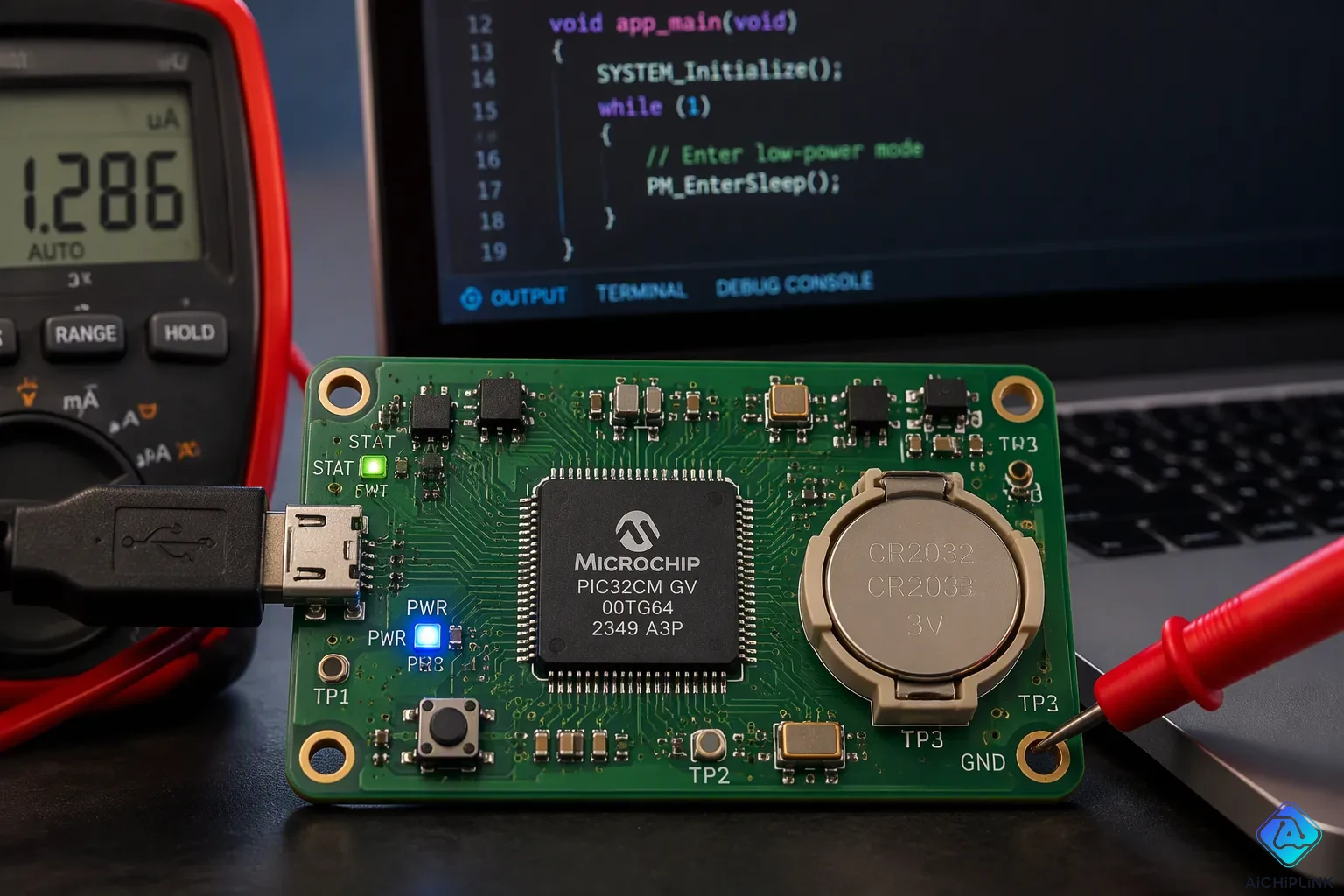
The PIC32CM GV family is a line of pic32cm gv low-power 32-bit microcontrollers from Microchip. Each device pairs the Arm Cortex-M0+ core with flash memory and a set of on-chip peripherals. The design goal is clear: balance speed and power use for embedded applications where cost matters. Engineers who need a small, quick controller for a battery-powered product will find this family worth a close look.
Cortex-M0+ Core and Architecture
The Cortex-M0+ core is a small 32-bit processor. It runs program instructions straight from flash memory, so the chip needs no outside memory for most control tasks. A 32-bit word size gives the core two real advantages over 8-bit and 16-bit microcontrollers. First, it moves more data per instruction, which raises throughput at the same clock rate. Second, it can reach a much larger memory space without bank switching or paging tricks. The PIC32CM1602GV shows this architecture in a real device. It is a Cortex-M0+-based flash microcontroller built for general control work.
Key Specs and Family Variants
The PIC32CM1602GV carries modest on-chip resources, and that restraint suits small control jobs. The table below lists its main specifications.
| Specification | Value |
|---|---|
| Flash memory | 16.38 kbyte |
| RAM | 2.05 kbyte |
| Operating voltage | 1.62 V to 3.63 V |
| Package options | 32-pad QFN; 32-lead QFP |
The wider family offers more room to choose. The PIC32CM1602GV00032 variant, for example, runs at up to 48 MHz and adds a richer peripheral mix. It provides 16 KB of flash and 2 KB of SRAM. Four SERCOM modules handle UART, SPI, and I2C traffic. Six 16-bit timer/counters, a 32-bit real-time clock and calendar, and 10 PWM channels cover timing duties. Analog support includes one 10-channel 12-bit ADC and one 10-bit DAC. Up to 60 touch channels serve capacitive interfaces. The part comes in a 32-pin package and shares the same 1.62 V to 3.63 V supply range.
Microchip positions the broader PIC32CM series around different application focuses. The PL10 and MC variants target their own niches within the same series. Developers who want a fast start can use the Microchip PIC32CM-GV Device Family Pack (DFP) through Keil. The pack supplies device support files, so a project builds against the correct memory map and register set from day one. This tooling lowers the entry cost for teams moving from an 8-bit platform to a 32-bit one.
How Low-Power Operation and Sleep Modes Work
A microcontroller puts a processor and its support circuits onto one piece of silicon. The CPU gets program instructions from flash memory and runs them step by step. Timers count events, serial interfaces move data, and ADCs sample analog signals. All of these blocks share the same chip and the same supply rail. This tight integration keeps the design small and cheap. It also makes fine-grained power control possible, because the firmware can turn individual blocks on and off as the job demands.
Sleep Modes and Power Consumption
The CPU rarely needs to run at full speed all the time. Most embedded control tasks spend long stretches waiting for a button press, a sensor threshold, or a timer tick. Sleep modes take advantage of this gap. The device drops into a low power state and halts the core while the chip waits for an event. A wake-up source then brings the CPU back within a few cycles.
The family offers several low power modes, and each one trades wake-up speed for savings. In idle and doze modes, the core stops but selected peripherals keep running. A deeper setting, deep sleep mode, shuts down more of the chip and draws the least current. The deep sleep state suits designs that sit idle for minutes or hours between events. Engineers pick the shallowest sleep level that still meets the response time the product needs.
Effective power management goes beyond picking a mode. Firmware should enter sleep as soon as work finishes and wake only on real events. Clock gating stops the clock signal to unused blocks, so they burn no dynamic power. Power gating the peripherals cuts their supply entirely when they sit idle. Together these techniques lower power consumption in microcontrollers during both active and idle periods. The result is a measurable drop in average current consumption over a full duty cycle.
Power-Efficient Peripherals and Event System
The on-chip peripherals carry much of the low power story. Timers, serial interfaces, and ADCs can run while the CPU sleeps. A peripheral detects a threshold crossing and raises an interrupt. The core wakes, handles the event, and returns to sleep. This pattern keeps the average power low without sacrificing responsiveness.
The event system makes this approach stronger. It lets one peripheral trigger another directly, with no CPU involvement at all. An ADC can start a conversion on a timer match, for example, and the core stays asleep through the whole sequence. Designers who write power optimized firmware rely on this path to cut wake-ups.
The low power functionalities reach the clock tree as well. The firmware can scale the system clocks down when full speed adds nothing. It can also shut off unused oscillators. Each choice trims power while the device keeps watching its inputs. These microcontrollers therefore hold a low sleep current and still react fast. That balance makes the family a strong fit for always-on sensing and control.
Embedded Control Peripherals in Action
Analog, Timers, and Serial Interfaces
The PIC32CM1602GV00032 puts a full set of control blocks on one chip. A 10-channel 12-bit ADC reads sensors, and a 10-bit DAC drives analog outputs. Six 16-bit timer/counters handle capture and compare tasks, while a 32-bit real-time clock and calendar keeps time across power cycles. Ten PWM channels give smooth control of motors and LEDs. These peripherals let microcontrollers watch and act on the physical world in embedded control designs without extra chips or power-hungry support parts. A thermostat, for example, reads temperature on the ADC and sets a heater output on a PWM pin.
These microcontrollers move serial traffic through four SERCOM modules. Each module sets up as UART, SPI, or I2C, so one part covers many bus standards. A designer can link a display over SPI and a sensor over I2C at the same time. The event system connects these peripherals and cuts CPU load. A timer match can start an ADC conversion with no code in the loop. That design saves power and keeps timing tight. Fewer wake-ups also mean longer battery life.
Touch Sensing and Safety Features
Capacitive touch support reaches up to 60 channels on the PIC32CM1602GV00032. Buttons, sliders, and wheels need no moving parts, so panels stay sealed and reliable. The touch block runs during sleep and wakes the core only on a real press, which saves power. This approach suits home automation panels and consumer products with tight power budgets. A user taps a glass surface, and the controller reports the event without a mechanical switch.
Safety features protect the system when firmware or hardware misbehaves. A watchdog timer resets the device if code stalls. Clock monitoring flags a failed oscillator, and the firmware can switch to a backup source. Brown-out detection holds the chip in reset when the supply sags. These checks matter in embedded control designs that run unattended for years and must keep power use low. Reliable clocks and a clean reset path keep the product safe. The result is a controller that recovers from faults on its own.
Why It Fits Low-Power Embedded Control
Power Consumption Benefits for Always-On Designs
Battery-powered products succeed or fail based on their power budget. A device that drains its battery in weeks fails the user, no matter how clever its features are. The pic32cm gv low-power 32-bit microcontrollers tackle this problem at every level. Sleep modes cut the draw when the core has nothing to do. Power-efficient peripherals keep watching the outside world during those quiet stretches. Together these traits stretch battery life in always-on designs.
Good power saving techniques for microcontrollers start with firmware discipline. The code should enter sleep the moment a task ends. It should wake only for real events. Clock gating and peripheral shutdown trim the rest. These steps lower power consumption in microcontrollers across the full duty cycle. A designer who follows them will minimize power consumption without adding hardware. That discipline pays off in any low power embedded system design.
Typical Use Cases and Where It Fits Best
Home automation is a natural fit for this family. Wall switches, sensor nodes, and thermostat panels sit idle for long stretches. They wake on a touch or a threshold, act, and return to sleep. Consumer products follow the same pattern. Remote controls, wearables, and small appliances all need long standby time and quick response. The touch block and the event system serve these jobs well.
The family fits best where cost, power, and responsiveness all matter at once. Teams moving from 8-bit parts gain 32-bit headroom without a power penalty. Designs that need more compute can look at other members of the series. Either way, the low power implementation stays simple. Engineers can optimize power consumption early and trust the result.
The PIC32CM GV is a Cortex-M0+-based, low-power family of pic32cm gv low-power 32-bit microcontrollers built for embedded control. Sleep modes cut draw during idle stretches. Power-efficient peripherals keep sensing alive while the core rests. Keil tooling eases the move to 32-bit code. These traits serve home automation panels, sensor nodes, and consumer products that must stay ready for years.
Teams weighing power consumption in microcontrollers will find the trade-offs clear. Designers can compare low power modes against their duty cycle and pick the shallowest setting that meets response needs. That turns power consumption into a design input. Readers planning an always-on product should test this family against their own energy budget.

Written by Jack Elliott from AIChipLink.
AIChipLink, one of the fastest-growing global independent electronic components distributors in the world, offers millions of products from thousands of manufacturers, and many of our in-stock parts is available to ship same day.
We mainly source and distribute integrated circuit (IC) products of brands such as Broadcom, Microchip, Texas Instruments, Infineon, NXP, Analog Devices, Qualcomm, Intel, etc., which are widely used in communication & network, telecom, industrial control, new energy and automotive electronics.
Empowered by AI, Linked to the Future. Get started on AIChipLink and submit your RFQ online today!
Frequently Asked Questions
What supply voltage does the PIC32CM GV family need?
The family runs from 1.62 V to 3.63 V. That wide range lets a design share one rail with common batteries and low-voltage logic. Engineers gain headroom for power supply tolerance without adding a regulator stage.
How much flash and RAM does the PIC32CM1602GV00032 offer?
The part carries 16 KB of flash and 2 KB of SRAM. That memory suits small control loops, sensor handling, and touch firmware. Teams with larger code needs can look at other members of the series for more room.
Which low power modes should firmware use first?
Firmware should enter idle or doze mode as soon as a task ends. These modes stop the core while selected peripherals keep running. Deep sleep mode saves the most power for long idle stretches. Engineers pick the shallowest mode that still meets response time.
How does the event system cut power use?
The event system lets one peripheral trigger another with no CPU work. A timer match can start an ADC conversion while the core stays asleep. Fewer wake-ups mean lower average power and tighter timing across the duty cycle.
Does Keil support this family?
Yes. Microchip offers the PIC32CM-GV Device Family Pack through Keil. The pack supplies device support files, so a project builds against the correct memory map and register set. Teams moving from 8-bit parts get a fast start on 32-bit microcontrollers.