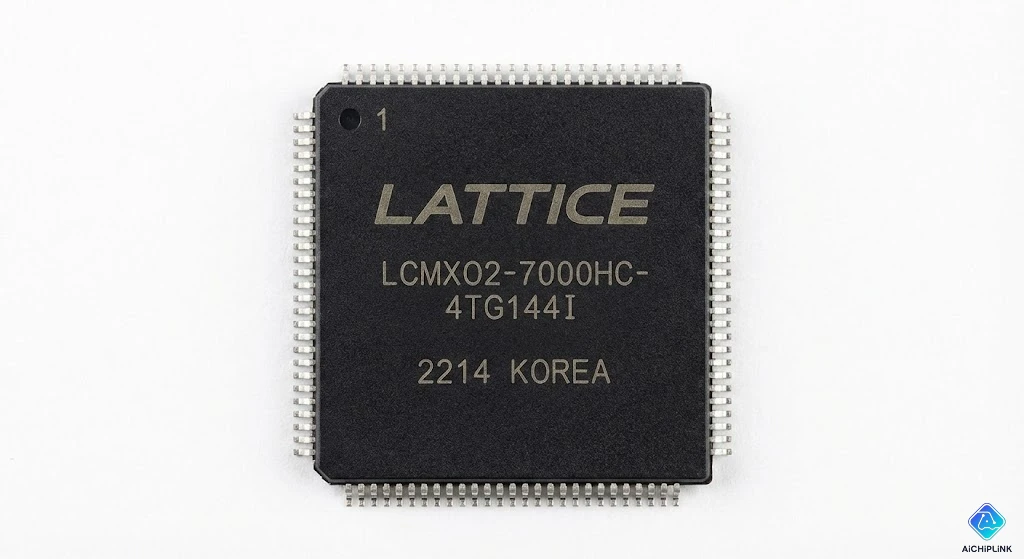
In the FPGA world, you usually have to choose between two extremes:
- Small & Easy: Low density CPLDs in easy-to-solder packages (like TQFP).
- Big & Complex: High density FPGAs in difficult BGA packages requiring multi-layer boards.
The Lattice LCMXO2-7000HC-4TG144I breaks this rule.
It packs a massive 6864 LUTs (Logic Look-Up Tables) into a simple, reworkable TQFP-144 package. This makes it a "Unicorn" component—powerful enough for real DSP and Soft-Core processors, but simple enough to hand-solder on a 2-layer prototype board.
This guide explores why this specific part number is a favorite among industrial designers and how to use it effectively.
Table of Contents
- 1. Decoding the Part Number
- 2. Technical Architecture: Flash & Instant-On
- 3. The "HC" Advantage: Power Simplified
- 4. Hardware Considerations: TQFP-144
- 5. Applications & Tools
- 6. Conclusion
1. Decoding the Part Number
Lattice part numbers are logical but dense. Here is the translation for LCMXO2-7000HC-4TG144I:
The Breakdown Matrix
| Segment | Code | Meaning |
|---|---|---|
| LCMXO2 | MachXO2 | Lattice's low-cost, low-power FPGA family. |
| 7000 | Density | 6864 LUTs. (This is the top end of the XO2 family). |
| HC | Performance | High Performance / High I/O. Optimized for 3.3V/2.5V operation. |
| 4 | Speed | Speed Grade 4. (Standard speed). |
| TG144 | Package | TQFP-144 (Thin Quad Flat Pack, 144 pins). 20x20mm body. |
| I | Temp | Industrial (-40°C to +100°C). |
Why this matters: Finding 7000 LUTs in a TQFP package is rare. Most competitors (like Intel Cyclone or Xilinx Spartan) force you into BGA packages once you cross the 2000-4000 LUT threshold.
2. Technical Architecture: Flash & Instant-On
Unlike SRAM-based FPGAs (which are "blank" at power-up and need an external boot ROM), the MachXO2 is Non-Volatile.
- Flash-Based: The configuration is stored internally.
- Instant-On: The device wakes up in microseconds, making it perfect for "System Supervisor" roles (e.g., managing the power-up sequence of a larger CPU).
- User Flash Memory (UFM): It includes 256 Kbits of extra flash storage. You can use this to store user data, calibration coefficients, or ID codes, saving the cost of an external EEPROM.
3. The "HC" Advantage: Power Simplified
The MachXO2 family comes in two flavors: HC and ZE. This part is HC.
| Feature | HC (This Part) | ZE (Zero Power) |
|---|---|---|
| Voltage Regulator | Integrated | External Required |
| Core Voltage ($V_{CC}$) | 3.3V or 2.5V (Single Supply) | 1.2V |
| Performance | Higher Speed | Lower Power |
| Use Case | General Purpose / Interface Bridging | Battery Powered IoT |
The Benefit: With the LCMXO2-7000HC, you can power the entire chip (Core and I/O) from a single 3.3V rail. This simplifies PCB design drastically compared to FPGAs that need 1.0V, 1.8V, and 3.3V rails simultaneously.
4. Hardware Considerations: TQFP-144
The TG144 package is the hero feature for prototyping and low-volume manufacturing.
- Reworkable: If you have a soldering fault, you can fix it with a standard iron. BGAs require X-ray inspection and expensive rework stations.
- PCB Cost: The 0.5mm pitch allows for cheaper PCB manufacturing rules (often compatible with 2-layer or 4-layer boards).
- I/O Count: You get 114 User I/Os. This is a fantastic I/O-to-Size ratio, allowing for wide parallel buses or controlling 40+ stepper motor drivers.
5. Applications & Tools
Software: You design for this chip using Lattice Diamond software. It is free (with license request) and stable.
Key Use Cases:
- Motor Control: With 7000 LUTs, you can implement multiple Field Oriented Control (FOC) loops.
- Glue Logic Replacement: Replace 20 different logic gate chips (buffers, ANDs, flip-flops) with this single chip to save board space.
- Display Driving: Driving LED matrices or interfacing with legacy LCD screens using the high I/O count.
6. Conclusion
The Lattice LCMXO2-7000HC-4TG144I is the "Swiss Army Knife" of the FPGA world. It offers high logic density, non-volatile storage, and single-supply operation, all wrapped in a user-friendly TQFP package. For industrial designs requiring robust 3.3V logic and ease of assembly, it remains unbeatable.
Sourcing Lattice FPGAs Need to secure stock for your production run? Visit Aichiplink.com to check inventory for LCMXO2-7000HC and other MachXO2 devices.

Written by Jack Elliott from AIChipLink.
AIChipLink, one of the fastest-growing global independent electronic components distributors in the world, offers millions of products from thousands of manufacturers, and many of our in-stock parts is available to ship same day.
We mainly source and distribute integrated circuit (IC) products of brands such as Broadcom, Microchip, Texas Instruments, Infineon, NXP, Analog Devices, Qualcomm, Intel, etc., which are widely used in communication & network, telecom, industrial control, new energy and automotive electronics.
Empowered by AI, Linked to the Future. Get started on AIChipLink.com and submit your RFQ online today!
Frequently Asked Questions
1. What makes the LCMXO2-7000HC unique among FPGAs?
It offers nearly 7000 LUTs in a TQFP-144 package, avoiding complex BGA designs.
2. Does the LCMXO2-7000HC require external configuration memory?
No. It is flash-based and non-volatile, so it powers up instantly without an external ROM.
3. What power supply does this FPGA need?
The HC version can run on a single 3.3V or 2.5V supply, simplifying power design.
4. Is the TQFP-144 package suitable for prototyping?
Yes. It is easy to solder, reworkable, and compatible with low-cost PCB fabrication.
5. What software is used to program the LCMXO2-7000HC?
It is programmed using Lattice Diamond, which is free to download from Lattice.