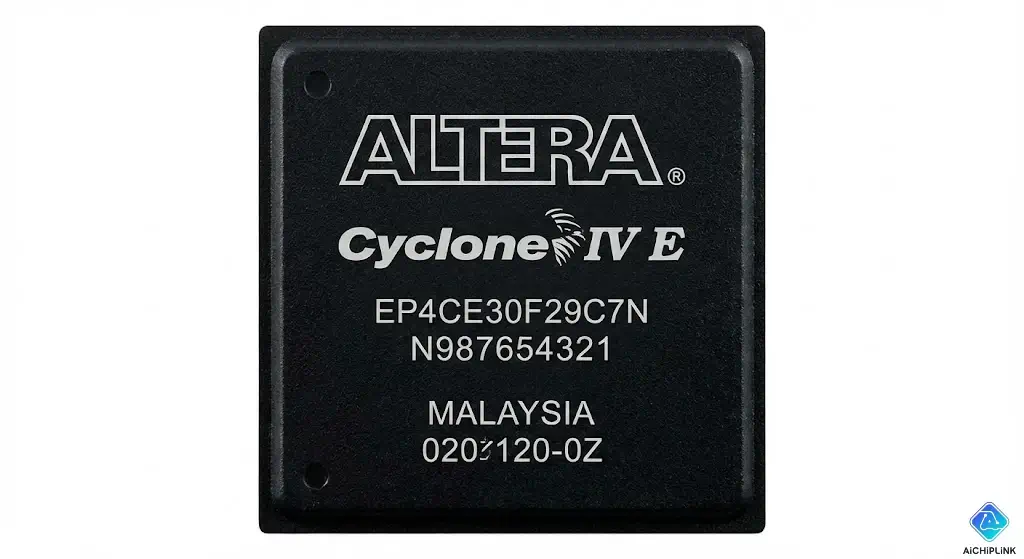
In the FPGA world, you often have to choose between logic density (Compute) and connectivity (I/O). Usually, if you need 500+ pins, you are forced to buy an expensive high-end chip with massive logic capacity you don't actually need.
The Intel (Altera) EP4CE30F29C7N is the exception to this rule.
As part of the cost-optimized Cyclone® IV E family, this device pairs a moderate logic fabric (~30k LEs) with a massive 780-pin FBGA package. This results in a staggering 532 User I/Os, making it the ultimate choice for system bridging, I/O expansion, and multi-axis control where connectivity is king.
This guide decodes its specs, explains the power requirements, and highlights why it remains a favorite for industrial designs.
Table of Contents
- 1. Decoding the Part Number
- 2. Technical Specifications: The I/O Powerhouse
- 3. Why Choose the F29 Package?
- 4. Software & Development Tools
- 5. Hardware Design: Power & PCB
- 6. Conclusion
1. Decoding the Part Number
Altera part numbers are logical and descriptive. Here is the breakdown for EP4CE30F29C7N:
The Breakdown Matrix
| Segment | Code | Meaning |
|---|---|---|
| EP4C | Cyclone IV | The 4th Generation Low-Cost Family. |
| E | Variant | Enhanced Logic (No Transceivers). Optimized for general logic and I/O. |
| 30 | Density | 28,848 Logic Elements (approx. 30k). |
| F29 | Package | FBGA-780. The "29" refers to the 29mm x 29mm body size. |
| C | Temp | Commercial (0°C to 85°C). |
| 7 | Speed | Speed Grade 7 (Mid-range speed). |
| N | RoHS | Lead-Free (RoHS Compliant). |
Procurement Tip: [Check Stock for EP4CE30F29C7N at Aichiplink] to find verified inventory. This part is widely used in industrial equipment, so stock is generally stable.
2. Technical Specifications: The I/O Powerhouse
The EP4CE30 is balanced specifically for "connectivity-first" applications.
- Logic Elements (LEs): 28,848. Enough for soft-core processors (Nios II) and complex state machines.
- Embedded Memory: 594 Kbits (distributed in M9K blocks).
- Multipliers: 66 Embedded Multipliers (18 x 18). Suitable for basic DSP like motor control loops or audio filtering, though not designed for heavy AI loads.
- PLLs: 4 Phase-Locked Loops for clock management.
- User I/Os: 532. This is the headline feature.
Who needs 532 Pins?
- Test Equipment: Connecting to hundreds of probe points in Automated Test Equipment (ATE).
- LED Video Walls: Driving massive arrays of parallel LED data lines.
- Industrial Hubs: Aggregating signals from dozens of legacy sensors. Note: Since Cyclone IV is natively 3.3V max, 5V tolerance requires external limiting resistors or bus switches.
3. Why Choose the F29 Package?
Most 30k LE FPGAs come in smaller 256-pin or 484-pin packages to save space. The F29 (780-pin) package is unique because it unlocks the full I/O potential of the silicon die.
- EP4CE30 in F484: Only ~328 I/Os accessible.
- EP4CE30 in F29: 532 I/Os accessible.
Trade-off: The 780-pin BGA requires a more complex PCB (likely 6+ layers) to route all the signals out, compared to simpler packages.
4. Software & Development Tools
The good news for budget-conscious engineers: You don't need a license.
- Software: Intel Quartus Prime Lite Edition.
- It is free to download and use.
- Fully supports the Cyclone IV family.
- Simulation: ModelSim-Intel FPGA Starter Edition.
- Programming: Standard USB-Blaster (or compatible clone) via JTAG or Active Serial (AS) headers.
5. Hardware Design: Power & PCB
Designing with the EP4CE30F29C7N requires careful attention to power rails.
- Core Voltage ($V_{CCINT}$): 1.2 V. This must be a clean, stable rail capable of handling current spikes during switching.
- I/O Voltage ($V_{CCIO}$): The I/O banks are split. You can run Bank 1 at 3.3V, Bank 2 at 2.5V, and Bank 3 at 1.8V simultaneously to interface with different chips.
- Configuration: Uses Active Serial (AS) with an EPCS/EPCQ flash memory device for boot-up.
- PCB Layout: The 780-pin BGA has a 1.0mm pitch. While not "fine pitch" (0.8mm or less), routing 500+ signals requires careful stack-up planning to avoid crosstalk.
6. Conclusion
The Intel EP4CE30F29C7N is a specialized tool in the engineer's kit. It isn't for high-performance computing (use a Stratix for that), but for applications that need to talk to everything at once. Its massive I/O count, combined with the low-cost Cyclone IV architecture and free software support, makes it the gold standard for high-density interface bridging.
Sourcing Cyclone IV FPGAs Need to build a high-connectivity prototype? Visit Aichiplink.com to search for the EP4CE30F29C7N and compatible EPCS configuration memory.

Written by Jack Elliott from AIChipLink.
AIChipLink, one of the fastest-growing global independent electronic components distributors in the world, offers millions of products from thousands of manufacturers, and many of our in-stock parts is available to ship same day.
We mainly source and distribute integrated circuit (IC) products of brands such as Broadcom, Microchip, Texas Instruments, Infineon, NXP, Analog Devices, Qualcomm, Intel, etc., which are widely used in communication & network, telecom, industrial control, new energy and automotive electronics.
Empowered by AI, Linked to the Future. Get started on AIChipLink.com and submit your RFQ online today!
Frequently Asked Questions
What is the main advantage of the EP4CE30F29C7N?
Its biggest advantage is the very high I/O count (532 user I/Os) combined with moderate logic density, making it ideal for I/O-centric system designs.
Does the EP4CE30F29C7N support high-speed serial transceivers?
No. The Cyclone IV E family does not include SerDes. It supports standard I/O interfaces such as LVCMOS, LVTTL, and LVDS.
Is a paid Quartus license required?
No. The device is fully supported by Intel Quartus Prime Lite Edition, which is free to use.
What PCB considerations are required for the F29 (780-pin) package?
A 6-layer or higher PCB is recommended to properly route the large number of I/Os and ensure power integrity.
Is the EP4CE30F29C7N 5V tolerant?
No. The maximum I/O voltage is 3.3V. External level shifting or current-limiting solutions are required for 5V interfaces.