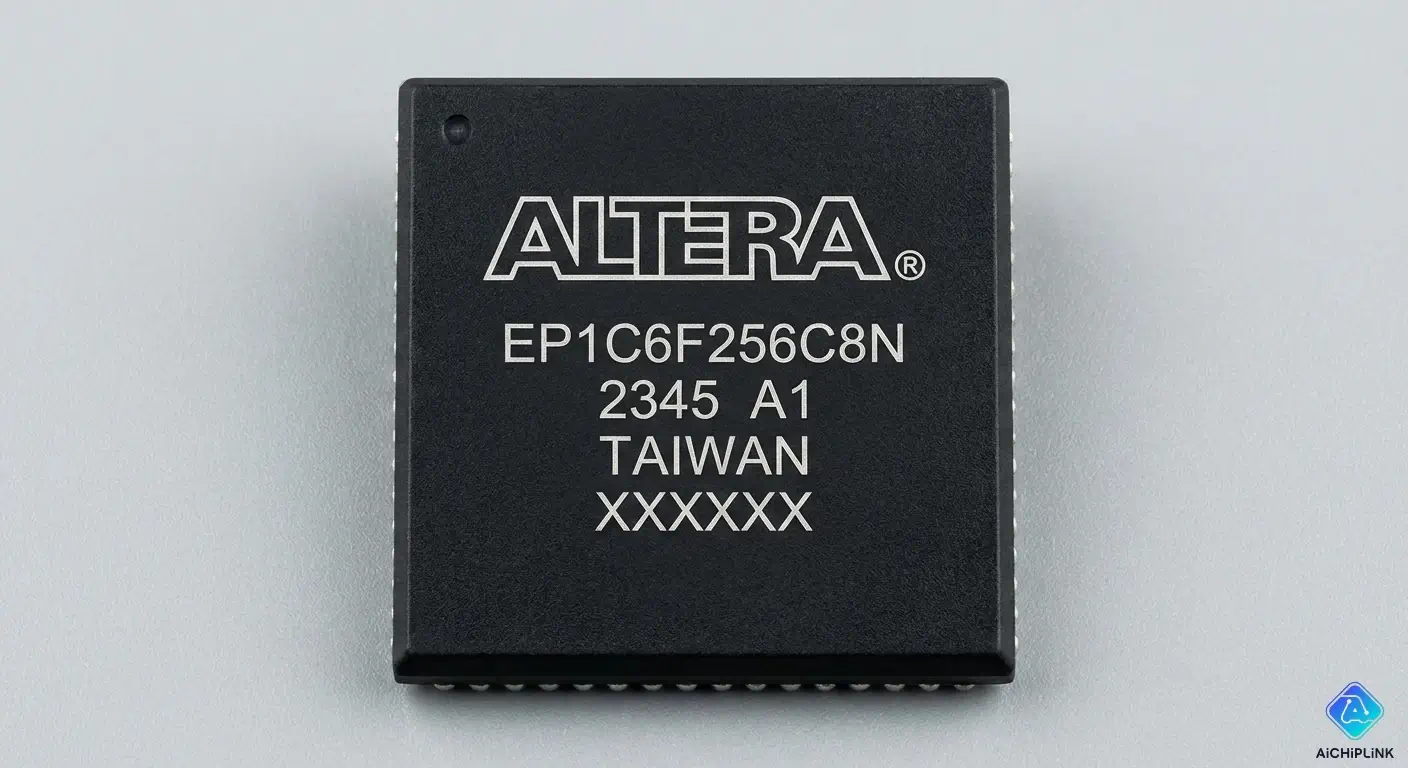
Before Intel acquired Altera, and before FPGAs were commonplace in every maker's toolkit, there was the Cyclone® I.
The EP1C6F256C8N is the quintessential "Low-Cost FPGA." Launched in the early 2000s, it revolutionized the industry by offering substantial logic density at a price point that made sense for high-volume consumer electronics.
While it is now considered a "Legacy" or "Obsolete" part, thousands of industrial controllers, medical devices, and university lab kits still run on this silicon. If you need to repair an old board or maintain a legacy design, this guide covers everything you need to know.
Table of Contents
- 1. Decoding the Part Number: The Legend Begins
- 2. Technical Specifications: 6K LEs of Power
- 3. Software Compatibility: The Quartus Trap
- 4. Hardware Design: Handling the F256 Package
- 5. Upgrade Path: Moving to Cyclone IV
- 6. Conclusion
1. Decoding the Part Number: The Legend Begins
Altera part numbers are highly structured. Here is the breakdown for EP1C6F256C8N:
The Breakdown Matrix
| Code Segment | Meaning | Detail |
|---|---|---|
| EP1C | Cyclone I | The first generation of Altera's low-cost family. |
| 6 | Density | 5,980 Logic Elements (often referred to as "6K"). |
| F | Package Type | FineLine BGA (Ball Grid Array). |
| 256 | Pin Count | 256 Pins (1.0mm pitch). |
| C | Temp Grade | Commercial (0°C to 85°C). |
| 8 | Speed Grade | -8 (Slowest). Note: -6 and -7 are faster variants. |
| N | RoHS | Lead-Free (None-Leaded). |
Legacy Status
This chip is officially Obsolete (EOL). However, due to its massive install base, it is still actively traded in the broker market.
Procurement Tip: Be wary of refurbished chips (sanded tops). [Check Stock for Genuine EP1C6F256C8N at Aichiplink] to verify provenance.
2. Technical Specifications: 6K LEs of Power
For its time, the EP1C6 was a powerhouse. Even today, it is capable of handling complex state machines, simple soft-core processors (Nios II Economy), and extensive glue logic.
- Logic Elements (LEs): 5,980
- M4K RAM Blocks: 20 blocks (Total 92,160 bits)
- PLLs (Phase Locked Loops): 2 (Great for clock multiplication)
- Global Clocks: 8
- Core Voltage ($V_{CCINT}$): 1.5V
- I/O Voltage ($V_{CCIO}$): 3.3V, 2.5V, 1.8V (LVDS support is limited compared to newer families).
The 1.5V Requirement
Unlike modern FPGAs that run on 1.2V or 1.0V, the Cyclone I requires a robust 1.5V regulator for its core logic. Do not feed it 1.2V, or it will not configure.
3. Software Compatibility: The Quartus Trap
This is the #1 issue engineers face with the EP1C6.
Modern software DOES NOT support this chip. If you download the latest "Quartus Prime Lite" (v20+), you will not find the Cyclone I in the device list. Intel dropped support for Cyclone I years ago to reduce the installer size.
The Solution: You must download Quartus II Web Edition 13.0 Service Pack 1 (13.0sp1).
- This is the last version to support the Cyclone I family.
- It is available for free on the Intel FPGA website (look in the "Legacy Archives").
- It works on Windows 7 and Windows 10 (compatibility mode may be required for the USB-Blaster driver).
4. Hardware Design: Handling the F256 Package
The F256 is a FineLine BGA package with a 1.0mm ball pitch.
- PCB Layout: You typically need a 4-layer PCB to route the signals out from the inner balls. 2-layer boards are extremely difficult to route for this package unless you only use the outer rings of pins.
- Configuration: The EP1C6 is volatile (SRAM based). It loses its configuration when power is lost. You need an external configuration chip.
- EPCS1 or EPCS4 (Active Serial) are the standard companions.
- JTAG: Always break out the 10-pin JTAG header for debugging with a USB-Blaster.
5. Upgrade Path: Moving to Cyclone IV
If you are designing a new product, do not use the EP1C6. It is expensive and power-hungry by modern standards. Use the Cyclone IV E family instead.
Recommended Replacement: EP4CE6F17C8N
- Family: Cyclone IV E.
- Logic: ~6,000 LEs (Similar capacity).
- Package: F256 (Same pin count, but NOT pin compatible).
- Voltage: 1.2V Core (Lower power consumption).
- Price: Significantly cheaper and readily available.
6. Conclusion
The Intel/Altera EP1C6F256C8N holds a special place in FPGA history. While it requires older software (Quartus II 13.0) and a specific 1.5V power rail, it remains a capable device for maintaining legacy industrial systems. For new designs, however, looking to the Cyclone IV or Cyclone 10 series will provide better performance per watt.
Sourcing Legacy Altera Chips Need to repair an old industrial controller? Visit Aichiplink.com to search for hard-to-find Cyclone I FPGAs and EPCS configuration memories.

Written by Jack Elliott from AIChipLink.
AIChipLink, one of the fastest-growing global independent electronic components distributors in the world, offers millions of products from thousands of manufacturers, and many of our in-stock parts is available to ship same day.
We mainly source and distribute integrated circuit (IC) products of brands such as Broadcom, Microchip, Texas Instruments, Infineon, NXP, Analog Devices, Qualcomm, Intel, etc., which are widely used in communication & network, telecom, industrial control, new energy and automotive electronics.
Empowered by AI, Linked to the Future. Get started on AIChipLink.com and submit your RFQ online today!
Frequently Asked Questions
Is the EP1C6F256C8N still in production?
No. The EP1C6F256C8N is officially obsolete (EOL), but it is still available through legacy and broker markets.
Which Quartus version supports EP1C6F256C8N?
Only Quartus II Web Edition 13.0 SP1 supports Cyclone I devices. Newer Quartus Prime versions do not.
What core voltage does the EP1C6 require?
The core voltage ($V_{CCINT}$) is 1.5V. Using 1.2V will prevent the FPGA from configuring.
Does EP1C6F256C8N need external configuration memory?
Yes. It is an SRAM-based FPGA and requires external configuration devices such as EPCS1 or EPCS4.
What is the recommended modern replacement?
For new designs, Cyclone IV E (EP4CE6 series) is the closest functional replacement with lower power consumption and better availability.