Battery Monitor IC Selection for Industrial ESS
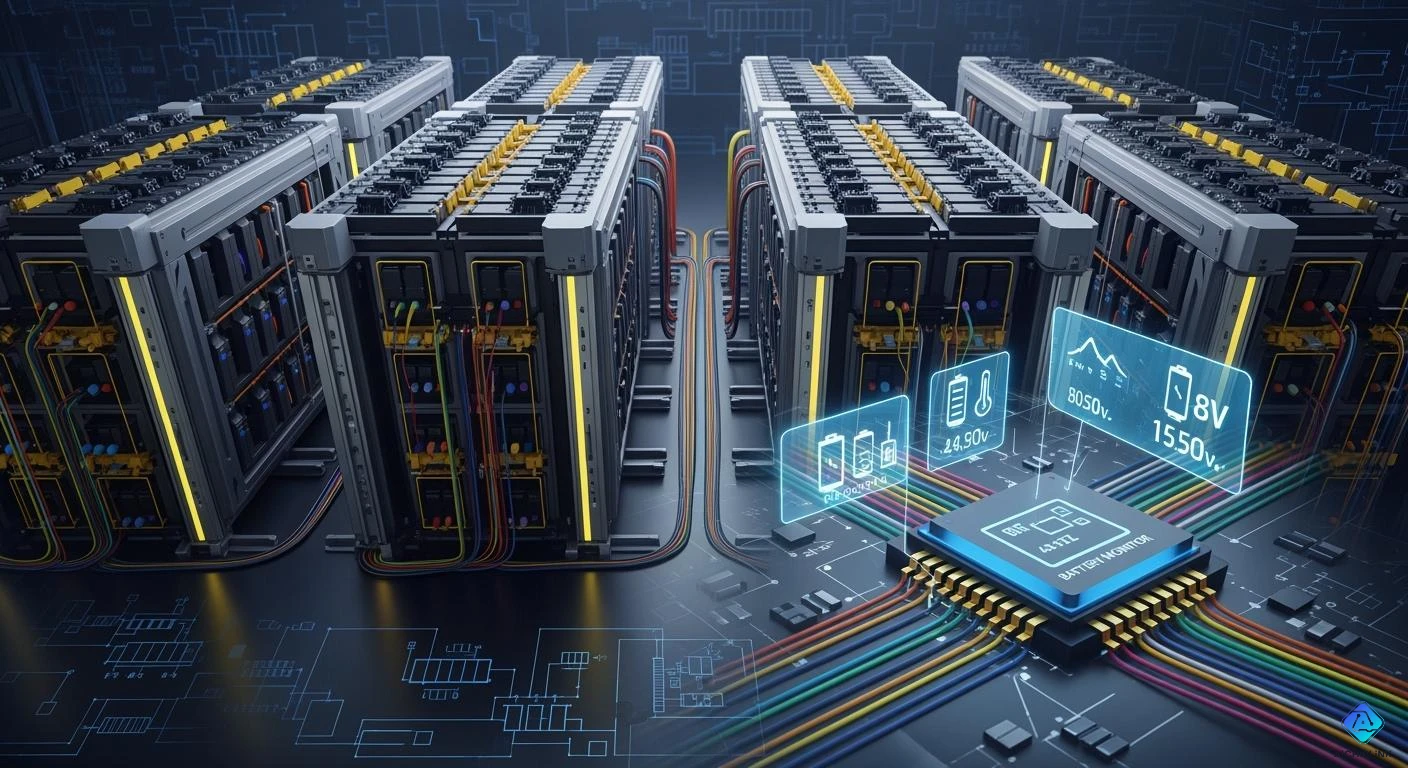
You need to look at important things when picking a Battery Monitor IC for industrial energy storage systems. Measurement accuracy is the most important thing. A high-accuracy IC helps stop overcharging and over-discharging. This keeps batteries safe and can make them last up to 30% longer. If readings are wrong, fires or short circuits can happen. Bad readings can also make batteries last less than half as long. You should also think about scalability, safety features, battery chemistry compatibility, and communication protocols. These choices help you make systems that last longer, work well, and stay safe.
Key Takeaways
-
Accurate measurement is very important. It stops batteries from getting too full. This helps batteries last longer, sometimes up to 30% more.
-
Pick a Battery Monitor IC that works with your battery type. When they match, the system works safely and well.
-
Make sure your IC can grow with your needs. A scalable IC lets you add more batteries later. You do not need to change the whole system.
-
Safety features matter most. Good ICs protect against getting too hot or too full. This keeps the system safe from harm.
-
Use strong communication methods. CAN or RS485 help send data well. They also help connect parts of the system easily.
Battery Monitor IC Selection Criteria
Measurement Accuracy & Resolution
You need a Battery Monitor IC that shows the voltage for each cell. Accurate readings help you stop overcharging or over-discharging. These problems can hurt batteries or cause safety issues. High resolution lets you notice small voltage changes. This helps you find problems early and keep your system safe.
Tip: Accurate cell monitoring makes batteries last longer and saves money on repairs.
Here are the industry standards for measurement accuracy and resolution:
| Feature | Specification |
|---|---|
| Measurement Accuracy | Maximum 0.033% error |
| Resolution | 16-bit |
| Measurement Time for 12 cells | 290μs |
You should check if the Battery Monitor IC works with your battery chemistry. Some ICs work with lithium-ion. Others work with lead-acid or other types. Make sure the IC fits your battery’s voltage and charging needs.
Scalability & Channel Count
Industrial energy storage systems use many battery cells. You need a Battery Monitor IC that can handle enough channels. Some ICs support 7 cells. Others can monitor up to 16 cells or more. The right channel count helps you build bigger systems or add more cells later.
| IC Model | Supported Channels | Voltage Measurement Accuracy | Notes |
|---|---|---|---|
| TI BQ79616 | Up to 16 | ±1.25mV | High-precision battery management |
| ADI LTC6811-1 | Up to 12 | Under 1.2mV | Exceptional precision |
| NXP MC33771C | 14 | 0.8mV | Ideal for energy storage systems |
| MP2797 | 7 to 16 | N/A | SPI or I2C communication |
| JoulWatt JW3376 | 16 | N/A | Designed for precise battery monitoring |
| Nuvoton BM-IC | N/A | N/A | Daisy-chain communication with high speed |
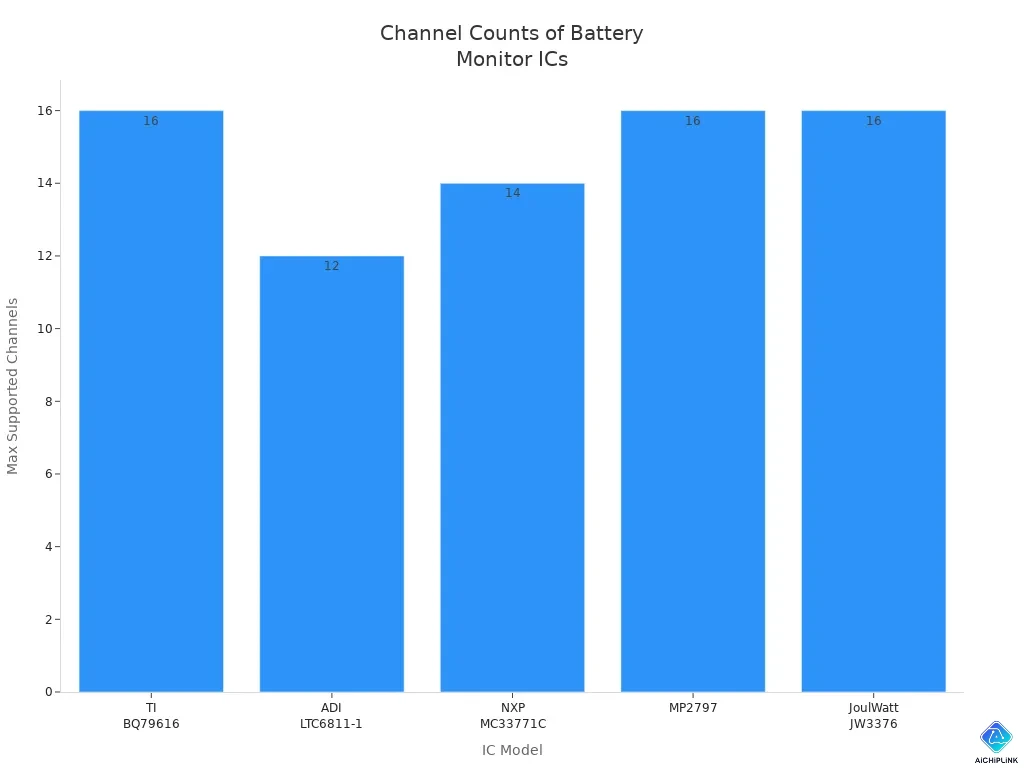
A scalable Battery Monitor IC lets you:
-
Build systems for different project sizes.
-
Add more battery capacity as your needs grow.
-
Replace parts without changing the whole system.
You should check how the IC gets power. Some ICs use power from the battery stack. Others need a separate supply. Stackable designs can support systems up to 1,500V. This is important for big industrial setups.
Safety & Protection
Safety is very important in industrial energy storage. A good Battery Monitor IC has features that protect your system and people. These features help you avoid fires, overheating, and battery damage.
| Safety Feature | Description |
|---|---|
| Overcharge Prevention | Monitors battery charge levels to prevent exceeding safe limits, reducing the risk of damage. |
| Thermal Management | Utilizes sensors to detect heat and prevent conditions that could lead to thermal runaway. |
| Compliance with Safety Standards | Ensures that the battery management system meets industry safety regulations for hazardous environments. |
Look for these safety features:
-
Thermistors and temperature sensors to spot overheating.
-
Automatic control to slow or stop charging if the battery gets too hot.
-
Real-time monitoring to catch faults before they cause problems.
Note: Real-time safety monitoring helps you avoid downtime and keeps your system running well.
Communication & Integration
You need a Battery Monitor IC that connects to your battery management system (BMS) using reliable communication protocols. The most common protocols are RS485 and CAN.
| Protocol | Distance | Speed | Topology | Role in BMS |
|---|---|---|---|---|
| CAN | 10–40 meters at 1Mbps; up to hundreds of meters at lower bit rates | Up to 1Mbps | Multi-master, Bus | Primary BMS communication |
| RS485 | 1200 meters at low speed(100 kbps) | Up to 10Mbps | Half-duplex, Bus | External BMS communication |
RS485 works well for long distances and noisy places. CAN is good for real-time communication between many devices. Both protocols help you collect data, control charging, and keep your system safe.
A well-integrated Battery Monitor IC lets you:
-
Track voltage, current, and temperature in real time.
-
Use smart algorithms to predict battery health.
-
Schedule maintenance before problems happen.
-
Balance cells and manage charging cycles for longer battery life.
You should check if the IC fits your system’s design, like daisy-chain or CAN-based setups. This makes it easier to expand or upgrade your energy storage system.
Battery Monitor IC Comparison
Leading ICs Overview
There are many Battery Monitor ICs used in big energy storage systems. LTC6804 gives very accurate readings and steady voltage checks. It uses a buried-Zener reference and a delta-sigma converter with filters you can pick. This setup helps you get good readings even when there is noise. Nuvoton BM-IC lets you use daisy-chain communication and move data fast. TI BQ79616 and ADI LTC6811-1 can watch many cells and have strong integration features. These ICs help you keep track of lots of cells and keep your system safe.
Pros & Cons
Every Battery Monitor IC has good points and bad points. You need to choose what fits your project best.
| Feature | CAN Bus Architecture | isoSPI Architecture |
|---|---|---|
| Components Required | CAN transceiver, microprocessor, isolator | Simple transformer, single twisted pair |
| Wiring Complexity | Four wires | Two wires |
| Noise Immunity | Needs extra filtering | High noise immunity |
| System Integration | Standardized, works with other CAN subsystems | Proprietary, only with same-type devices |
| Weight and Complexity | Adds weight and complexity | Reduces weight and complexity |
| Cost | Higher | Lower |
| Data Rate | Not specified | Up to 1 Mbps |
| Module Connectivity | Parallel connection | Daisy-chain connection |
isoSPI makes wiring easier, lowers weight, and costs less. CAN bus gives you standard integration and works with other systems. LTC6804 keeps your system safe and reliable with good measurements and less noise. You can put battery modules in different places and collect data at the same time for better battery health checks.
Application Suitability
You need to think about what your system needs before picking a Battery Monitor IC. Off-the-shelf solutions work well if your project matches standard products. Custom BMS designs are good for special needs, like unique cell chemistry or voltage ranges. You should look at balancing strategies and how the IC fits in. If your system needs high accuracy and noise immunity, LTC6804 is a good choice. For big setups with flexible module placement, Nuvoton BM-IC or isoSPI architectures help you grow your system easily. Always check if the IC fits your battery type and how it communicates.
Tip: Pick an IC with features that match your system’s size, chemistry, and safety needs for the best results.
Industrial ESS Considerations
Environmental Robustness
You need a battery monitor IC that works in tough places. Big changes in temperature can make your system act differently. Many ICs must work from -40°C to +85°C, and some go up to +125°C. Humidity can let water get inside, so you need to keep out water and dust. Vibration is a problem if your system moves or is near big machines. Electromagnetic interference can also cause trouble. You want an IC that keeps working even with lots of electrical noise.
To keep your battery monitor IC working well, look for these things:
-
Thermal management stops overheating and helps the IC last longer.
-
Protection circuits keep out voltage spikes and high currents.
-
Strong materials and good packaging fight heat, water, and shaking.
-
Self-tests and smart checks help you find problems early.
-
Power management saves energy and helps the IC work better.
Compliance & Certification
You have to follow strict rules when you build industrial energy storage systems. These rules keep your system safe and help you avoid expensive recalls. About 30% of battery recalls happen because the battery management system does not meet the rules. You should check for these certifications:
-
Electrical safety (CE or UL)
-
Battery safety (IEC 62619, IEC 63056, or UL 9540)
-
Transport safety (UN 38.3)
-
Grid-code compliance for utility use
Rules help you pick and use battery monitor ICs. They make sure your system is safe, works well, and is ready for real use.
Cost vs. Performance
Advanced battery monitor ICs may cost more at first. These ICs use less power and take up less space. Over time, they help you save money, especially if you build many systems. Cheaper controllers may seem good, but they often need more parts and can cost more later. Good ICs lower your risk of warranty claims and problems in the field.
"When it comes to accuracy, and accuracy over the vehicle lifetime, there are no trade-offs," said Mike Kultgen, general manager of BMS, ADI. "The better the accuracy, the better you can understand the state of the battery cell, the more capacity you can extract out of it, the more reliable the battery pack will operate."
You should balance cost and performance. A good IC gives you longer battery life, fewer repairs, and more value over time.
Implementation Tips
BMS Integration
You must connect your battery monitor IC to the BMS carefully. Good integration keeps your system safe and reliable. Always follow industry standards so your setup works well.
| Standard | Focus Area |
|---|---|
| IEC 62619 | Lithium-ion battery safety, thermal management, and electrical protection |
| UL 1973 | Safety for energy storage, fire resistance, and environmental durability |
| IEC 61508 | Functional safety and risk assessment |
| IEC 61000 series | Electromagnetic compatibility in high-interference environments |
Use secure ways to send information. Add authentication protocols and encrypted channels for protection. Intrusion detection systems and secure gateways help keep your network safe. Multi-factor authentication and role-based access control stop people who should not get in. Update firmware often with secure boot and encrypted updates.
Real-time monitoring and anomaly detection help you spot cyberattacks early. These systems look for strange patterns and alert you if something is wrong. Machine learning can find hidden threats that older systems might miss.
Tip: Good integration protects your data and helps batteries last longer.
Maintenance & Diagnostics
You need to keep your battery monitor IC working well for a long time. Regular checks and smart diagnostics help you find problems early.
| Feature | Description |
|---|---|
| Thermal Management | Prevents overheating with sensors, heat sinks, and control algorithms |
| Protection Circuits | Guards against electrical stress with voltage clamps and current limiters |
| Power Supply Design | Keeps operation stable with voltage regulators and filtering circuits |
| Diagnostic Capabilities | Monitors health and predicts failures with built-in test circuits and monitoring algorithms |
| Power Management | Reduces energy loss and stress with adaptive switching and voltage scaling |
You should always watch voltage, current, and temperature. Advanced circuits help you spot overvoltage, short circuits, and overheating. Communication checks make sure data stays correct. Cell balancing keeps batteries healthy. Self-diagnostics find faults inside the IC.
| Feature | Contribution to Predictive Maintenance |
|---|---|
| State Estimation Algorithms | Show battery charge, health, and life for early failure detection |
| Multi-Parameter Sensing | Tracks voltage, current, temperature, and resistance for full fault detection |
| Advanced Fault Detection | Finds safety hazards and performance issues in real time |
| Communication Protocols | Allow remote monitoring and fast response to problems |
Note: Smart diagnostics and predictive maintenance help you avoid downtime and expensive repairs.
You can pick the best Battery Monitor IC for your industrial ESS by thinking about accuracy, safety, and how well it fits your system. Make sure the IC’s features match what your project needs. Use parts that are trusted and have good instructions to help you work faster and make fewer mistakes. The checklist below helps you check each important thing before you choose:
| Key Considerations | Details |
|---|---|
| BMS Architecture Decisions | Pick standard ICs to finish your project faster and skip waiting for custom firmware |
| Communication Interface | Choose I2C or another protocol that works with your system and helps you build quicker |
| Component Selection | Use parts that are easy to find and still being made |
| Thermal Design | Put in a PTC thermostat to keep things safe at 55°C |
| Development Approach | Use trusted parts to make designing easier |
| Component Strategy | Pick ICs that have lots of instructions and help |
Tip: Look at this checklist before you pick your battery monitor IC so your ESS will be safe and work well.

Written by Jack Elliott from AIChipLink.
AIChipLink, one of the fastest-growing global independent electronic components distributors in the world, offers millions of products from thousands of manufacturers, and many of our in-stock parts is available to ship same day.
We mainly source and distribute integrated circuit (IC) products of brands such as Broadcom, Microchip, Texas Instruments, Infineon, NXP, Analog Devices, Qualcomm, Intel, etc., which are widely used in communication & network, telecom, industrial control, new energy and automotive electronics.
Empowered by AI, Linked to the Future. Get started on AIChipLink and submit your RFQ online today!
Frequently Asked Questions
What is the most important feature in a battery monitor IC?
You should care most about measurement accuracy. Good accuracy keeps batteries safe and helps them last longer. It also saves money by stopping repairs and system downtime.
How do I know if an IC supports my battery chemistry?
Look at the datasheet to see what chemistries the IC works with. Most ICs say if they work with lithium-ion, lead-acid, or other types. You need to pick an IC that matches your battery so it works safely and well.
Why does communication protocol matter?
The protocol is how your system sends and gets data. CAN and RS485 are used a lot. Pick one that fits your system’s size and how much noise is around. Good communication helps keep batteries safe.
Can I upgrade my system later with more cells?
Yes, if you choose a scalable IC. Some models let you daisy-chain or stack more cells. This means you can add cells without changing everything else.