Air Quality Sensor Types Explained for Cleaner Air
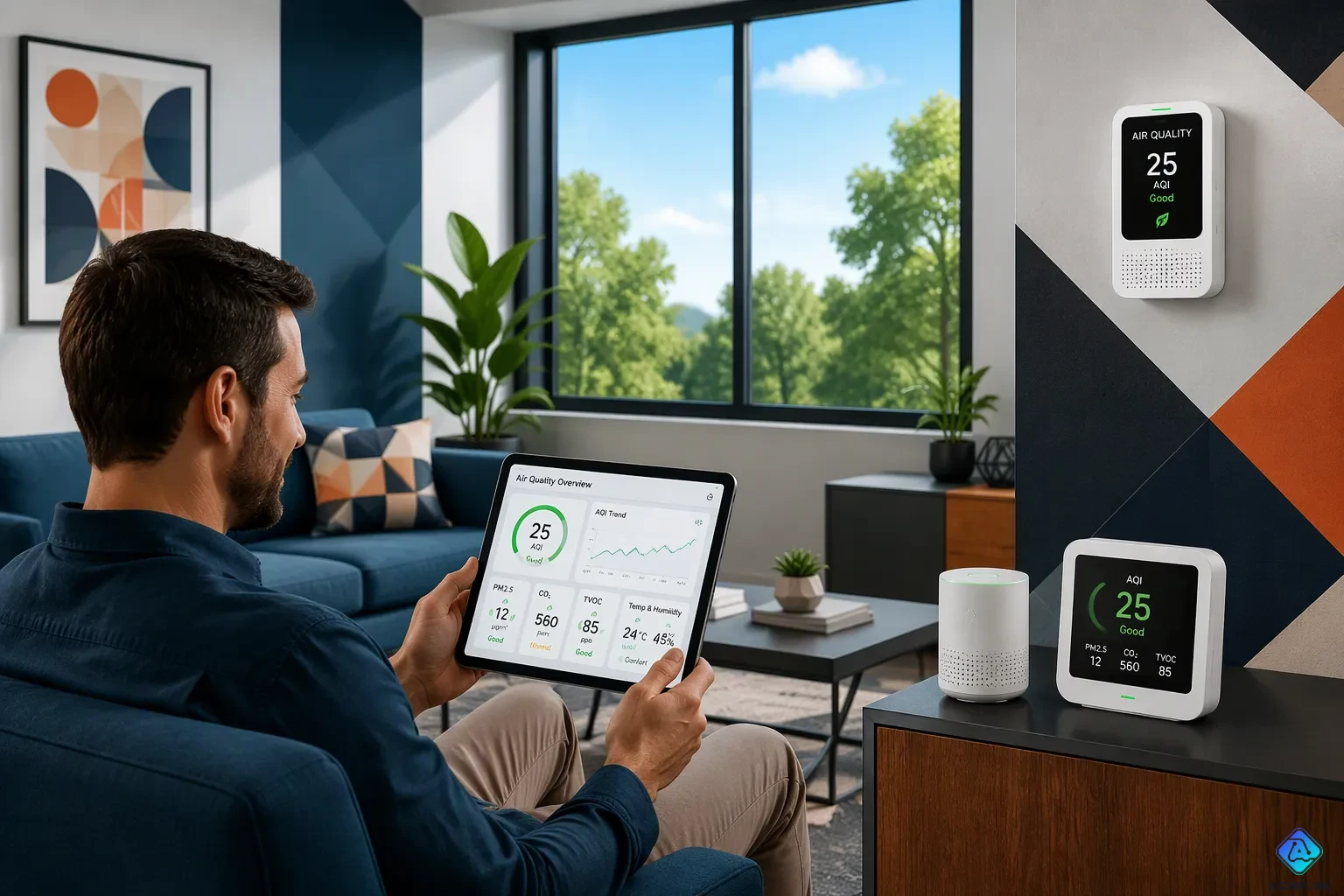
You will find four main air quality sensor types: laser scattering, electrochemical, thermal conductivity, and optical sensors. These fit into four device groups: reference-grade, low-cost, mobile, and satellite.
Each of these air quality sensor types targets certain pollutants. Particulate sensors track sizes from PM1 to PM10. Gas sensors track NO2, O3, SO2, and CO. Urban pm2.5 levels change a lot. Yearly averages in five Colombian cities ranged from 12.93 to 16.12 µg/m³. The right match matters.
Matching the sensor type to your goal is the key to cleaner air. This comparison helps you choose or combine air quality sensors for your own air quality monitoring needs.
Key Takeaways
-
Four main sensor types measure air pollution: laser scattering, electrochemical, thermal conductivity, and optical sensors.
-
Reference-grade monitors give the most accurate data for meeting regulations, but they cost $15,000 to $40,000 upfront.
-
Low-cost sensors give you low-priced, real-time readings for home and community use. But treat them as a guide, not a final answer.
-
Mobile and satellite monitoring help cover areas that lack sensors. But they work best when paired with ground-based sensors.
-
Pick a sensor that fits your goal, budget, and accuracy needs, and think about mixing sensor types to get a fuller picture.
Air Quality Sensor Types by Technology
Laser Scattering and Optical Sensors
Laser scattering and optical sensors count particles in the air and measure their size. The process follows a clear order:
-
A tiny nozzle pulls sampled air into a dark optical chamber. This chamber holds a light source (LED or laser), lenses, a detector, and a light trap.
-
Each particle in the airstream passes through the focused laser beam inside the sensing area. The particle scatters light in all directions.
-
A photodiode placed at a right angle to the laser beam detects how strong the scattered light is.
-
A pre-amplifier boosts the signal and turns it into a digital signal for processing.
-
Based on Mie scattering theory, the peak of the scattered-light signal matches particle size. This link lets the sensor work out particle count and mass concentration.
In laser-scattering particulate matter sensors like the Sensirion SPS30, a fan creates a controlled airflow. A feedback loop between the microprocessor and fan keeps it steady. Particles carried by the airflow pass through a focused laser beam at the photodiode position, which causes light scattering. The photodiode detects the scattered light and turns it into mass/number concentration output. This happens through proprietary algorithms running on the internal microcontroller.
This design makes optical sensors a common choice for pm2.5 measurement and for tracking PM1 and PM10. You get fast, real-time readings of particulate levels.
Electrochemical and Thermal Conductivity Sensors
Electrochemical sensors detect gases through a chemical reaction at an electrode. Air passes over electrochemical cells, and the cell produces a resistance or voltage change. The device turns that change into an estimated concentration. The CairClip NO2/O3 sensor, for example, draws a controlled airflow over a single electrochemical cell that responds to both NO2 and O3. So isolating one pollutant requires a separate measurement in field tests. Oxidative gas sensors show a strong linear relationship (R² > 0.98) between recorded voltage and target gas concentration over a wide range. These devices do drift, with a bias of up to 20% after 9 months of continuous operation. Lifespan varies: ordinary gases such as CO and H2S typically last 2–3 years, special gases such as hydrogen fluoride last only 12–18 months, and most manufacturers state a gas sensor lifespan of 2 to 5 years. Heat, humidity, and contamination can make that span shorter.
Thermal conductivity sensors work a different way. They measure how easily a gas carries heat away from a heated element. Each gas has its own thermal signature, so a shift in conductivity points to a change in gas composition. These sensors suit binary gas mixtures and stable environments better than complex outdoor air.
Low-cost air pollution monitors usually combine one or more of these sensors with other parts. Together, these parts detect, monitor, and report specific pollutants. Each technology suits different pollutants and use cases. Laser scattering fits particle tracking, while electrochemical cells fit targeted gas measurement. Neither ranks above the other; the pollutant you care about decides the fit.
Reference-Grade Air Quality Monitoring
FRM and FEM Monitors
Traditional reference-grade FRM/FEM monitors are the foundation of air quality monitoring technology. FRM means Federal Reference Method, and FEM means Federal Equivalent Method. These instruments collect or test air under very strict conditions. They measure particulate matter and gases like NO₂ and O₃ with high accuracy and reliability. Regulators see them as the benchmark, or gold standard, for air sampling. That is why they form the base of any official air quality monitoring network.
You will find these instruments in fixed shelters at carefully picked sites. They run all the time and send air quality data into compliance programs. Their precision holds up over many years of use. That reliability makes them the top choice for checking compliance with environmental standards.
Where Reference Monitors Fit Best
Reference-grade monitors are at their best in regulatory reporting and official city comparisons. Scientists also set them up at fixed sites to gather long-term records of key pollutants. A traditional FRM/FEM air quality monitoring network gives you numbers you can defend in court or in a policy debate.
The downsides are real. These air quality monitors cost a lot to buy and run. One regulatory-grade unit costs $15,000 to $40,000 upfront, and yearly operation and maintenance can go over $15,000 per year. A full station can cost much more:
Running an air quality monitoring station full of reference-grade instruments can cost $100,000–$250,000 a year or more, and it needs skilled technicians to support it.
Monitor Tier Upfront Cost per Unit Annual O&M per Unit Regulatory-grade (FRM/FEM) reference monitor $15,000 – $40,000 Can exceed $15,000 per year Reference-grade PM analyzer (BAM, TEOM) $25,000 – $60,000+ — Reference-grade gas analyzer (NO₂, O₃) $15,000 – $40,000+ — Mid-tier professional-grade $500 – $5,000 Several hundred dollars/year (if not in subscription) Low-cost consumer sensor $100 – $500 $0 – $200
Size and siting add more limits. The equipment is bulky, so it stays in one spot. You cannot carry it down a street or into a home. Still, for air quality measurement at a single official site, few options can match it. Low-cost sensors track trends well, but studies do not suggest using them to report absolute concentrations or to compare directly against standards. That gap is exactly where frm and fem equipment proves its worth.
Low-Cost Air Quality Sensors and Indoor Air Quality
Portable vs. Stationary Devices
Low-cost air quality sensors give you real-time readings for a small part of the price of reference equipment. Citizen science projects depend on them a lot. You can choose between two forms, and each one fits different habits.
| Attribute | Stationary Sensors | Portable Sensors |
|---|---|---|
| Form factor | Fixed in one place | Handheld, compact |
| Usage | Indoor and outdoor monitoring (neighborhoods, urban hotspots, schools, offices) | Monitoring while on the go, indoor and outdoor |
| Setup | Easy to set up | Easy to use |
| Connectivity | Often link to networks or apps for real-time data | Very few link to smartphones for real-time tracking |
| Power | N/A | Last several days on one charge |
Stationary low-cost air quality sensors stay in one spot and send steady air quality data to apps. Portable units go with you and run for days on one charge. Both kinds of low-cost sensors work well for air quality monitoring; your daily routine decides which one fits better.
Monitoring Indoor Air Quality at Home
Indoor air quality monitoring begins with detection. Air quality monitors sample the air and point out pollutants that may need action. Common targets include:
-
Particulate matter, including pm2.5
-
Radon and carbon monoxide
-
co₂ and formaldehyde
-
Volatile organic compounds, read by a voc sensor
-
Temperature and humidity
Multi-parameter monitors pack these readings together. Some track several environmental parameters in one device. You see pollutant levels in real time and get alerts when values rise.
The benefits are clear. Low-cost sensors are affordable, easy to get, and quick to warn you. The limits are real too. Low-cost units need calibration and are less precise than reference gear. Treat their readings as a guide, not a final answer. For indoor air quality, that guide still helps you act early. Stationary air quality monitors work well for long-term indoor air quality tracking, and portable low-cost sensors let you check any room when you need to. Together, low-cost sensors make indoor air quality visible to anyone.
Mobile Air Quality Monitoring and Satellites
Mobile Monitoring on the Move
Mobile air quality monitoring puts sensors on cars, bikes, and backpacks. These mobile air quality sensors collect detailed, real-time readings as you move through a city. You can see how pollution levels change from block to block and hour to hour. This method shows where pollution builds up, like busy roads and industrial areas, and when peaks happen.
Repeated high readings at the same spots point to local hotspots. In a Krakow case study, a mobile car system often recorded elevated PM10 at the same locations, including Zabierzów, the Vistula riverbed near Liszki and Piekary, and Skawina. Those hotspots matched areas with the most unreplaced solid fossil fuel furnaces. A validated car system maps multiple pollutants across a much larger area than a stationary grid. Local governments use that map to target interventions.
Satellite Views for Regional Coverage
Satellite air quality monitoring gives you a regional or global view of pollution. Satellites track broad patterns across whole regions, and they help fill gaps between ground stations. Satellite-based air quality monitoring works best as part of a wider air quality monitoring network, not as a stand-alone tool.
Satellites carry real limits for ground-level work:
| Limitation | Problem |
|---|---|
| Column vs. surface | Satellites measure the full vertical column, not air at breathing height |
| Cloud interference | Clouds block the view and weather disrupts readings |
| Temporal resolution | Most satellites pass over only once per day |
| Spatial resolution | A few kilometers smooths out neighborhood hotspots |
Satellite instruments observe the full vertical column of the atmosphere rather than the surface layer where people actually breathe. Turning a column measurement into a ground-level concentration depends on models that add uncertainty, particularly for PM₂.₅.
Ground-based low-cost sensors fill these gaps. They measure at breathing height, in all weather, at block-level scale. Pair satellite air quality monitoring with mobile air quality monitoring and fixed stations, and you get a fuller picture of air quality data for any region.
Combining Air Quality Sensors for Cleaner Air
Matching Sensors to Your Goal
Your goal is the first thing to think about. For a home, choose air quality monitors that track the pollutants you really face. Field guidance gives a clear checklist to follow:
-
What it measures: PM1/PM2.5/PM10, VOCs, co₂, NO2, O3, humidity, and temperature. Inside, focus on VOCs, co₂, pm2.5, humidity, and formaldehyde; outside, focus on PM2.5/PM10, ozone, and NO2.
-
Indoor or outdoor use, which decides if extras like GPS will help you.
-
Accuracy: look at third-party tests such as SCAQMD's AQ-SPEC, then compare readings with local government stations.
-
Portable or stationary form, battery life, connectivity, and cloud integration for history and remote access.
Community projects often pick low-cost sensors to cover more area. Regulatory work needs reference-grade FRM/FEM units. Research may mix all air quality sensor types. Budget and accuracy pull against each other, so state your target accuracy before you buy.
Building a Holistic Monitoring Approach
No single type of monitoring technology meets every goal. Each one plays a different role, and combining them gives a fuller picture of air quality data.
| Technology | Strength | Gap Filled by Integration |
|---|---|---|
| Reference-grade FRM/FEM monitors | Regulatory-grade accuracy; anchor for calibration | Costly, fixed siting, sparse coverage |
| Stationary low-cost sensors | Cost-effective, high spatiotemporal resolution | Variable quality, eased by colocation with reference units |
| Mobile monitoring | Block-by-block snapshots across a city | Temporally limited, so pair with fixed stations |
| Satellites | Wide regional view; fills gaps over remote areas | Coarse resolution, cloud dependence, so fuse with ground data |
This hybrid model, sometimes called Air Quality Monitoring 2.0, blends satellite data with ground readings and modeling. A denser air quality monitoring network tracks how pollutants form and move. Low-cost sensors make that density affordable and let citizens take part. The trade-offs are real: low-cost units vary in performance, mixed data needs expertise, and large amounts arrive in uneven formats. Still, a well-built air quality monitoring network gains reliability from many measurement points. Start with one reference anchor where you can, add low-cost sensors around it, and layer mobile and satellite views on top. That mix moves you toward cleaner air.
Laser scattering and optical sensors count particles in real time, and they can detect fine particulate levels. Electrochemical sensors turn gas reactions into a current that matches the concentration. Thermal conductivity sensors identify a gas by how it carries heat. Reference-grade monitors are the base for regulatory reporting, low-cost units give affordable real-time alerts, mobile surveys find hotspots, and satellites cover whole regions.
Match your choice to purpose, budget, and accuracy. Home users need affordable indoor units. Community projects gain from dense low-cost networks. Regulatory work requires FRM/FEM monitors. Researchers can mix all types. Keep one-time costs separate from ongoing ones, and run a small pilot before you scale up. Combining sensor types makes any air quality monitoring plan stronger, and no single option fits every goal.

Written by Jack Elliott from AIChipLink.
AIChipLink, one of the fastest-growing global independent electronic components distributors in the world, offers millions of products from thousands of manufacturers, and many of our in-stock parts is available to ship same day.
We mainly source and distribute integrated circuit (IC) products of brands such as Broadcom, Microchip, Texas Instruments, Infineon, NXP, Analog Devices, Qualcomm, Intel, etc., which are widely used in communication & network, telecom, industrial control, new energy and automotive electronics.
Empowered by AI, Linked to the Future. Get started on AIChipLink and submit your RFQ online today!
Frequently Asked Questions
How do the main sensor technologies differ?
Laser scattering and optical sensors count particles and measure their size. Electrochemical sensors turn gas reactions into a voltage or current signal. Thermal conductivity sensors identify a gas by how it carries heat. Each technology works for different pollutants, so the pollutant you target decides the match.
Do I need reference-grade monitors for my project?
Only if you need numbers that meet regulatory standards. Reference monitors cost $15,000 to $40,000 upfront and work well for compliance reporting and official city comparisons. For home use or community projects, low-cost sensors give affordable real-time readings. Just treat those readings as a guide, not a final answer.
Why can't satellites replace ground sensors?
Satellites measure the full vertical column, not the air at breathing height. Clouds block the view, and most satellites pass over only once per day. A few kilometers of resolution also smooths out neighborhood hotspots. Pair satellite data with ground stations to get a fuller picture.
Can I combine several sensor types?
Yes, and combining them often works best. Anchor your air quality monitoring with one reference unit where you can. Add low-cost sensors around it to get more coverage. Layer mobile surveys and satellite views on top. No single type meets every goal, so a mix covers more ground.