Current Divider Calculator
Calculate branch currents in parallel circuits using the current divider rule. Supports up to 10 resistors with instant, accurate results.
Current Divider Calculator
Introduction
What is a Current Divider?
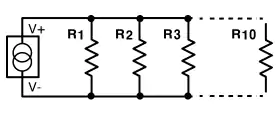
Parallel circuits in which the source or supply current divides into a variety of parallel paths are known as current divider circuits. Both of the components in a parallel wired circuit have their terminals connected together and share the same two end nodes.
Parallel circuits are distinguished by the fact that, although different currents can flow through different branches, the voltage is shared by all linked paths. VR1 = VR2 = VR3... and so on. As a result, finding individual resistor voltages is no longer necessary, and branch currents can be easily calculated using Kirchhoff's Current Law (KCL) and, of course, Ohm's Law.
The current flowing through any branch of a parallel circuit can be calculated using this Current Divider Calculator.
When a circuit is connected in parallel, the total current from the power source is divided among the circuit's branches depending on the resistance values of each branch. Since current follows the path of least resistance, more current will flow through branches with lower resistance, while less current will flow through a branch with high resistance.
Mastering the Current Divider Calculator
Understanding how current splits in a parallel circuit is essential for effective circuit design. Our calculator applies the standard Current Divider Rule to simplify this process for you.
The Current Divider Formula
To find the current flowing through a specific branch, we use the following equation:
Where:
- : Current flowing through the specific branch.
- : Total source current entering the node.
- : Equivalent parallel resistance of the entire circuit.
- : Resistance of the specific branch you are measuring.
Step-by-Step Guide
- Input Data: Simply enter the total source current () and the resistance values for each resistor in your parallel circuit.
- Automatic Calculation: The tool automatically computes the equivalent resistance and the resulting current for each individual branch.
- Variable Branches: Whether you are analyzing a simple 2-resistor circuit or a complex network, this tool is flexible. It supports 2 to 10 branches—just enter values for the active branches and leave the unused fields blank.
The unit of this calculator's result is the one stated. Amperes (A), milliamperes (mA), or microamperes (A) may be used to express the resultant value.
Frequently Asked Questions
What is meant by current dividers?
Current dividers or current division is the process of finding the individual branch currents in a parallel circuit were each parallel element has the same voltage. Kirchhoff's current law, (KCL) states that the algebraic sum of the individual currents entering a junction or node will equal the currents leaving it.
What is voltage and current divider rule?
Current Division Rule A parallel circuit acts as a current divider as the current divides in all the branches in a parallel circuit, and the voltage remains the same across them. The current division rule determines the current across the circuit impedance.
What is voltage divider formula?
A voltage divider is applying a voltage across a series of two resistors. We may draw in a few different ways, but they should always essentially be the same circuit. Thus formula is given as follows: V o u t = R b R a + R b × V i n V_{out} = \frac{R_b}{R_a+R_b} \times V_{in} Vout=Ra+RbRb×Vin.
How do I calculate current?
Ohms Law and Power To find the Voltage, ( V ) [ V = I x R ] V (volts) = I (amps) x R (Ω) To find the Current, ( I ) [ I = V ÷ R ] I (amps) = V (volts) ÷ R (Ω) To find the Resistance, ( R ) [ R = V ÷ I ] R (Ω) = V (volts) ÷ I (amps) To find the Power (P) [ P = V x I ] P (watts) = V (volts) x I (amps)
Does a voltage divider affect current?
Application Dont's. As tempting as it may be to use a voltage divider to step down, say, a 12V power supply to 5V, voltage dividers should not be used to supply power to a load. Any current that the load requires is also going to have to run through R1.
Is current divided in a parallel circuit?
"A parallel circuit has two or more paths for current to flow through." Simply remember that PARALLEL means two paths up to thousands of paths. The flow of electricity is divided between each according to the resistance along each route.
How do you calculate amps in a parallel circuit?
Divide the voltage by R1 to get I1. V/R1 = I1. I1 will be measured in amps. Divide the voltage by R2 to get I2.
What is the voltage divider equation?
Using the voltage divider ratio rule, we can see that the largest resistor produces the largest I*R voltage drop. Thus, R1 = 4V and R2 = 8V. Applying Kirchhoff's Voltage Law shows that the sum of the voltage drops around the resistive circuit is exactly equal to the supply voltage, as 4V + 8V = 12V.
Can you measure current in parallel?
A multimeter set to measure current can only measure the current going through it. ... Devices in parallel must have the same voltage across them, although the currents through each can be different.
Hot SKU
Related Tools
Resistor Color Code Calculator
AIChipLink’s Resistor Color Code Calculator is an interactive tool for identifying resistor values based on 4-band, 5-band, and 6-band color codes. Simply select the colors, and the calculator will display the resistance in Ohms (Ω), tolerance, and power rating. Whether you are building a circuit, repairing electronics, or sorting resistors in your lab, this calculator provides an accurate and efficient way to decode resistor values.
Ohms Law Calculator
AIChipLink’s Ohm’s Law Calculator helps engineers and students quickly calculate resistance, current, voltage, and power in an electrical circuit. Simply enter any two known values, and the calculator will instantly compute the remaining parameters. This fast and easy-to-use online tool illustrates the fundamental relationship between voltage, current, and resistance, making it essential for circuit design, troubleshooting, and electronics learning.
Op-Amp Voltage and Gain Calculator
The Op Amp Voltage and Gain Calculator is an easy-to-use tool for analyzing operational amplifier circuits. It calculates the output voltage, inverting gain, and non-inverting gain based on the input parameters. Simply enter the values of V1, V2, Vp, Vn, and the resistor values R1, R2, R3, and R4, and the calculator will instantly provide accurate results. This tool is suitable for both professional engineers and beginners learning op amp circuit design.
Inverting Op-Amp Resistor Calculator
The Inverting Op Amp Resistor Calculator is a practical tool for analyzing operational amplifier inverting circuits. By entering parameters such as the desired gain, output voltage (Vout), R1 resistance, and the input voltages V1, V2, Vp, and Vn, the calculator automatically determines the required resistor values (R2, R3, and R4). Simply input the values and click “Calculate” to quickly design and verify inverting op amp configurations.
AIChipLink – Your Trusted Electronic Components Distributor

12.28 M
Listed Part Number
3,000+
Leading Manufacturers
4.9 M
In-stock SKU
15,000+
Warehouse Area(㎡)