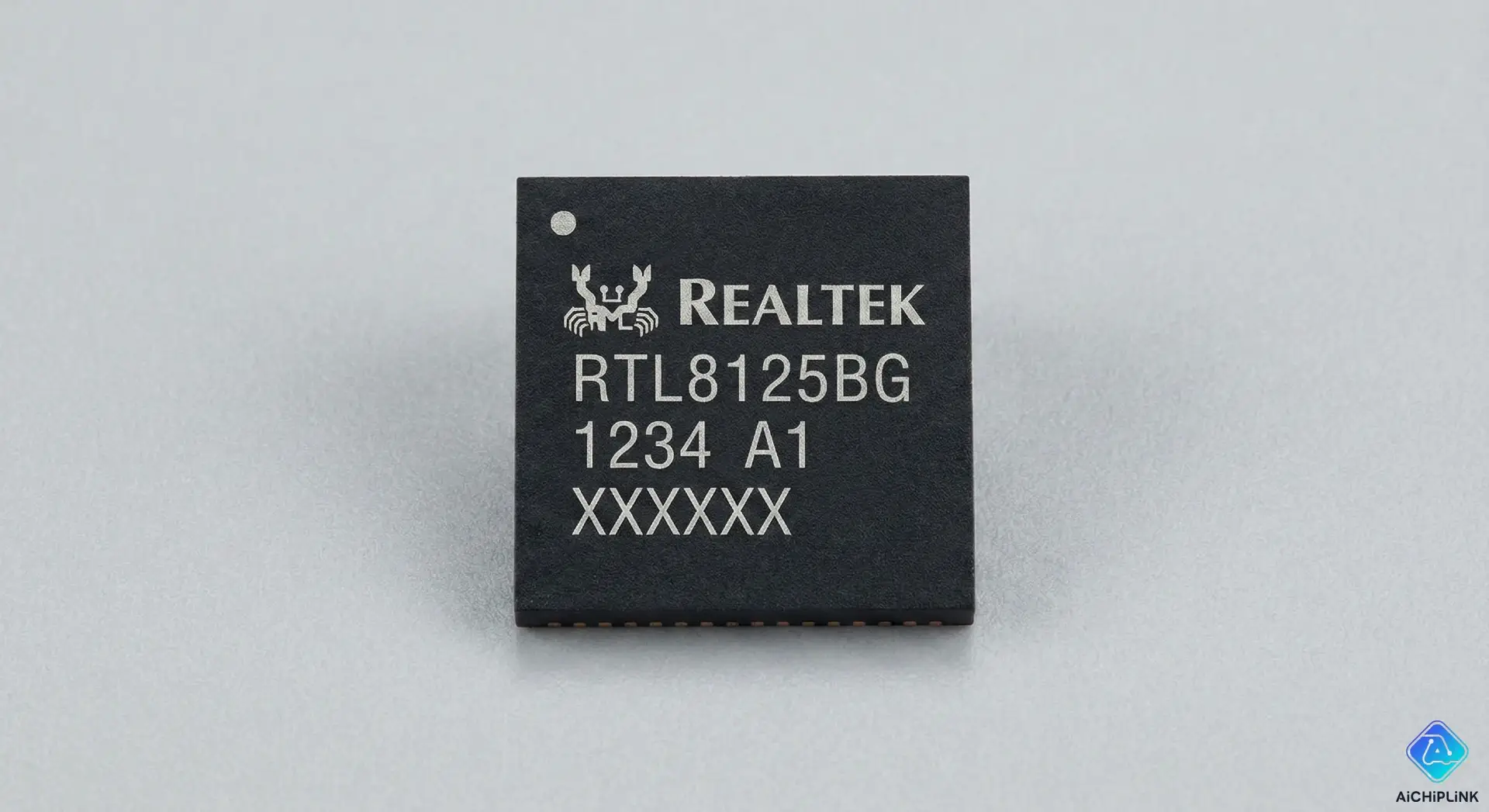
As gigabit internet becomes a bottleneck for modern fiber connections and Wi-Fi 6 routers, the industry has shifted rapidly towards 2.5 Gigabit Ethernet (2.5GbE). Leading this charge in the consumer and embedded market is the Realtek RTL8125BG.
Found in millions of gaming motherboards, PCIe network adapters, and mini-PCs, the RTL8125BG offers a cost-effective yet high-performance upgrade path from standard Gigabit. This guide dives into its technical specifications, driver optimization, and how it stacks up against competitors like Intel.
Table of Contents
- RTL8125BG Datasheet & Technical Specifications
- Driver Support & Optimization
- Hardware Integration & Pinout
- Conclusion
RTL8125BG Datasheet & Technical Specifications
The RTL8125BG is a fully integrated single-chip 10/100/1000M/2.5G Gigabit Ethernet controller. It combines a Media Access Controller (MAC), a 2.5G PHY, and a PCIe controller into a single package.
Key Specifications Table
| Feature | Specification |
|---|---|
| Throughput | 2.5 Gbps (NBASE-T) |
| Interface | PCIe 2.1 x1 (supports v1.1) |
| Cabling | Cat5e (for 2.5G short reach) / Cat6 |
| Standards | IEEE 802.3bz (2.5GBASE-T), 802.3u/ab |
| Package | QFN-48 (6x6 mm) |
| Special Features | Wake-on-LAN, RealWoW!, DASH |
The Rise of 2.5GBASE-T
The "BG" revision is specifically optimized for NBASE-T performance. This technology allows users to achieve speeds up to 2.5Gbps using existing Cat5e cabling infrastructure in many cases, saving the cost of rewiring buildings with Cat6a. For a technical overview of how Multi-Gigabit speeds are achieved over copper, refer to the Wikipedia article on 2.5GBASE-T.
Comparison: RTL8125BG vs. Intel I225-V
The battle for 2.5G supremacy is primarily between Realtek and Intel.
- Intel I225-V: Historically plagued by hardware revisions (B1, B2, B3) to fix packet loss and jitter issues.
- Realtek RTL8125BG: widely regarded as a more stable "drop-in" solution with fewer hardware errata, making it the preferred choice for budget-conscious but reliability-focused designs.
Price Analysis & Stock Availability
The RTL8125BG is highly cost-competitive, often costing significantly less than comparable Intel silicon.
Note: For volume manufacturing, sourcing authentic revisions is key. [Check Stock for RTL8125BG at Aichiplink] to view inventory from verified global distributors.
Driver Support & Optimization
While hardware is critical, drivers define the user experience.
Windows 11 & Linux Drivers
Realtek frequently updates its drivers to maintain compatibility with the latest OS kernels.
- Windows: The "NDIS" drivers are robust. Ensure you download the specific "PCIe FE / GBE / 2.5G / Gaming Family Controller" driver.
- Linux: The standard
r8169kernel driver supports the RTL8125 family, but for optimal performance (especially to unlock full 2.5G speeds and jumbo frames), installing the officialr8125module from Realtek is often recommended.
Realtek Dragon Software for Gaming
The RTL8125BG supports Realtek Dragon, a bandwidth management software. It automatically detects online games and prioritizes their traffic over background downloads (like Windows Updates), reducing latency and jitter for gamers.
Hardware Integration & Pinout
For hardware engineers designing a PCIe card or motherboard, the RTL8125BG offers a straightforward integration path.
PCIe 2.1 x1 Interface Implementation
The chip interfaces directly with the host via PCI Express 2.1 x1.
- Bandwidth: PCIe 2.1 x1 provides 5GT/s, which is ample bandwidth to support full duplex 2.5GbE traffic without bottlenecks.
- Power Management: It supports L1 sub-states, compliant with ECMA-393, ensuring low power consumption when the link is idle (Modern Standby).
QFN-48 Package & Thermal Considerations
- Package: 48-pin QFN 'Green' package.
- Thermal: While efficient, running at 2.5G does generate heat. A dedicated heat sink is usually not required for the chip itself if airflow is adequate, but using a thermal pad to connect the exposed ground pad (E-Pad) to the PCB ground plane is mandatory for heat dissipation. For PCB design guidelines on thermal management, EEPower's Thermal Resistance Guide is an excellent resource.
Conclusion
The Realtek RTL8125BG has democratized 2.5G networking, moving it from a niche server feature to a standard consumer expectation. Its balance of performance, low power, and affordability makes it the top choice for modern connectivity designs.
Sourcing Realtek Components Ensure your products perform as specified by using authentic controllers. Visit Aichiplink.com to search for RTL8125BG and other Realtek communications ICs.
Frequently Asked Questions
Can RTL8125BG reach 2.5G on Cat5e?
Yes, over shorter distances (typically up to 30-50 meters depending on cable quality and interference), the RTL8125BG can negotiate a stable 2.5Gbps link on Cat5e. For full 100m reach, Cat6 is recommended.
Is RTL8125BG compatible with RTL8125B?
Yes, "BG" is essentially a minor revision or a specific marking code within the "B" family (RTL8125B). They are generally pin-compatible and driver-compatible.
Does it support Jumbo Frames?
Yes, the RTL8125BG supports Jumbo Frames up to 9K bytes (9216 bytes), which significantly reduces CPU overhead when transferring large files on a local network.
Why does my connection drop to 1Gbps?
This usually happens if the link partner (switch or router) only supports 1G, or if the cable quality is poor. Ensure you are connected to a 2.5G/Multi-Gig switch port.
Does it require an external Flash?
The RTL8125BG can operate with an external SPI Flash to store configuration data (MAC address, subsystem ID), or it can use an eFuse for a lower BOM cost design.