PCIe Retimer vs Redriver: Key Differences and Performance Metrics
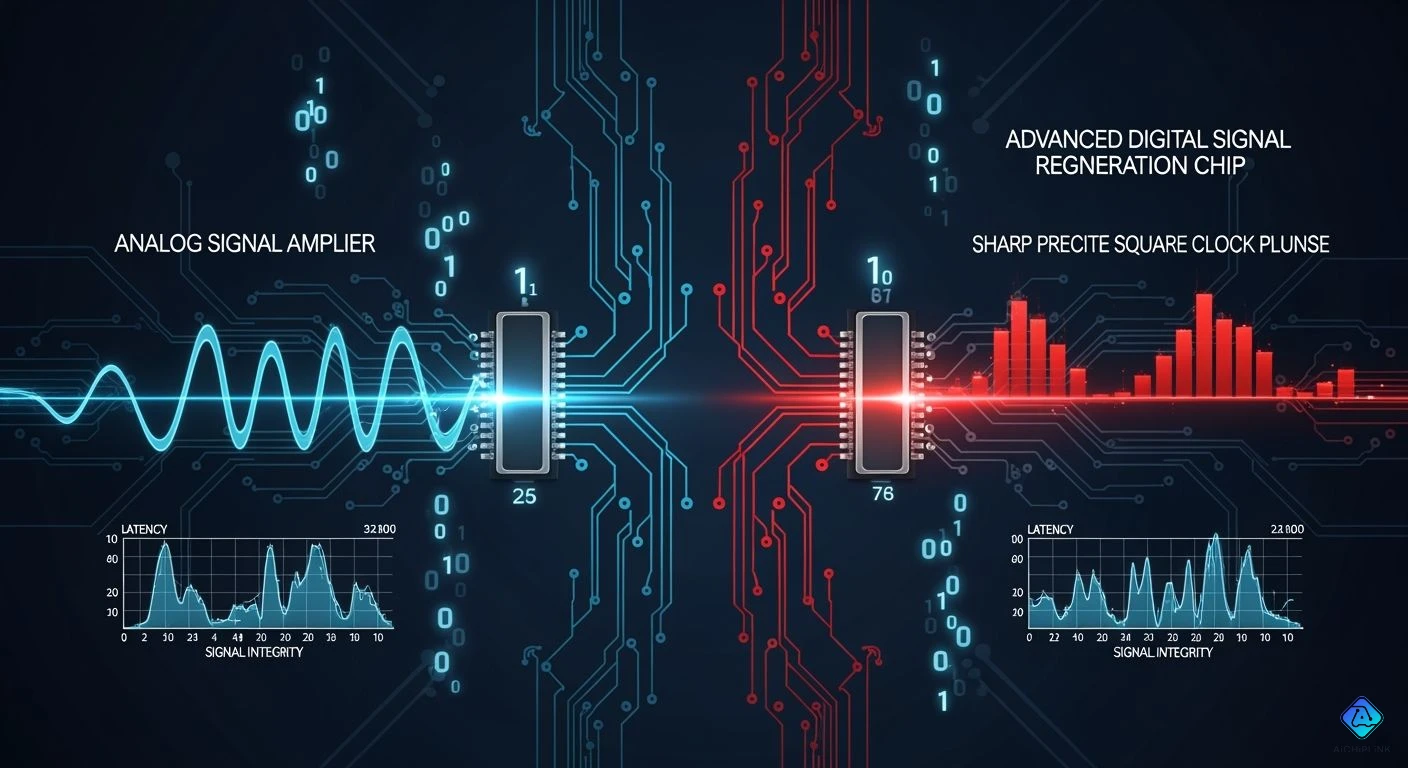
Understanding the pcie retimer vs redriver comparison helps. It helps you pick the right signal integrity solutions. These solutions fit your system architecture well. PCIe redrivers offer simple analog equalization. They also boost signal power. In contrast, PCIe retimers perform digital signal regeneration. They use Clock and Data Recovery (CDR). This helps send a clean copy of your data.
Modern peripheral component interface express designs face problems. They have severe signal degradation at high data transfer rates. Ultra-fast bandwidth demands tight channel control. This control is needed across high-speed links.
| PCIe Generation | Transfer Rate | Maximum Channel Insertion Loss |
|---|---|---|
| PCIe 5.0 | 32 GT/s | 36 dB |
| PCIe 6.0 | 64 GT/s | 32 dB |
You should select redrivers for short paths. They work best for low power needs. They also help latency-critical links. You should deploy pci express retimers for long-reach channels. Use them for channels exceeding 28 dB loss. These channels require complete jitter budget resets. Evaluating key differences ensures stable communication. This keeps all board topologies working well.
Key Takeaways
-
Redrivers boost analog signal strength fast.
-
They help short board traces work.
-
Retimers recreate clean digital data.
-
They help long, complex pathways work.
-
Redrivers offer near-zero delay for systems.
-
These systems need ultra-fast speed.
-
Retimers remove signal noise completely.
-
They reset the total jitter budget.
-
High-loss paths over 16 dB need retimers.
-
They ensure stable data transfer.
Architecture: PCIe Retimer vs Redriver
Fast board designs need clear hardware choices. Good choices keep your signals clean. Knowing the inside chip parts helps. It shows how signal tools differ.
💡 Key Takeaway: Redrivers act as basic analog boosters. They raise raw signal strength. Retimers process digital data instead. They fix timing and rebuild logic.
Analog Signal Conditioning in Redrivers
A redriver device works only with analog signals. The chip takes an incoming signal. It boosts the signal size. Then it sends the data along. It does not read digital bits.
Inside redrivers, signals pass through boosters. They also use special equalizing circuits:
-
Analog Filtering Mechanism: CTLE works as a flipped filter. It adds big boosts to fast signals. It keeps low boosts for slow signals. This balances out signal loss.
-
Signal Restoration: It opens the messy signal eye diagram. This brings back clear analog shapes. The main receiver sees better data.
-
Channel Loss Mitigation: It adds a straight boost. For instance, it gives ±14dB at 8GHz. This makes long paths feel shorter. It fixes bad signal loss. It meets PCIe standard rules.
Redrivers do not have clock recovery tools. So they handle incoming signals instantly. They do not read the main protocol. You get a fast, simple path. It boosts high-speed signals quickly. But this analog path has one flaw. It boosts bad channel noise too.
Digital Signal Regeneration in Retimers
Retimers use digital parts to rebuild data. They do not just boost wave shapes. A retimer decodes the data carefully. It cleans up timing errors. Then it creates a new signal.
In a PCIe retimer, the CDR tool works. It pulls the timing from weak inputs. This new clock has zero jitter. The tool uses it to read data. The retimer builds a clean stream. It sends data with fresh timing. This erases all old jitter.
In PCIe retimer digital processing, DFE helps. DFE works as a smart equalizer. It stops interference between symbols. It actively fixes ruined signals. It handles notch filter flaws. It also fixes high-frequency loss.
After equalizing, PCS logic reads the bits. The device timing resets completely. It sends valid digital data out. The data crosses the rest board. This digital path shows a trade-off. It marks the pcie retimer vs redriver choice.
Hardware Requirements and Clocking Dependencies
Hardware needs depend on these chip differences. You must plan for chip size. You need proper power delivery. You must route clock lines right.
| Feature | Redriver Architecture | Retimer Architecture |
|---|---|---|
| Operating Domain | Pure Analog | Mixed-Signal Digital |
| Reference Clock | Not Required | Required (e.g., 100 MHz Refclk) |
| Silicon Footprint | Compact | Larger (Includes CDR & PCS logic) |
| Internal Processing | CTLE, Gain Stages | CTLE, CDR, DFE, PCS logic |
Redrivers make board layout very easy. They do not need extra clocks. You can place redrivers in tiny spaces. You skip routing extra clock lines.
Retimers need an external clock input. The clock drives internal logic loops. Retimers use bigger silicon chips. They need good power filtering. This supports their digital logic cores. Knowing these clock rules helps. It keeps peripheral component interface express designs working well.
PCIe Performance Metrics Comparison
Designers check metric numbers. You weigh signals against heat. Device pick impacts design layout.
Signal Latency and Thermal Power Budgets
Redrivers process analog waves fast. They pass signals right away. Retimers use digital logic decoding. This conversion adds minor delays.
| Component Type | Typical Latency Metric | Signal Processing Characteristic |
|---|---|---|
| PCIe 5.0 Redriver | Picoseconds (negligible) | Analog amplification without signal processing |
| PCIe 5.0 Retimer | 5 to 10 Nanoseconds (single-digit ns) | Full digital signal regeneration |
Speed differences matter for AI. Redrivers help low-latency tasks. Retimers use extra thermal power. Retimer logic gates make heat. You must cool retimer chips. Redrivers run cool and save.
💡 Tip: Check your latency budget first. Pick redrivers for fast timing. Pick retimers for signal rebuilding.
Jitter Budget Reset and Noise Amplification
Fast channels create noise. Redrivers boost high waves fast. But they have drawbacks.
PCIe ReDrivers function as analog amplifiers designed to boost continuous waveforms without digitally reconstructing the signal. Consequently, when signal attenuation or channel noise exceeds operational thresholds, the device indiscriminately amplifies the entire analog input—boosting underlying noise and accumulated jitter directly alongside the intended high-frequency signal.
Retimers stop noise growth fast. Internal CDR circuits clean signals.
| Mechanism | Action in PCIe Retimers | Action in PCIe Redrivers |
|---|---|---|
| Signal Processing | Uses Clock Data Recovery (CDR) to retime, reclock, and send a fresh signal copy. | Amplifies existing signal and attenuates data-dependent jitter. |
| Jitter Budget Impact | Completely resets accumulated jitter and restores signal quality. | Adds to random jitter via internal device thermal noise. |
| Reach Extension | Doubles channel distance past original baseline specifications. | Provides limited reach extension without resetting jitter. |
A retimer fixes data errors:
-
Data-Dependent Jitter (DDJ): Clears ISI distortion errors.
-
Random Jitter (RJ): Fixes heat noise issues.
-
Bounded Uncorrected Jitter (BUJ): Clears crosstalk issues.
This reset keeps long paths safe.
Insertion Loss Compensation and Reach
Motherboards fight bad channel loss. Fast rates drop signal power. Signals fade fast on FR4.
Redrivers fix mild 10-15 dB loss. They help short server risers. Retimers fix heavy 28 dB loss. They rebuild waves at fast speeds. A retimer doubles your reach. You route backplanes without data errors.
Lane Skew and Signal-to-Noise Ratio
Multi-lane slots need tight alignment. Trace gaps cause lane skew. Redrivers cannot align delayed data. They boost lanes without fixing time.
Retimers align data paths digitally. Buffers match signals on lanes. This raises Signal-to-Noise Ratio (SNR). Good timing drops bit error rates. Dense server designs gain big benefits. Retimers keep links steady and safe.
PCIe Link Training and Protocol Awareness
Fast physical paths need active management. Modern features help keep links stable.
LTSSM State Machine Participation
Redrivers act as transparent analog parts. They do not read LTSSM status. Retimers join in LTSSM checks instead. Protocol-aware retimers give big benefits:
-
Dividing Physical Channels: A protocol-aware extension retimer splits bad channels into small segments.
-
Lowering Bit Error Rates (BER): Short segments raise signal margins. They cut bit error rates well.
-
Preventing Frequent Link Recovery: Good signals stop bad recovery loops during work.
Dynamic Auto-Adaptation vs Static Tuning
You set redriver gains by hand early. Redrivers use static settings always. They ignore temperature and aging.
Retimers run dynamic equalizer fixes automatically. The retimer joins link checks with endpoints. Internal code updates CTLE and DFE values. This tuning boosts lane signals fast.
💡 Key Takeaway: Redrivers use fixed settings. Retimers adjust signal options live.
On-Chip Eye Monitoring Diagnostics
Checking pci express tools needs good tools. Retimers include built-in tests for channels. You do not need extra gear.
New retimer tools help fix systems fast:
-
Real-time 2D Eye Diagram Capture: Draws signal eye maps. It tests signal margins well.
-
PAM4 Telemetry Data: Gives clear multi-level signal data. It tracks link health fast.
-
Integrated GUI & Analysis Capabilities: Offers quick access for setup and testing.
-
Flexible Connectivity Options: Works over PCIe or sideband connections. It helps test hardware live.
Selecting Redriver or Retimer Devices
Picking right board parts takes planning. Check trace length and channel loss.
Distance and Channel Topology Thresholds
Distance sets your hardware choice. Short traces on basic FR4 drop little power. Use simple analog chips for paths under six inches.
Server backplanes lose power fast. Long paths hurt signal edges. Measure total path loss first. Paths losing over 16 dB need digital rebuilds. Deciding on selecting redriver or retimer devices depends on total loss numbers.
PCIe Gen 4, Gen 5, and Gen 6 Guidelines
Fast speeds shrink loss limits. New generations cause more signal loss. PCIe 4.0 runs at 16 GT/s speed. PCIe 5.0 hits 32 GT/s fast data rates. PCIe 6.0 uses PAM4 at 64 GT/s. PAM4 drops noise safety margins.
The pcie retimer vs redriver choice changes with new speeds:
| Design Criterion | Redriver Condition | Retimer Condition |
|---|---|---|
| Data Rate & Protocol | Lower data rates (e.g., PCIe Gen 1 to Gen 3, up to 16Gbps) | High-speed data rates above 16Gbps (e.g., PCIe 4.0, 5.0, USB 4.0, Thunderbolt 3.0) |
| System Scale & Complexity | Smaller, less complex system designs | Complex system designs requiring strict protocol compliance |
| Signal Degradation Management | Suitable for mild attenuation; amplifies both signal and noise without jitter correction | Required to compensate for severe signal degradation and ensure full protocol compliance |
Cost, Layout, and Design Trade-Offs
Budgets and trace space alter final picks. Redrivers lower overall chip costs. They use smaller footprints and draw less power. You layout traces easily without extra clock paths.
Retimers raise initial hardware costs. Each chip adds routing work. They need an extra clock source. They use more power and generate heat. Pick wise parts to shield fast data.
Navigating the pcie retimer vs redriver trade-offs keeps hardware working fast.
💡 Summary: Redrivers save money and power on short paths. pci express retimers fix lost signals on long channels.
Check your channel signal loss numbers carefully. Pick redrivers for fast, low-loss paths. Deploy retimers when selecting redriver or retimer devices for AI servers.

Written by Jack Elliott from AIChipLink.
AIChipLink, one of the fastest-growing global independent electronic components distributors in the world, offers millions of products from thousands of manufacturers, and many of our in-stock parts is available to ship same day.
We mainly source and distribute integrated circuit (IC) products of brands such as Broadcom, Microchip, Texas Instruments, Infineon, NXP, Analog Devices, Qualcomm, Intel, etc., which are widely used in communication & network, telecom, industrial control, new energy and automotive electronics.
Empowered by AI, Linked to the Future. Get started on AIChipLink and submit your RFQ online today!
Frequently Asked Questions
What main factor determines your signal booster choice?
First, measure total channel insertion loss. Choose an analog device for short lossy paths. Make sure loss stays under 16 dB. Long paths over 28 dB loss need retimers. Digital retimers reset your jitter budget fully.
How do you check retimer and redriver latency?
Check system timing budgets carefully. Redrivers process analog signals very fast. They add negligible picosecond delays. Retimers decode digital data instead. This processing adds 5 to 10 nanoseconds. Pick redrivers for ultra-low latency systems.
Does a redriver need an external clock?
No external reference clock is needed. A redriver chip boosts analog signals directly. It has zero clock dependencies. Conversely, retimer circuits need reference clocks. You must route one on your board.
Why do PCIe 6.0 designs use retimers?
PCIe 6.0 uses PAM4 signaling. It has tighter noise margins. Fast 64 GT/s channels drop signals quickly. Retimers run Clock and Data Recovery. This digital step cleans heavy noise. It prevents data errors on complex links.