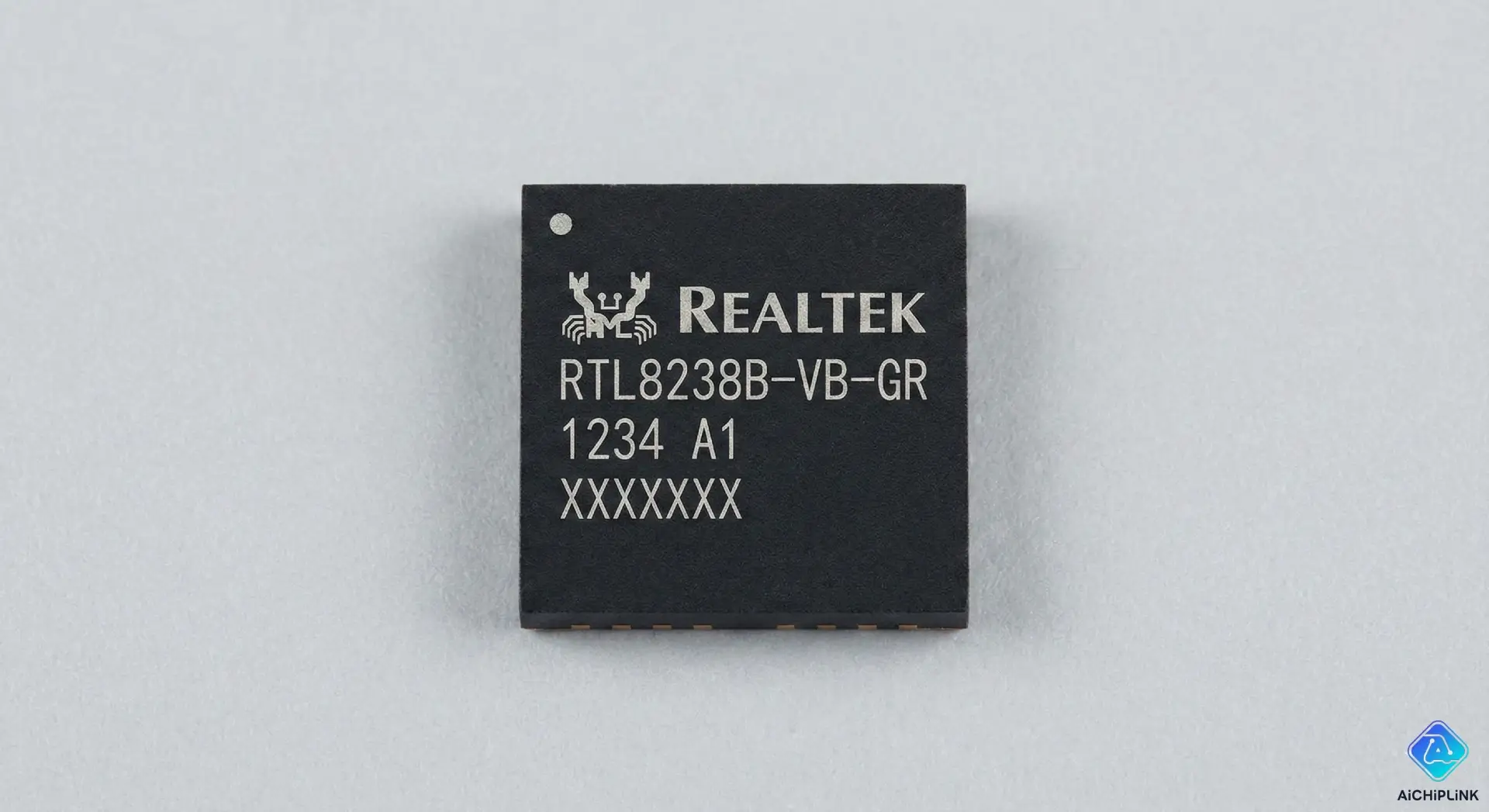
In the competitive landscape of enterprise and SMB networking equipment, the "Port Density per Dollar" metric often dictates market success. Whether designing a 24-port managed switch for an office rack or a high-density industrial aggregation unit, engineers face a common bottleneck: PCB real estate and routing complexity.
Routing 24 or 48 individual Gigabit Ethernet ports to a central switching ASIC using traditional interfaces is a layout nightmare. This is where the Realtek RTL8238B-VB-GR steps in.
As an Octal (8-Port) Gigabit Ethernet PHY utilizing the high-speed QSGMII interface, this chip effectively compresses the physical layer connectivity of eight ports into a compact BGA footprint with a minimal interface pin count. It is the silent workhorse behind countless cost-effective, high-performance switches available today.
This comprehensive guide goes beyond the datasheet to explore the architectural advantages of the RTL8238B, the intricacies of QSGMII routing, and the thermal engineering required to keep high-density switches cool.
Table of Contents
- 1. Decoding the Silicon: RTL8238B-VB-GR Specs
- 2. The Physics of Density: Why Octal PHYs?
- 3. Interface Architecture: The Magic of QSGMII
- 4. Application: Designing 24-Port & 48-Port Switches
- 5. Hardware Design & Thermal Challenges
- 6. Conclusion & Sourcing
1. Decoding the Silicon: RTL8238B-VB-GR Specs
The RTL8238B-VB-GR is a highly integrated physical layer transceiver. It provides all the necessary physical layer functions to transmit and receive data over standard twisted-pair cabling (Cat5e/Cat6).
Part Number Breakdown
Understanding the Realtek naming convention helps in selecting the exact component variant:
- RTL: Realtek Semiconductor.
- 8238: The specific model number for the Octal Gigabit PHY.
- B: Silicon Revision (Stepping). "B" indicates a mature revision with errata fixes over the original "A" version.
- VB: Package Type. Indicates a TFBGA (Thin Fine-pitch Ball Grid Array) package.
- GR: Green Package. Indicates the chip is Halogen-free, RoHS compliant, and shipped in Tape & Reel format for automated manufacturing.
Key Specifications Matrix
| Feature | Specification | Engineering Impact |
|---|---|---|
| Port Count | 8 Ports (Octal) | Replaces 8 single PHYs, reducing BOM count drastically. |
| Data Rates | 10Base-T, 100Base-TX, 1000Base-T | Full backward compatibility for legacy devices. |
| Host Interface | QSGMII (Quad Serial GMII) | Reduces interface pins to the MAC layer significantly. |
| Crossover | Auto-MDIX | Eliminates need for crossover cables. |
| Cable Length | >140m (Cat5e) | Exceeds IEEE standard (100m) for better margin. |
| Process | Low Power CMOS | Critical for fanless switch designs. |
| Package | TFBGA-128 (est.) | Compact footprint requiring precise PCB layout. |
Price Analysis & Stock Availability
Realtek components are renowned for their high cost-performance ratio. The RTL8238B is often significantly more affordable than comparable Octal PHYs from competitors like Marvell (Alaska series) or Broadcom, making it the default choice for budget-conscious ODM designs.
Procurement Tip: High-density PHYs are subject to market cycles. [Check Stock for RTL8238B-VB-GR at Aichiplink] to view real-time inventory from verified distributors.
2. The Physics of Density: Why Octal PHYs?
In the early days of networking, a 24-port switch might have used 24 individual PHY chips. This is unthinkable today due to cost, size, and power constraints.
The Evolution: Single -> Quad -> Octal
- Single PHYs: Great for isolation, but consume huge board space.
- Quad PHYs: The standard for many years, but still requires 6 chips for a 24-port switch.
- Octal PHYs (RTL8238B): The current standard for high-density. A 24-port switch needs only 3 chips. A 48-port switch needs only 6 chips.
- Impact: This allows a 24-port switch to fit into compact desktop enclosures rather than requiring full 19-inch rackmount chassis widths just to accommodate the silicon.
Energy Efficient Ethernet (EEE) at Scale
The RTL8238B supports IEEE 802.3az (Energy Efficient Ethernet).
- LPI Mode: When no data is being transferred, the PHY enters a Low Power Idle state.
- Scale Impact: Saving 200mW per port might seem small, but on a 48-port enterprise switch running 24/7, this adds up to nearly 10 Watts of power savings. This reduction reduces the load on the power supply unit (PSU) and lowers the cooling requirements, potentially allowing for quieter fans.
3. Interface Architecture: The Magic of QSGMII
The true "secret sauce" of the RTL8238B is its use of the QSGMII interface standard.
RGMII vs. QSGMII: The Pin Count Revolution
To understand the value of QSGMII, we must compare it to the traditional RGMII (Reduced Gigabit Media Independent Interface).
- RGMII approach: Each Gigabit port requires ~12 signal lines (TX data, RX data, clocks, control).
- For 8 ports: $12 \times 8 = 96$ signal pins.
- Routing 96 high-speed traces from PHY to Switch ASIC is a layout nightmare, requiring many PCB layers.
- QSGMII approach: QSGMII (Quad Serial GMII) multiplexes 4 Gigabit ports into a single 5 Gbps differential pair (TX+/-, RX+/-).
- The RTL8238B (8 ports) uses 2 QSGMII lanes.
- Total signal pins: $4 \text{ pairs} \times 2 = 8$ signal pins (plus reference clock).
- Result: We reduced the pin count from 96 to ~10. This massive reduction simplifies the PCB routing complexity by an order of magnitude.
Signal Integrity Challenges at 5Gbps
While QSGMII saves pins, it increases the speed.
- Frequency: RGMII operates at 125 MHz. QSGMII operates at 5 Gbps serial data rate.
- PCB Impact:
- Impedance Control: Traces must be strictly controlled to 100Ω differential impedance.
- Loss Budget: At 5Gbps, dielectric loss in standard FR4 becomes a factor. Traces should be kept short (typically < 4-6 inches) to avoid the need for re-timers.
- AC Coupling: QSGMII lanes typically require 100nF AC coupling capacitors placed close to the receiver pins.
4. Application: Designing 24-Port & 48-Port Switches
The RTL8238B is rarely used in isolation; it is part of a system.
The Realtek Ecosystem (RTL83xx / RTL93xx)
Realtek provides a complete ecosystem where the RTL8238B pairs seamlessly with their switch controllers (ASICs).
- RTL8382L / RTL8393: Layer 2 / Layer 3 Managed Switch Controllers.
- RTL9300 / RTL9310: Newer generation 10G-uplink capable switch SoCs. These ASICs are designed with native QSGMII SerDes blocks specifically mapped to accept RTL8238B inputs.
System Topology Example: 24-Port Gigabit Switch
A typical design consists of:
- Main SoC (e.g., RTL9302): Provides the switching fabric, CPU, and uplink ports (10G SFP+).
- 3x RTL8238B:
- PHY 1: Ports 1-8 -> Connects to SoC QSGMII Interface 0 & 1.
- PHY 2: Ports 9-16 -> Connects to SoC QSGMII Interface 2 & 3.
- PHY 3: Ports 17-24 -> Connects to SoC QSGMII Interface 4 & 5.
- Magnetics: 6x Quad-port Transformer modules (or 24x Integrated RJ45 MagJacks).
Management Interface (MDC/MDIO)
The switch controller manages the RTL8238B via the standard two-wire SMI (Serial Management Interface), consisting of MDC (Clock) and MDIO (Data).
- Addressing: Since there are multiple PHY chips on the board, each RTL8238B must have a unique PHY Address. This is configured via "Hardware Strapping" resistors (pull-up/pull-down) on specific pins during power-up.
- Example: PHY 1 (Addr 0-7), PHY 2 (Addr 8-15), PHY 3 (Addr 16-23).
5. Hardware Design & Thermal Challenges
Integrating an Octal PHY is not just about connecting nets; it requires rigorous physical design.
BGA Layout & Fanout Strategies
The RTL8238B comes in a TFBGA package.
- Layer Count: A minimum of 4 layers is usually required, with 6 layers being recommended for better EMI performance and power distribution.
- Fanout: The "dog-bone" fanout strategy is commonly used for the outer rows, while inner rows may require via-in-pad technology if the pitch is very fine (though standard BGA fanout often suffices for this class).
- Analog vs Digital: Strict separation of Analog Power (AVDD33, AVDD10) and Digital Power (DVDD10) planes is crucial to prevent digital switching noise from degrading the sensitive analog transceivers.
Thermal Management for 8 Ports
Driving 8 Gigabit copper ports generates heat.
- Power Dissipation: While efficient, an Octal PHY can dissipate 2W-3W depending on traffic load and cable length.
- Passive Cooling: In fanless desktop switches, a heatsink is mandatory. It is usually adhered to the top of the RTL8238B package using thermal tape or epoxy.
- Airflow: In rackmount switches with fans, the chips should be placed in the airflow path, not hidden behind tall components like RJ45 jacks or capacitors.
Power Supply Sequencing
Like most complex SoCs, the RTL8238B requires specific power sequencing. Typically, the I/O voltage (3.3V) comes up first, followed by the core voltage (1.0V/1.1V). Failing to follow the sequence specified in the datasheet can cause latch-up or long-term reliability issues.
6. Conclusion & Sourcing
The Realtek RTL8238B-VB-GR is the unsung hero of the modern networking industry. By compressing the connectivity of eight ports into a single, cost-effective, and energy-efficient chip, it enables the high-density switches that power our offices, factories, and homes.
For engineers, mastering the RTL8238B means mastering QSGMII signal integrity and thermal management. Once tamed, this chip offers an unbeatable combination of performance and value.
Securing Your Supply Chain In the world of high-volume network manufacturing, component availability is everything. Do not let PHY shortages stall your production line. Aichiplink specializes in sourcing hard-to-find Realtek networking ICs from verified global stocks.

Written by Jack Elliott from AIChipLink.
AIChipLink, one of the fastest-growing global independent electronic components distributors in the world, offers millions of products from thousands of manufacturers, and many of our in-stock parts is available to ship same day.
We mainly source and distribute integrated circuit (IC) products of brands such as Broadcom, Microchip, Texas Instruments, Infineon, NXP, Analog Devices, Qualcomm, Intel, etc., which are widely used in communication & network, telecom, industrial control, new energy and automotive electronics.
Empowered by AI, Linked to the Future. Get started on AIChipLink.com and submit your RFQ online today!
Frequently Asked Questions
What is the RTL8238B-VB-GR used for?
The RTL8238B-VB-GR is an 8-port Gigabit Ethernet PHY used in 8/24/48-port network switches, SMB routers, industrial networking devices, and managed/unmanaged L2/L3 switch designs. It provides the physical-layer interface between the MAC and RJ45 ports.
What interface does the RTL8238B-VB-GR use to connect to the switch SoC?
The RTL8238B uses QSGMII (Quad Serial GMII), allowing it to multiplex 4 copper ports per 5Gbps serial lane. This drastically reduces PCB pin count and simplifies routing compared to traditional RGMII.
Is the RTL8238B-VB-GR compatible with Realtek switch SoCs like RTL838x / RTL93xx?
Yes. The RTL8238B-VB-GR is designed to work seamlessly with Realtek switch controllers such as RTL8382L, RTL8393, RTL9300, RTL9310, all of which include native QSGMII interfaces optimized for real-time PHY communication.
What are the thermal and power requirements of the RTL8238B-VB-GR?
Typical power consumption is 2W–3W for all 8 ports. Fanless systems usually require a small heatsink, while rackmount designs rely on airflow from system fans. Proper PCB layout and separation of analog/digital power planes is recommended.
Does the RTL8238B-VB-GR support Energy Efficient Ethernet (EEE)?
Yes. It fully supports IEEE 802.3az Energy Efficient Ethernet, enabling Low Power Idle (LPI) operation. This significantly reduces power consumption in 24/48-port switches during periods of low traffic.



.png&w=256&q=75)


