Reflection Attenuator Calculator
This Reflection Attenuator Calculator helps you determine the correct R1 resistor value for designing a reflection attenuator, ensuring proper signal attenuation and impedance matching in your circuit.
Reflection Attenuator Calculator
FORMULAS
Introduction
Reflection Attenuator Calculator
Overview
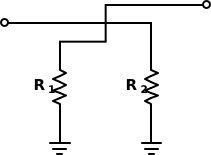
This calculator helps you determine the required termination resistor values for a Reflection Attenuator. Ideally, a reflection attenuator uses a quadrature hybrid coupler terminated with two identical resistors (or variable loads).
The calculator provides two possible resistor solutions based on the system impedance () and the desired attenuation:
- High Resistance State: Where the resistor value () is greater than the system impedance ().
- Low Resistance State: Where the resistor value () is smaller than the system impedance ().
Formulas
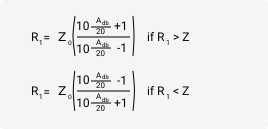
To calculate the resistor values, we first determine the Reflection Coefficient () based on the desired Attenuation ().
Once we have the reflection coefficient, there are two formulas to find the resistance (), depending on whether the resistance is higher or lower than the characteristic impedance ():
Case 1: (High State)
Case 2: (Low State)
Where:
- : The calculated termination resistance ().
- : The system characteristic impedance (typically ).
- : The voltage reflection coefficient derived from the desired attenuation.
Applications
General Function Attenuators are passive circuits used to reduce the amplitude of a signal without significantly distorting its waveform. They act as a bridge between a high-power source (transmitter) and a sensitive load (receiver/antenna), ensuring the signal level is within a safe operating range.
Why Use Reflection Attenuators? Unlike standard Pi or T-pad attenuators, Reflection Attenuators offer unique advantages in RF design:
- Variable Control: They are frequently used as variable RF attenuators by using PIN diodes or FETs as the variable resistors.
- Bandwidth: Depending on the type of coupler used (e.g., Lange coupler or Hybrid coupler), these attenuators can operate over broad bandwidths (often octave bandwidths).
- Digital Applications: They often feature discrete states, making them suitable for digital step attenuators. With careful design, they can provide a response that is invariant to phase changes.
Frequently Asked Questions
1.How does attenuator work?
As signal at the input of the attenuator will experience a 3 dB reduction in power by the time it reaches the load. That 3 dB less power will be 100% reflected by the load and experience another 3 dB reduction in power by the time is returns back to the input, for a total loss of 6 dB.
2.How do you calculate reflection attachment?
Enter Attenuation and Zo to solve for R1 and R2. R1 = Zo * ((10 ^ (dB / 20) - 1) / (10 ^ (dB / 20) + 1)) for R1 < Zo. R1 = Zo * ((10 ^ (dB / 20) + 1) / (10 ^ (dB / 20) - 1)) for R1 > Zo.
3.How do you calculate attenuator loss?
Enter values for R1 and R2 to calculate attenuator loss and impedance. Alternatively, generate R1 and R2 for a wanted attenuation. *Strictly, a loss quantity when expressed in dB should be positive. However, convention and some literature quote return loss as a negative value akin to an S (1,1) measurement on a Network analyser.
4.What is the formula for attenuator resistance?
The power level at various points in the RF circuit is chosen based on the 1dB compression points of the devices in transmit or receive chain. The most popular values of PI attenuator pads are 3dB and 6dB. Following equation or formula is used for PI attenuator resistance values calculation.
5.What are the functions of attenuator?
An attenuator is an electronic device that reduces the power of a signal without appreciably distorting its waveform. An attenuator is effectively the opposite of an amplifier, though the two work by different methods. While an amplifier provides gain, an attenuator provides loss, or gain less than 1.
6.How to find the emf of an attenuator?
After selecting preferred values, simple series and parallel resistor calculations are used to find the attenuator input impedance, input voltage and output voltage. The source EMF is again assumed to be 2 Volts.
7.What is a 3 dB attenuator?
Insert a 3 dB attenuator in front of the load. Now the incident signal is referenced to the input of the attenuator. As signal at the input of the attenuator will experience a 3 dB reduction in power by the time it reaches the load.
8.Does an attenuator affect the tone?
Yep, attenuators do affect the tone. While I don't have an attenuator, I have played amps that have had built-in attenuators. If you didn't adjust the controls after engaging the attenuators, the amps (even the overpriced THD Univalve) sounded muddy.
9.What is the best attenuator?
Best Guitar Amp Attenuators Comparison Table: S.No. Model Ratings #1 Weber Mass III 4.8 #2 Rivera RockCrusher 5.0 #3 Panama Guitars Conqueror 4.5 #4 THD Electronics HP8 4.1 1 more rows.
10. What are the different types of attenuators?
There are essentially six different kinds of RF designs: fixed, step, continuously variable, programmable, dc bias and dc blocking. Key specifications of an attenuator to consider include the attenuation measured in decibels (dB), frequency range (MHz), power handling (W), and impedance (Ohms).
Hot SKU
Related Tools
Resistor Color Code Calculator
AIChipLink’s Resistor Color Code Calculator is an interactive tool for identifying resistor values based on 4-band, 5-band, and 6-band color codes. Simply select the colors, and the calculator will display the resistance in Ohms (Ω), tolerance, and power rating. Whether you are building a circuit, repairing electronics, or sorting resistors in your lab, this calculator provides an accurate and efficient way to decode resistor values.
Ohms Law Calculator
AIChipLink’s Ohm’s Law Calculator helps engineers and students quickly calculate resistance, current, voltage, and power in an electrical circuit. Simply enter any two known values, and the calculator will instantly compute the remaining parameters. This fast and easy-to-use online tool illustrates the fundamental relationship between voltage, current, and resistance, making it essential for circuit design, troubleshooting, and electronics learning.
Op-Amp Voltage and Gain Calculator
The Op Amp Voltage and Gain Calculator is an easy-to-use tool for analyzing operational amplifier circuits. It calculates the output voltage, inverting gain, and non-inverting gain based on the input parameters. Simply enter the values of V1, V2, Vp, Vn, and the resistor values R1, R2, R3, and R4, and the calculator will instantly provide accurate results. This tool is suitable for both professional engineers and beginners learning op amp circuit design.
Inverting Op-Amp Resistor Calculator
The Inverting Op Amp Resistor Calculator is a practical tool for analyzing operational amplifier inverting circuits. By entering parameters such as the desired gain, output voltage (Vout), R1 resistance, and the input voltages V1, V2, Vp, and Vn, the calculator automatically determines the required resistor values (R2, R3, and R4). Simply input the values and click “Calculate” to quickly design and verify inverting op amp configurations.
AIChipLink – Your Trusted Electronic Components Distributor

12.28 M
Listed Part Number
3,000+
Leading Manufacturers
4.9 M
In-stock SKU
15,000+
Warehouse Area(㎡)