What Are BAW Filters?
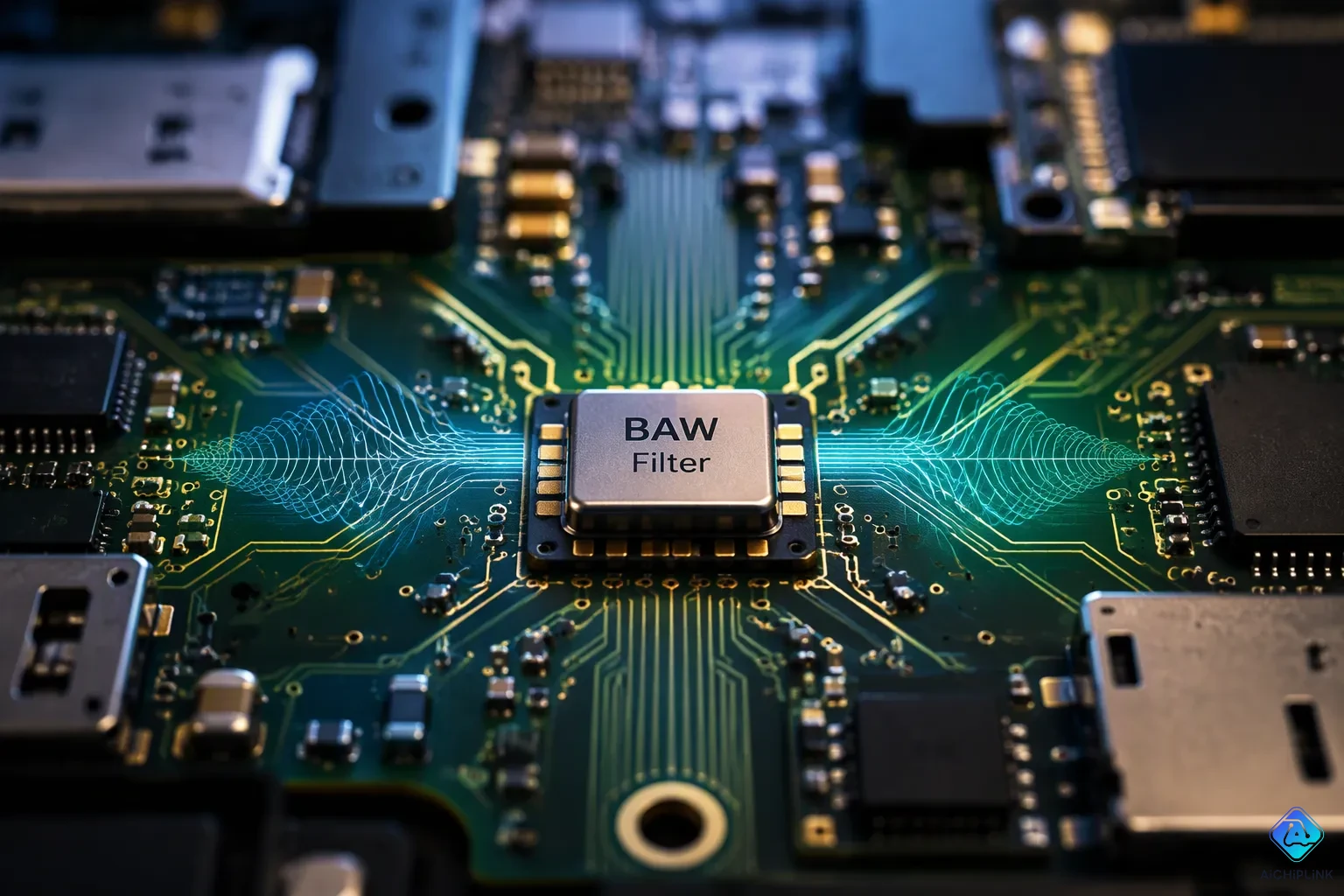
A BAW filter is a bulk acoustic wave device that uses acoustic resonances to filter frequencies above 2 GHz with high Q factor and temperature stability. Wireless communication needs RF filters to separate wanted signals from interference. A BAW filter works like a traffic cop, allowing only the desired RF signals to pass through. BAW technology is a fairly new RF advancement. These BAW devices are small and low-cost while working up to 6 GHz. This ability makes BAW filter technology important for modern 5G and high-frequency RF bands. The global BAW market for BAW filters reached US$ 7333 million in 2025, showing the importance of this RF technology in the wireless RF industry. Engineers depend on BAW components for better RF performance.
Key Takeaways
-
BAW filters use sound waves that travel through the substrate to filter high frequencies up to 6 GHz with a high Q factor.
-
BAW filters handle heat and power better than SAW filters for 5G networks.
-
FBAR and BAW-SMR are two kinds of BAW: FBAR uses an air cavity, and BAW-SMR uses a reflector stack.
-
SAW filters still work with frequencies below 2.7 GHz, so both BAW and SAW filters are used together in today's wireless devices.
An Introduction to BAW Filter Technology
What Is an RF Filter and Why Is It Needed?
An RF filter is a part that picks which radio frequencies go through a circuit and which ones get blocked. Think of it like a sieve for radio waves. The filter lets the wanted signal pass and stops unwanted interference from other transmitters. This job matters more than ever today. A modern smartphone works over 50 bands, from 500 MHz to 6 GHz, so it needs RF filters to handle this wide frequency range. The global RF Front-End Module market size was estimated at 17.94 USD Billion in 2024, according to Market Research Future. That number shows how much the wireless industry relies on filtering parts.
From the early days of single-band GSM devices to today's multi-band 5G smartphones supporting dozens of frequency bands simultaneously, filter technology has undergone remarkable transformation.
Without rf filters, calls drop, data slows down, and devices interfere with each other. Engineers need low-cost, small rf filters that handle high frequencies well. This need drives the development of bulk acoustic wave filters.
How a Bulk Acoustic Wave Filter Works
A bulk acoustic wave filter uses a piezoelectric material to turn electrical signals into acoustic waves. The device sends sound energy through the bulk of the substrate instead of along its surface. This design allows higher frequencies and a better Q factor than surface wave devices. A typical baw device works from 2 GHz to 6 GHz. It stays compact and low-cost, which fits modern handsets.
The piezoelectric materials at the heart of these devices decide their performance. Engineers pick from several options.
| Material Form | Piezoelectric Coupling (keff²) | Key Property |
|---|---|---|
| Single crystal AlN | More than double that of polycrystalline AlN | Excellent c-axis crystal orientation; better piezoelectric coupling coefficient (e33) |
| Polycrystalline AlN film | ~6% (traditional baseline) | Lower coupling due to poorer crystal orientation |
Several piezoelectric materials serve baw resonators today:
-
Aluminum Nitride (AlN): Used as the piezoelectric material in FBAR/BAW devices, enabling Q-factors above 2000 from 2–8 GHz, ideal for 4G LTE/5G; process-compatible with CMOS foundries.
-
Scandium-doped AlN: Doping AlN with scandium yields over 2× improvement in bandwidth, addressing BAW filters' limited bandwidth.
-
Lithium Niobate (LiNbO₃ or LN): A strongly piezoelectric material showing promising results for increasing bandwidth.
-
Single crystal AlN thin films: Used by Akoustis (XBAW) to provide better piezoelectric properties than polycrystalline counterparts for wideband acoustic wave filters in 5G and WiFi.
These materials support thin-film bulk acoustic resonators and other baw devices. Wafer-level packaging keeps these parts small and ready for mass production. This resonator technology keeps moving forward, and it now supports much of the rf front end in high-frequency wireless gear.
SAW vs BAW vs FBAR: Key Differences
Structure, Frequency Range, and Performance
RF engineers pick from three main acoustic wave filter types. Surface acoustic wave (SAW) filters, bulk acoustic wave filters, and FBAR filters each have different structures. The key difference is how acoustic waves move. In SAW parts, acoustic waves move across the surface of a piezoelectric material. The wave strength drops quickly as it goes deeper into the material. These waves are known as Rayleigh waves. In BAW parts, acoustic waves move through the whole piezoelectric material. This difference in structure creates big gaps in how well they perform.
| Feature | SAW | BAW |
|---|---|---|
| Acoustic wave propagation | Across the surface of the substrate | Through the bulk of the substrate |
| Construction complexity | Simpler design | More complex; requires thin-film fabrication |
| Cost | Generally less expensive | Generally more expensive |
| RF performance | Lower Q and maximum frequency | Higher Q and maximum frequency |
SAW filters work from 20 MHz to 1.6 GHz.
BAW filters work from 2 GHz to 6 GHz. This frequency gap explains why both types are used together in today's devices. SAW handles lower bands. BAW handles higher bands.
FBAR is a specific type of BAW. There are two main BAW types. The first type uses an air cavity. These are cavity-type thin-film bulk acoustic resonators, often called FBAR filters. The second type uses a reflective mirror. These are BAW-SMR, or solidly mounted acoustic resonators. A BAW-SMR device uses a Bragg mirror with layers that alternate. An FBAR filter uses a suspended membrane above an air gap. Cavity-type thin-film bulk acoustic resonators trap the acoustic wave in that membrane. Solidly mounted acoustic resonators reflect the wave back through the piezoelectric material. Both types use piezoelectric materials like AlN. FBAR using AlN can have Q factors above 2000 from 2 GHz to 8 GHz. Lithium niobate and zinc oxide serve as other options. Each piezoelectric material gives different TCF values.
The temperature coefficient of frequency also sets these technologies apart.
| Filter Technology | TCF (ppm/°C) |
|---|---|
| SAW | -25 to -45 |
| TC-SAW | -15 |
| BAW (FBAR and SMR) | -20 to -30 |
BAW offers better temperature stability than standard SAW. Temperature-compensated SAW improves this factor. But BAW still has an edge for high-frequency designs.
Pros and Cons of Each Technology
Each technology has tradeoffs for RF designers. SAW filters cost less. They have a simpler design. They work well for frequencies up to 1.6 GHz. However, SAW's temperature drift is higher. SAW also gives a lower Q factor. These issues make SAW a bad choice for high-frequency bands.
BAW offers a higher Q factor. BAW provides better temperature stability of -20 to -30 ppm/°C. BAW can be integrated directly on active silicon. BAW resonators support higher frequencies with lower insertion loss. BAW devices also handle more power than SAW. The downsides include more complex fabrication. A BAW filter needs precise thin-film deposition and micro-machining. BAW typically costs more than SAW.
FBAR filter technology is the cavity-type branch of BAW. An FBAR filter uses a thin membrane suspended over an air cavity. Film bulk acoustic resonator filters using AlN offer very high Q factors. FBAR gives excellent power handling. Air-gap FBAR filters get rid of substrate losses. This improvement boosts device efficiency. ScAlN-based FBAR shows temperature coefficients near -19 ppm/°C for series resonance. The main downside of an FBAR filter is the fragile suspended membrane. This structure needs careful wafer-level packaging.
BAW-SMR offers a more rugged structure. A BAW-SMR device uses a solid reflector stack. This stack replaces the air cavity. BAW-SMR gives better robustness for manufacturing. BAW-SMR may have slightly lower Q than FBAR. Energy leaking into the reflector causes this difference. This resonator technology keeps improving with each generation.
Apple's iPhone adoption drove wide commercial use of BAW and FBAR filters. This market shift pushed the RF industry toward bulk acoustic wave technology for high-frequency bands.
Modern RF front ends use all three technologies together. SAW handles frequencies below 1.6 GHz in a cost-effective way. BAW and FBAR handle frequencies from 2 GHz to 6 GHz. This mix gives the best performance and cost for each RF band.
Why BAW Filters Dominate High-Frequency Wireless
The High-Frequency Advantage of BAW
BAW filters do very well in 5G, PCS, WCDMA, WiFi, and industrial, aerospace, and defense uses. These BAW devices handle high frequencies with low insertion loss and strong power handling. Engineers put BAW right onto active silicon to make fully integrated receivers. This integration cuts down the number of parts and makes the system more reliable.
AlN BAW is used for n77/n78/n79 bands at 3.3-5.0 GHz.
Besides delivering BAW filters for mobile handsets in n79 band, a 5G NR spectrum operating at 4.7 GHz, the Charlotte, North Carolina-based supplier of BAW filters has also delivered n77 band filters for small-cell 5G infrastructure designs.
The market shows this dominance is real. The 5G BAW Filter market is set for remarkable growth, with an expected CAGR of 7.9% from 2026 to 2033. According to Persistence Market Research, the global BAW filters market should grow from US$ 12.5 billion in 2024 to US$ 34.5 billion by 2033, a strong CAGR of 11.9%. These numbers show strong demand for high-frequency FBAR filters and other bulk acoustic wave solutions.
Coexistence with SAW Filters in Modern Devices
SAW will still cover frequencies below 2 GHz. The two technologies will live side by side because each has its own strengths. BAW filters are moving into IoT, industrial automation, and automotive telematics. Demand comes from the need for reliable, interference-free wireless communication. The IoT ecosystem is expected to reach about 30 billion connected devices worldwide by 2030. This growth will sharply raise demand for high-performance RF filtering.
| Attribute | SAW Filters | BAW Filters |
|---|---|---|
| Frequency focus | Dominant below 2 GHz | Preferred above 2 GHz |
| Cost profile | Lower cost, compact, volume-driven | Historically more expensive, performance-focused |
| Performance | Adequate for consumer-scale electronics | Superior selectivity, power handling, thermal stability |
| IoT role | Widely used in industrial IoT, GPS, smartphones | Emerging in IoT, industrial automation, automotive telematics |
| Growth outlook (2024–2030) | Stable, mature, incremental improvements | Fastest-growing subsegment, gaining value share |
| Key driver | High-volume demand, cost efficiency | 5G, complex RF front-ends, interference-free communication |
Competition still comes from TC-SAW and ceramic filters, which offer similar performance at lower cost below 2 GHz. BAW filters are also being tested for satellite communication terminals and LEO connectivity modules. This coexistence ensures the best performance across all frequency bands.
A BAW filter uses bulk acoustic wave resonance to give a high Q factor and steady performance from 2 GHz to 6 GHz. This makes BAW filters a must-have for 5G and today's wireless standards. SAW works at lower frequencies, but BAW sends energy through the substrate instead. An FBAR filter is a cavity-type BAW variant that offers high Q but needs a fragile suspended membrane. An FBAR is good for power handling, while BAW-SMR gives you a tougher build. SAW still covers bands below 2 GHz, so both technologies will live side by side in future devices. RF integration keeps moving forward. Si-based BAW resonators now fit standard CMOS front-end processes, reach 37 GHz, and take up a transistor-cell footprint. These RF advances will lead to smaller, fully integrated receivers.

Written by Jack Elliott from AIChipLink.
AIChipLink, one of the fastest-growing global independent electronic components distributors in the world, offers millions of products from thousands of manufacturers, and many of our in-stock parts is available to ship same day.
We mainly source and distribute integrated circuit (IC) products of brands such as Broadcom, Microchip, Texas Instruments, Infineon, NXP, Analog Devices, Qualcomm, Intel, etc., which are widely used in communication & network, telecom, industrial control, new energy and automotive electronics.
Empowered by AI, Linked to the Future. Get started on AIChipLink and submit your RFQ online today!
Frequently Asked Questions
What sets BAW filters apart from SAW technology?
BAW filters send acoustic waves through the substrate bulk. This design handles higher frequencies above 2 GHz. It gives better temperature stability and a higher Q factor. Wafer-level packaging keeps these parts compact. Wafer-level packaging also reduces production costs for RF components.
Why do 5G devices depend on BAW filters?
5G networks use frequency bands from 2 GHz to 6 GHz. BAW filters handle these high frequencies with low insertion loss. RF engineers use wafer-level packaging to put components on active silicon. Wafer-level packaging allows mass production at low cost. Modern BAW filter packaging depends on this process.
How does wafer-level packaging improve BAW production?
Wafer-level packaging seals the BAW device at the wafer stage. This process protects the fragile resonator structure. Wafer-level packaging reduces overall device size. Wafer-level packaging also lowers manufacturing costs. Wafer-level packaging is standard for modern RF devices.
What does Q factor mean for RF performance?
The Q factor measures how well a filter picks its target frequency. BAW filters reach Q factors above 2000. This high selectivity stops interference between nearby frequency bands. Higher Q gives clearer signals. RF designers choose them for tough high-frequency applications.
Can BAW filters work below 2 GHz?
Standard BAW filters work from 2 GHz to 6 GHz. SAW filters handle lower bands below 2 GHz. Both technologies are used together in modern RF front ends. Each filter type serves its best RF range. Wafer-level packaging works for both technologies.