LED Series Resistor Calculator
This tool calculates the current-limiting resistor value required to safely drive single or multiple LEDs. By entering the supply voltage, LED forward voltage, and operating current, the LED Series Resistor Calculator determines both the recommended resistor value and the required power rating. To ensure reliable operation and prevent excessive heat, it is recommended to select a resistor with a power rating 2 to 10 times higher than the calculated value. This tool is ideal for designing LED circuits with
LED Series Resistor Calculator
Formula

Introduction
How to Calculate the Resistor Value for an LED Series Circuit
Every Light-Emitting Diode (LED) has a maximum current limit. Exceeding this limit, even briefly, can permanently damage the LED. Therefore, using a series resistor to limit current is a standard and essential practice.
Note: This resistive method is best for low-power indicator LEDs. High-power LEDs (like those used in lighting) typically require a dedicated switching current regulator.
The Formula: Ohm's Law for LEDs
To calculate the required resistance, simply subtract the LED's forward voltage from the power supply voltage, then divide by the desired current.
Where:
- : Resistance value (in Ohms, ).
- : Supply Voltage. The voltage of your power source (e.g., 5V, 9V, 12V).
- : Forward Voltage. The voltage drop across the LED (see table below).
- : Forward Current. The current you want flowing through the LED.
- Tip: Typical 3mm and 5mm LEDs operate between 10mA to 30mA. If you don't have the datasheet, 20mA (0.02A) is a safe standard value.
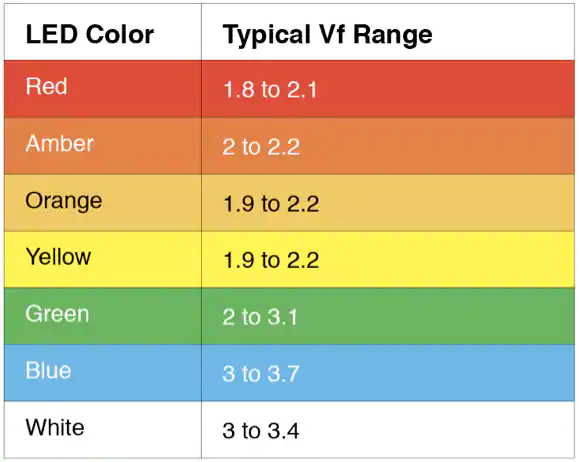
Reference: Standard LED Forward Voltages ()
The voltage drop across an LED depends on the semiconductor material used to produce its color.
| LED Color | Typical Voltage Drop () |
|---|---|
| Infrared | 1.2V - 1.6V |
| Red | 1.8V - 2.2V |
| Orange / Amber | 2.0V - 2.2V |
| Yellow | 2.0V - 2.4V |
| Green | 2.0V - 3.0V |
| Blue | 3.0V - 3.4V |
| White | 3.0V - 3.6V |
Frequently Asked Questions
How do you calculate the resistor in a LED series?
The value of the correct Resistor for LEDs in Series is the Supply Voltage (pressure) minus the total pressure consumed by all off the LEDs (Voltage Drop Across a Single LED times by the total Number of LEDs), that answer is then divided by the LED Current (electron flow) required by the circuit.
What size resistor do I need for LED?
LEDs typically require 10 to 20mA, the datasheet for the LED will detail this along with the forward voltage drop. For example an ultra bright blue LED with a 9V battery has a forward voltage of 3.2V and typical current of 20mA. So the resistor needs to be 290 ohms or as close as is available.
Do you need a resistor for each LED?
An LED (Light Emitting Diode) emits light when an electric current passes through it. The simplest circuit to power an LED is a voltage source with a resistor and an LED in series. Such a resistor is often called a ballast resistor. If the voltage source is equal to the voltage drop of the LED, no resistor is required.
How do I connect 220 volts to LED?
You can use a LED at 220V by having a capacitor in series in order to limit the current. The advantage is that the capacitor will not heat up! The role of the zener diode is to protect the LED from high voltages. During the positive half-cycle D1 limits the voltage on LED and R1 at 2.7 Volts.
What happens if you don't use a resistor with an LED?
When hooking up an LED, you are always supposed to use a current-limiting resistor to protect the LED from the full voltage. If you hook the LED up directly to the 5 volts without a resistor, the LED will be over-driven, it will be very bright for a while, and then it will burn out.
What voltage do LEDS use?
Typically, the forward voltage of an LED is between 1.8 and 3.3 volts. It varies by the color of the LED. A red LED typically drops around 1.7 to 2.0 volts, but since both voltage drop and light frequency increase with band gap, a blue LED may drop around 3 to 3.3 volts.
Should resistor go before after LED?
It doesn't matter! The resistor can go before – or after – the LED, and it will still protect it. the current that flows out of a battery is always equal to the current that flows back into the battery.
How do I calculate resistance?
If you know the total current and the voltage across the whole circuit, you can find the total resistance using Ohm's Law: R = V / I. For example, a parallel circuit has a voltage of 9 volts and total current of 3 amps. The total resistance RT = 9 volts / 3 amps = 3 Ω.
How do I know what voltage my LED is?
How to find voltage and current of LED 1.The easiest way is to look it up in the datasheet. 2.You could find the LED voltage by using a multimeter with diode function. 3.You could connect a battery to the LED and a potentiometer. Start with a high resistance on the potentiometer and gradually decrease it until you have an nice brightness.
What resistor do I need to reduce voltage?
To reduce voltage in half, we simply form a voltage divider circuit between 2 resistors of equal value (for example, 2 10KΩ) resistors. To divide voltage in half, all you must do is place any 2 resistors of equal value in series and then place a jumper wire in between the resistors.
Hot SKU
Related Tools
Resistor Color Code Calculator
AIChipLink’s Resistor Color Code Calculator is an interactive tool for identifying resistor values based on 4-band, 5-band, and 6-band color codes. Simply select the colors, and the calculator will display the resistance in Ohms (Ω), tolerance, and power rating. Whether you are building a circuit, repairing electronics, or sorting resistors in your lab, this calculator provides an accurate and efficient way to decode resistor values.
Ohms Law Calculator
AIChipLink’s Ohm’s Law Calculator helps engineers and students quickly calculate resistance, current, voltage, and power in an electrical circuit. Simply enter any two known values, and the calculator will instantly compute the remaining parameters. This fast and easy-to-use online tool illustrates the fundamental relationship between voltage, current, and resistance, making it essential for circuit design, troubleshooting, and electronics learning.
Op-Amp Voltage and Gain Calculator
The Op Amp Voltage and Gain Calculator is an easy-to-use tool for analyzing operational amplifier circuits. It calculates the output voltage, inverting gain, and non-inverting gain based on the input parameters. Simply enter the values of V1, V2, Vp, Vn, and the resistor values R1, R2, R3, and R4, and the calculator will instantly provide accurate results. This tool is suitable for both professional engineers and beginners learning op amp circuit design.
Inverting Op-Amp Resistor Calculator
The Inverting Op Amp Resistor Calculator is a practical tool for analyzing operational amplifier inverting circuits. By entering parameters such as the desired gain, output voltage (Vout), R1 resistance, and the input voltages V1, V2, Vp, and Vn, the calculator automatically determines the required resistor values (R2, R3, and R4). Simply input the values and click “Calculate” to quickly design and verify inverting op amp configurations.
AIChipLink – Your Trusted Electronic Components Distributor

12.28 M
Listed Part Number
3,000+
Leading Manufacturers
4.9 M
In-stock SKU
15,000+
Warehouse Area(㎡)